“I have never before seen what we’re seeing now,” said Tuvya Zaretsky, chairman of the Israel branch of Jews for Jesus. “We’re seeing a steady stream of particularly young Israelis who are coming to Jesus from all walks of life. There seems to be a greater openness to spiritual input.”
The First Wave of Jews coming to Jesus hit in the 1970s in America. The Second Wave were Russian Jews in the 1990s. And now – in a Third Wave – Jews in Israel are coming to faith in increasing numbers.
In the 1990s, there were about 3,000 Messianic Jews in Israel; today there are as many as 20,000 (still less than 1% of the population), said Simon Stout, executive assistant of Jews for Jesus. There is estimated to be 150 congregations of like-minded believers in Israel. Of Israel’s 84 cities and towns, 81 have at least one messianic Bible study.
“There is a very unusual turning in Israel,” said Zaretsky. “The community of believers there has solidified. They’ve found their voice. There’s less antagonism. The situation is changing.” When Jews for Jesus launched its Israel branch in 2000, its banners were torn down and workers beaten up by ultra-orthodox Jews who associated Christianity with the Holocaust. Now, Jews for Jesus has a staff of 31 and the world political situation has sparked greater interest in Jesus, Zaretsky said. After World War II’s Holocaust killed 6 million Jews, Israel was created by decree of the United Nations as a safe place for Jews. But now many Israelis feel more imperilled than ever. Iran, which is feared to be close to producing nuclear weapons, is constantly threatening Israel’s destruction. On the streets of Israel, terrorism is a constant.
“Young people generally feel very little hope for the future and are therefore more open to the gospel,” said Zaretsky. With half the country’s population, Tel Aviv is where Jews for Jesus runs a 3-story discipleship centre which hosts coffee house activities, art shows and other events to bring in neighbours in the trendy Florentine neighbourhood. A brief presentation of the gospel is always given; literature is on hand, and messianic Jews are present for anyone curious. In 2008, research showed that most Israelis had very little concept of who Yeshua was. They knew him by the name Yeshu, a corruption of his name imposed by the rabbis to expunge Christianity from Judaism. Yeshua is related to Yeshuah, which means “salvation”.
So Jews for Jesus took to the streets with banners to educate Israelis about Yeshua. The placards read: “Yeshu = Yeshua = Yeshuah” and included the phone number of the Jews for Jesus office. They took out ads in the newspaper with this motto and placed it on billboards and buses. The ultra-orthodox tore the signs down. Now workers hold up banners along streets and highways at different times. Jews for Jesus have also staged yearly region-wide campaigns, called “Israel, Behold Your God,” that included months of concentrated evangelism.
Ben’s Story
Ben, an 18-year-old high school student from northern Israel, contacted Jews for Jesus personnel through its website two months ago.
Igal, a missionary intern, talked to Ben via Skype and found out that his mother was a believer. Igal shared with him his personal testimony about how God set him free from drugs and brought him peace, encouraging Ben to believe that Yeshua would do the same for him, Stout said. Ben agreed to study more about Yeshua and actually stated that he wanted to give Yeshua a chance to work in his life. Igal prayed daily for Ben and talked to him once a week. Just this month, Ben prayed with Igal to accept Yeshua as his Messiah, Stout said. “People are receiving Christ at a fairly constant rate,” Stout said. “They’re coming in ones or twos each month. It’s not a speedy process. There are cultural barriers for Jews to accept Jesus Christ.”
Simon Stout’s Story
Stout was himself a non-believing, reformed Jew from Indianapolis who visited Israel on a government-subsidized tour in 2001. First he saw the horrors of concentration camps in Poland, where Jews were imprisoned and killed wholesale as part of Hitler’s anti-Semitism during World War 2. Leaving behind the dreary memorials and the cold weather, Stout landed in Israel when it was warm and lovely. “The first time I saw Jerusalem, there was a rainbow over part of the city,” he said. “There was something inside me that told me that there was a reason for me to be in Israel. I had this feeling that there was a God and He had a purpose for Israel.
“I felt God must be real because only He could have taken the horrors of World War II and birthed a nation and bring us back after 2,000 years,” he said. But it wasn’t until years later that Stout accepted Jesus when he came to Israel to study for a master’s in education. A friend from a messianic congregation invited him to visit. In Indianapolis, his only exposure to Christianity were school kids telling him he would burn in Hell for being a Jew; he also saw Jewish houses get egged, he said. Despite the bad first impression with Christianity, he wasn’t completely closed to hearing about Jesus. For two months, he attended Bible studies and fellowship groups. Then one night he had a dream about a flood in New York and a flood in China.
When he attended a Bible study about prophetic dreams, he hoped to find an interpretation. Instead the lady speaker prophesied over him: “God hears your prayers. Yeshua is real, and He has great plans for you.” Stout broke down crying. He accepted Yeshua and was baptized in the Mediterranean Sea. He decided to remain in Israel, where he has married and had two children. Originally, he taught English literature but two years ago started working with Jews for Jesus.
Massah
Another ministry of Jews for Jesus is its “Massah” outreach in India. Surprisingly, the Himalayas are a favourite hiking mecca for Israelis after they complete their mandatory military service at about age 20. Secular Jews, in particular, use the getaway to take drugs and forget the stressful experience of constant war threat in Israel, Zaretsky said.
For 5-6 weeks during the summer, there are so many Israelis in the Himalayas that entire restaurants and coffee houses are filled with Jews. There are even Hebrew-speaking waiters and Hebrew menus to cater to the sub-culture diaspora. There’s something about the mystique of India, with its varied spirituality, that seems to open Jewish youth to talk about alternatives. It’s the perfect spot to strike up a conversation about Yeshua. So yearly, the Israeli branch of Jews for Jesus forms a team that travels to India for ministry. “India is a relevant place to talk about spirituality and belief,” said one Messianic Jewish believer on a YouTube video about Massah. Another recounted about sharing the gospel with a Jew who, intrigued, told her: “This whole talk we’ve had would not have happened if we were in Israel.”
The parents of Shmuel Salway immigrated with his family from India and now the 42-year-old is associate pastor of the Adonai Roi congregation, which has functioned in Tel Aviv for 19 years. It’s now a church of 100 members. “We just had five baptisms last month,” Salway said. “The Jews are coming back to the land, and they’re coming to know the Messiah. We’re living in prophetic times. I believe Yeshua will come back in our lifetime. He’ll come back when many more Jews come to Messiah and cry out ‘Baruch Haba B’Shem Adonai’ – Blessed is He who comes in the name of the Lord.”
RADICAL REVIVAL SWEEPS CHINA’S GOVERNMENT CONTROLLED CHURCHES
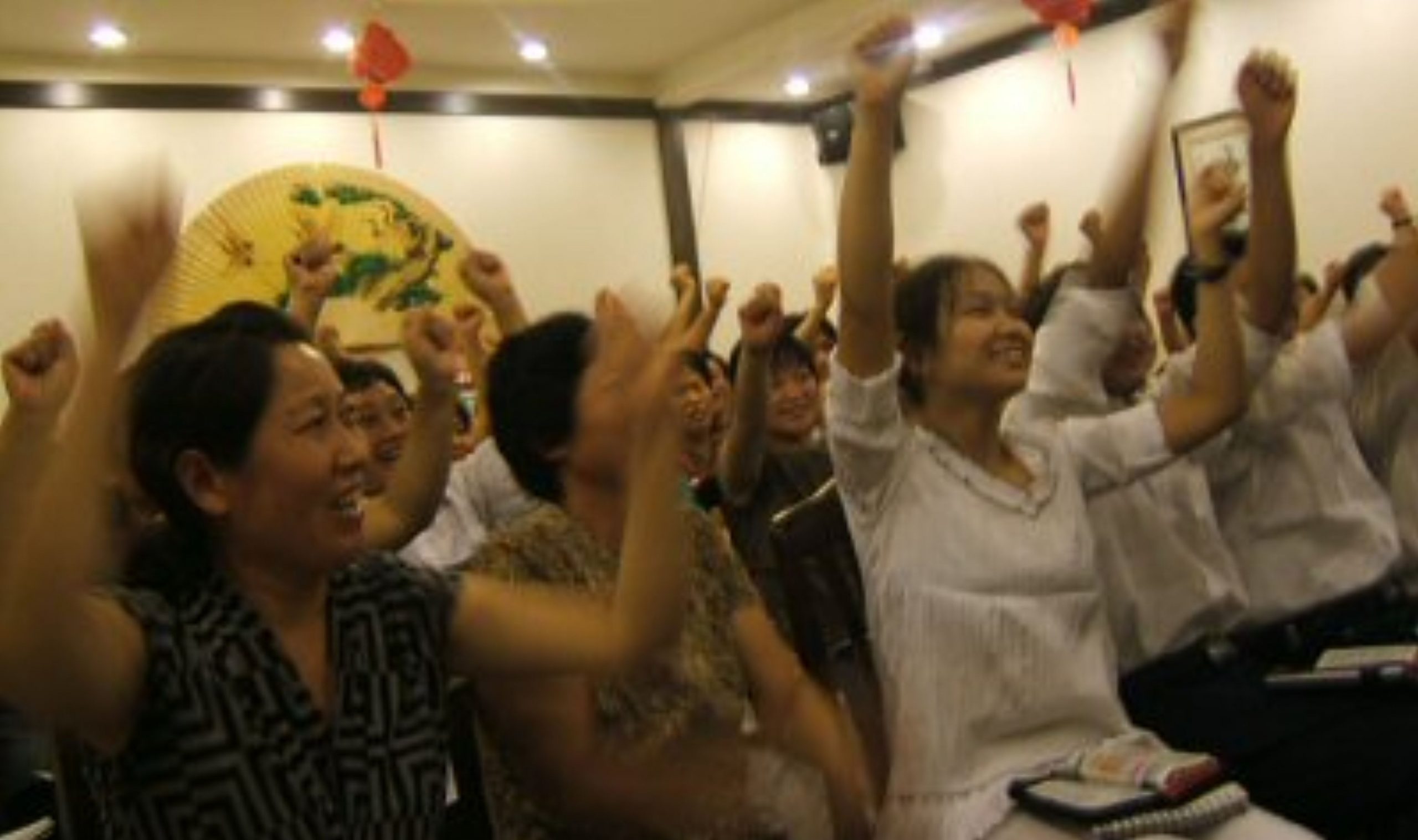
It’s Thursday evening and scores of men and women are dancing, waving flags, blowing shofars, singing and worshipping God. You might think you are in a charismatic service in the United States. But you are not.
This is communist China. And what Duan Huilai says is remarkable about this scene is that it’s happening in an officially government-controlled congregation known as Three-Self Church. “Dramatic changes are happening,” Duan said. “God is moving powerfully inside these Three-Self Churches.” Duan and his wife have for several years crisscrossed China documenting the Holy Spirit’s move among Three-Self Churches. “The most amazing thing is that the Lord is raising up God-fearing people in these churches—brothers and sisters who love God deeply and want to serve Him,” Duan said.
Pastor Duan says what is happening today in Beijing and in other parts of China as it relates to the powerful move of God amongst the Three-Self Churches is quite remarkable considering where the church has been in the last 30 years. “Every sermon that the pastor preached back then had to be vetted by the government authorities. Young people were never allowed to attend these churches so you’d only see old people, mostly women,” Duan said. “Preaching about the power of the Holy Spirit was forbidden. You couldn’t talk about end times or preach repentance.” Topics on healings, miracles, signs and wonders were out of the question. Not anymore. “Nowadays people have accepted these topics,” Duan said. Two main types of churches exist in China: registered and unregistered.
Three-Self Churches, are government-approved. Unregistered, sometimes called underground or house churches, operate outside government control, and for decades faced intense persecution. And with that persecution came tremendous growth. Three-Self Churches on the other hand never experienced that kind of explosive growth. Until now. “Now there’s big revivals happening in the Three-Self Churches,” Dr. Zhao Xiao said from his offices on the outskirts of China’s capital city. Zhao is one of China’s foremost experts on Christianity. A former Communist Party member and atheist, Zhao converted after reading the Bible. “If you go to Haidian Church, you’ll find yourself in a 100-metre line trying to get inside and worship. In Shenzhen, there are usually an average of 500 people being baptized each Sunday!” he shared.
Decades ago, the Chinese government had a law that said that young men and women below the age of 18 could not attend Three-Self Churches. Zhao says those rules have been relaxed in recent years. “There’s an increasing proportion of them in churches now—more young males, professionals, mainstream celebrities, especially in the big cities, that are attending the church unlike the past when it was mainly the elderly who attended.” Back at the Thursday night meeting in Fujian Province, folks have gathered for a four-day event called “Love Camp.” “Love Camp aims to help the Believer grow in their faith walk and get closer to God,” Sun Rengui said. Sun is a pastor and leads the camp. He says the idea came 12 years ago when the Holy Spirit one day showed up while he was preaching at the Three-Self Church he pastors.
“During the service, suddenly everyone at the church felt the Holy Spirit come. Some couldn’t stand straight, others fell down. Some were dizzy and nauseous. When the worship began, people started crying. After the service, some were being healed. I saw demons leaving people’s bodies.” Pastor Sun says his church had never experienced anything like it.” “It was unprecedented. We had no theological training in the work of the Holy Spirit. Word quickly spread. ” Soon, leaders from other churches came to us and were eager to receive the Holy Spirit. Later they also started witnessing the Holy Spirit’s move as well,” Pastor Sun said. But it wasn’t without controversy. “People doubted if it was real. There was even conflict among my church staff,” Sun said. “But as time passed, more people accepted it.”
Twelve years later, Pastor Sun says the impact of the Holy Spirit’s move is seen in the transformed lives of church members. “Our cell groups are expanding, more people are attending church, and more people are going outside the church to share the Gospel.” The church runs two orphanages and two elderly care centres, and twice a year puts on the Love Camp. For Pastor Duan and his wife, this is evidence that God is doing something special in China. “I was speaking in Shandong recently. Around 8,000 people joined the meeting. Last Christmas, I was speaking at a Three-Self Church in Yuhuan and there were 12,000 people,” Duan exclaimed with joy. “The number of Christians in China is growing rapidly. It means Christ is starting to play an active role in China’s society and that’s good in many ways,” Zhao said.
The world’s largest revival continues unabated despite widespread restrictions and persecution. Dr David Wang talks about why God is moving so dramatically among Asian believers at this time. David Wang is the International Director of Asian Outreach.
A. For 25 years I have been involved in Asian evangelism and mission. I must admit that there have been times of discouragement, particularly in the latter part of the 1960s. We saw a lot of activity and effort, but not many lasting results.
However I would say that for the past 20 years we have seen a tremendous response to the gospel of Jesus Christ. This is happening not only in countries such as Korea and Singapore, which are enjoying phenomenal revival, but also in countries closed to traditional mission activities such as China and Vietnam. We’re now seeing the Holy Spirit moving in dramatic ways, resulting in conversions and church growth, with regular signs, wonders and miracles.
The traditional word ‘harvest’ no longer seems adequate to describe what God is doing. I would describe it as ‘the great ingathering’. This is even happening in traditionally difficult Thailand and Japan. I visited these countries very recently and both missionaries and national leaders were reporting breakthroughs of an unprecedented nature.
Q. Why is the Asian Church suddenly growing so dramatically?
A. We must give credit to the early missionaries who laboured, bled and died sowing the seed of the gospel. Some of the seeds laid dormant for many years. But they did take root. As God’s time comes upon this continent, they are now bearing fruit. Aided by signs, wonders and miracles some are bearing a hundred fold!
Secondly, we now see an explosion of the Church led by indigenous leadership. God is raising up excellent Asian leadership. Asian workers are now evangelising, sending out missionaries and bringing in a great harvest.
Thirdly, persecution and suffering inflicted by communist or atheist regimes and other religious forces have enhanced the Church’s growth even further.
But ultimately I recognise that it seems to be God’s sovereign plan. He seems to have a timetable, and now is the time for the Asian Church to experience revival, renewal, growth and expansion. It is God’s time for this continent.
Q. You mentioned persecution what specific role has it played?
A. Persecution has brought out two things in the Church of Asia. Firstly, it has brought forth Christ’s beauty in the lives of the believers. I know of Christians who have been deprived of everything that we consider important and are suffering deeply for their faith, yet they are living out a life of purity and simplicity in Christ. That kind of living has a great impact.
Secondly, persecution has returned the Church back to the basics of Christianity. It is no longer the clergy who are important. It is no longer the building that is important. What is important is having a fundamental relationship with Jesus Christ. Believers who have suffered persecution experience that Jesus is very real to them.
This return to the basics of Christianity and living a faithful life of beauty in Christ have resulted in mass conversions of people to Christianity.
Q. We read of thousands of these persecuted believers sharing a handful of Bibles and often having no pastor. How can the free world help to meet their urgent need for leadership and Bible-based teaching?
A. Without question this is the number one concern for every one of us who are involved in ministry into the Restricted Access Nations of Asia.
I think first of all we have to realise that ultimately it is God who gives the increase. He is also the author and finisher of this good work. We have to go back and trust Him and say, ‘Lord, it is your Church. It is your body. It is your vine. You take care of it.’
This seems to be a basic philosophy for Christians in the East. When you talk to leaders in the rural areas of China they say things like, ‘Another church has sprung up in that village over there. And a church of 7,000 has just exploded out of nowhere in that mountainous region.’ They give thanks to God for what He has started, and commit it to Him saying, ‘Lord, you continue to finish your work.’ I suppose we have to learn to do the same.
On the other hand, for ministries like Asian Outreach, we do need to shift more and more from pure evangelism to evangelismplusdiscipling. I would say now that at least 50% of our efforts targeted into the Restricted Access Nations are discipling and training in nature. Other ministries are also making a similar shift. In this part of the world, it has to be evangelism plus discipling now.
Q. What can believers in Asia’s Third World countries teach their brothers and sisters in the First World nations of the West?
A. In the West, or in the free world as a whole, I see the church identifying far more with the powerful victory of Jesus’ resurrection. They want that kind of relationship. They are keen for the success, the prosperity, the good things of the Risen King. Few partake in the fellowship of Christ’s suffering (Philippians 3:10). However I see the opposite in the Asian Church, particularly in countries where situations are confining and restrictive. These believers are more willing to fellowship with the suffering of Christ. To them that is the greater reward and privilege.
Recently one of our coworkers went to China with a large sum of money to bail out a Christian worker. She had been sentenced to five years of hard labour in a very poor province of China. A few days later my coworker returned with the money. That woman refused to be bailed out. She said, ‘Pray for me, but don’t get me out of this situation. Here is where the sinners are. Here is where the criminals are. Here is where Jesus Christ would have come. Now He has sent me. So please don’t bail me out.’
Q. Dr Paul Kauffman, the founder of Asian Outreach, has been quoted as saying, ‘For the cost of sending out one Westerner to the mission field, five Asians can be sent.’ Should we be sending more Asians?
A. Yes, and no. Looking over the last 15 years I do see the Asian Church moving from a ‘bless me’ position to a ‘bless the world’ position. They are now ready not only in attitude but also in capability. Christians in Korea, Taiwan, Hong Kong, Singapore, Malaysia, Japan and even Thailand or Indonesia are now in a position where they can pray, they can send, they can give and they can go. I am seeing more and more of the Asian Church changing from being missionary-receiving to becoming missionary-sending.
However, I do want to sound a warning. Third World mission is not the rising star and the answer to ushering in the return of Christ. We have our share of weaknesses and problems. We are just as culturally insensitive. We suffer our share of egocentric nationalism. We stumble over the same things that Western missionaries have stumbled over. Perhaps we are even more arrogant! I think the key is for Western and Asian churches to both send out missionaries. Together let’s cooperate in learning, teaching, sharing, caring and shouldering in a relationship of interdependence the Great Commission responsibility.
Q. Should we be sending Asian missionaries even to the West?
A. This is something we have to really work at on both ends. We, on our end, have to stop being nationalistic. Thus far I see far more Korean missionaries going to Koreans in overseas countries, or Japanese missionaries going to Japanese, or Chinese missionaries working among the Chinese diaspora. I would like to see Asian missionaries going to wherever the need and the response are the greatest, be it in the West, be it Africa, be it Latin America or be it anywhere.
It is also time for the West to realize that mission has undergone a fundamental change. It is no longer ‘from the West to the rest’. Mission is now a universal endeavour of God’s church. People of various nationalities have to learn to work side by side to spread the Gospel. So if it’s time for Asian missionaries to go to the West, well, let’s do it.
Q. Are we seeing Asian leadership with such a global view?
A. I do see Asian leadership taking more and more of a strategic role in world evangelism. Some are even holding highly recognizable positions, such as Dr Thomas Wang heading up the AD2000 Movement.
But as a whole, the Asian Church is currently producing localized leaders who are effective in their own culture, among their own people. Only a few are also gifted with multicultural flexibility and availability. However, I believe that in days to come we will see more and more Asian leaders who are bigger than their own church, or their own denomination; bigger even than their own nationalities. Because they are totally for the kingdom, they will take a vital role in Christian leadership worldwide.
Q. How will Asian leadership be different?
A. Over the last one hundred years Christian leadership has been primarily trained with a Western theology. This theology has a strong emphasis on the Gospel as the knowledge of God, and the wisdom of God. But there is a general lack of understanding and application of the Gospel as the power of God see 1 Corinthians 1:24. Thus the propagation of the Gospel has been mostly information based, and somewhat ‘powerless’ in a warfaring sense.
Now we’re seeing an influx of Asians along with Africans and Latin Americans into the overall leadership of the Church. Because of their cultural and historical backgrounds, they have a far better understanding and application of the Gospel as the power of God. Signs, wonders and power encounters are more common to their thinking and lives. I see this having a balancing effect, enabling the Church to make great advances into the world of darkness.
Q. There are some who believe that this ‘power of God’ belongs to another age. Yet we hear many stories of signs and wonders in Asia leading to mass conversions. Is God doing something different in Asia?
A. God is creative. He doesn’t have to repeat himself in any way. But I do see that He has a pattern of operation when it comes to breaking up new ground, opening up new countries.
He allows new signs, wonders and miracles to take place to create tremendous impact. Because Asian cultural influences include a traditional dominance of spiritism and spiritual activities, God has to use signs, wonders and miracles in a very, very phenomenal and outstanding manner to demonstrate that there is no other god but Himself.
I believe He also wants to demonstrate to people in the West that He is a God of power, a God of might. He is the Great Physician. Unfortunately for many, God is our last resort, and not the first and only resort. Therefore we don’t go to Him as desperately and frequently as our Asian brothers and sisters, seeking Him regularly for supernatural intervention. A Biblical principal is that the more you ask the more you receive; the more you knock, the more the doors are opened; the more you seek, the more you will find. That perhaps is one reason why we see more signs, wonders and miracles in Asia. They knock more. They seek more. They ask more.
Q. If God is raising up His Church through mass conversions and is refining it through persecution, where is God taking His people?
A. As I see the events happening all about us, I summarize the work of the Holy Spirit as ‘Immanuel and Maranatha’.
Firstly, I see God being with us. God is not only being with us in a theological way, a historical way, in a hearsay way: ‘I hear that God is doing this and this and this… wow!’ But God is with us in a very ‘Immanuel’ way: personal, current and relevant. And you know it: you sense it, you hear it, you see it, you touch it.
I am sensing that God’s Spirit is taking His people to a realization of the reality of Christ. Jesus is very real. As I fellowship with Christians in China, I don’t hear people saying, ‘We heard about,’ or ‘We read about,’ but rather ‘I experienced Him, I touched Him He touched me, He revealed Himself to me, I saw Him, and also He healed me.’ He is Immanuel in a first person, hands-on manner.
On the other hand I am seeing ‘Maranatha’. Christ is coming back very soon. I think I have never seen the world so shaken up, so disrupted, so changed to the point where everyone is in a state of confusion, flux, and uncertainty. Countries and peoples who previously were not particularly open to the Gospel are becoming receptive. With that kind of openness, the Church is presented with an unequalled opportunity: publish the good news, and proclaim the Gospel ’till He comes.
That’s where I see He’s taking His people. He is giving His people a strong sense of the reality of Immanuel. He is also giving us a strong awareness of Maranatha. Something really big is going to happen very soon.
Q. How can West and East work together to support and encourage each other?
A. In my 25 years of ministry I have seen some basic changes in the relationship between the Asian and Western Church. In the beginning there was a total reliance on the Western missionaries for personnel, provision and prayers to meet the needs in Asia. Everything seemed to be reliant on the West. Then I saw the pendulum swing to the other extreme. One general mood was ‘Missionaries, go home!’ Even missions echoed such a cry. Total dependence swung to total independence.
Now I see a new and more balanced phase: a phase of interdependence. I think both the Eastern and the Western churches have matured to accept the validity of each other, with each other’s strengths and weaknesses. I see them valuing each other’s giftings. I see more and more a symbiotic relationship developing where we say, ‘You rely on me and I rely on you.’ We now recognize that we need each other to survive, to perpetuate.
I do not call this relationship a partnership. Partnership is often an arrangement of convenience. I would like to see more of a marriage relationship developing, which is not an arrangement of convenience but of mutual commitment and trust. It is a body relationship.
I have seen Asians receiving Westerners, and I pray that Westerners will increasingly receive Asians.
Q. What has been the burden of prayer upon your heart, above all else, about Asia?
A. In Asia I have seen churches grow from nothingness into, perhaps, the biggest churches in the world today, such as Yonggi Cho’s church and now the Hope of Bangkok, and several others such as the Full Gospel Assembly of Malaysia. I saw them when they were small, and now they’ve grown tremendously. As I look at this kind of phenomenon, the thing that encourages me greatly is to see the birthing and the growing up of a church. The thing that concerns me is that often the church started as an organism and ended up as an organization; started as a corporate body of believers and ended up as a corporation.
My prayer for Asia is that I want to see the basic, beautiful gospel of Jesus Christ proclaimed, and a simple, pure bride of Jesus Christ prepared. That’s my prayer.
(c) Asian Report, March/April, 1992 (G.P.O. Box 3448, Hong Kong).
The Rev Cindy Pattishall-Baker wrote as a Uniting Church minister and Consultant for Evangelism and Renewal in the South Australian Synod of the Uniting Church.
Evangelism can lead to renewal and on to revival of the church. I have seen this in my experience in ministry in the last sixteen years as someone committed to the renewal of people and churches.
We need to release the dedicated and already discipled people of our parishes and churches into sharing their faith with those outside the church. This is a strategy for renewal that will lead to the revival of the church in the 1990’s.
Time and time again new converts begin the process of renewing the church and individuals in it. Their fresh approach to religion, their radical testimonies to the faith, and their enthusiasm to share the gospel and to live in its power, affect many others.
Does it work? Let’s look at one parish I know really well where I served for seven years.
Evangelism leads to revival
Margaret Matthews, a nurse and an elder in the Cobden Uniting Church Parish, gave this account at the Conference on Conversion Growth in Launceston, Tasmania, 1012 March, 1988. It describes her experiences of both personal and parish-wide renewal that started with evangelism.
Cobden is in the heart of a dairying district in Western Victoria, and a recent decision to expand the local factory has assured the future viability of the town. Our population of 1,450 is stable. We all know our neighbours. Our parish has two churches, both of which now have active Sunday Schools, youth groups and fellowship groups. Bible studies are an integral part of our life, catering for all levels of faith from 13 to 84 year olds. All participate in the leadership of worship. We started evening services with a more relaxed, informal worship style where newcomers felt more at ease.
Our growth story really began many years ago, when during a prolonged time of ministerial vacancy we were visited by an evangelist who challenged us to pray for revival in our church. A small group gathered together following the lines suggested: that we share the leadership, pray for the church and each other, and bring a name before the group and pray that God would prepare their hearts as we approached them and shared his Word.
We saw our prayers answered and we saw our fellowship grow to 2030 people who met under our first minister after the formation of the Uniting Church in 1977.
Like most of our generation, we clung to the concepts we had grown up with: preaching the gospel was the minister’s job and bringing newcomers to the church was no longer our responsibility. We lost our sense of purpose and our direction for several years. Our numbers began to dwindle and although we continued to pray that others might come to know the Lord, we were almost back to the original six or seven of us.
A new minister arrived. Hearing our prayer for revival and seeing us do nothing actively to bring it about, she organized an evangelism workshop for our Presbytery and persuaded eight of us to go to it. For myself, it was a real step of faith. I had forgotten how easy it had been, with the Lord’s help, to share my faith with friends, and now we were being asked to knock on stranger’s doors a terrifying thought!
It became our ministry to make those strangers into friends: getting to know people, listening and ministering to their needs, sharing their stories, sharing our story and God’s story, depending on God to do the rest.
We all came home from the workshop inspired to put what we had learned, into practice. We set aside one night each week to go visiting on a regular basis. We first met for prayer to ask the Lord to prepare the way and to go with us, and those of our group who did not go out joined together to pray for those who did. After our visit we returned to the church to talk it over, to learn from each other’s experiences, to get any hurts or knockbacks off our chests, and to share any blessings with those who stayed behind to pray.
To our surprise, after a few weeks, we realized we were enjoying this experience and started looking forward to it. We found that our little team of eight just couldn’t keep up with all the people who would like us to return for a visit. There was a great thirst out there beyond our church of people wanting to know more about the Lord, about the church, or wanting to share the hurt that took them away from the faith in the past.
About twelve months later, a second evangelism workshop was organized by our own and neighbouring parishes. Now many others in the church could see the importance of evangelism and most of our elders and several of our converts attended it. By then, I had begun a Bible Study home cell for some of the new converts who had no background of Christianity, but a wonderful new faith which was to change their lives, and lead me into a deeper faith commitment.
I didn’t start out to be an evangelist. I didn’t have that burning desire to share my faith with everyone I met, which I found among our converts. My visiting was an act of obedience to God’s will for us to share the gospel with all people. It was a stepping out in faith on the road that takes you from `What can God do for me?’ to `What can I do for God?’
Margaret, through the witness of her converts, later sought the infilling of the Holy Spirit and today not only continues to share her faith but is a mighty preacher and dynamic Bible Study teacher. From the witness of these early evangelists and those who were converted to the faith, the parish grew by 135% on their adherents roll and by 26% in four years (198387) in their confirmed members’ roll. In 1988, the 241 regular Sunday worshippers included 121 of the people who had faith for longer than ten years and 119 (49%) of the people having come to faith in the last five years (between 198388). In 1989, 94% of those converted to the faith were still regular attenders at worship (some now 6 years old in their faith).
Revival first started in this parish because an evangelist came and proclaimed the gospel. That gave others a hunger to do the same. It almost failed when a minister arrived during a prolonged vacancy and the people abdicated their responsibility to him, but it was later revived by another minister. As the converts grew in faith and hungered for a deeper expression of their faith, they sought, received and began to use their spiritual gifts. It led them into a personal encounter with the Holy Spirit. This influenced the established church to reevaluate itself and to also grow in renewal.
Renewal that brings revival
Our strategies in the church for bringing renewal have at times been wrought with force, causing judgment, mistrust and resistance. This resistance in the church can gravely hurt those in the renewal movement. So they have at times left the churches that would not accept their way or stayed in their church and developed a ghetto mentality of `we-they’ that made it harder for others to see renewal as an option for their lives.
In past years, the renewal movement often concentrated on changing worship to allow all the spiritual gifts to be prevalent and seen by sceptics and nonbelievers alike, thinking that this would aid in renewing others. Signs and wonders, although reaching some and exciting them to seek renewal, also frightened many more and turned them right off renewal.
A strategy for the renewal of the church needs to be more than just a change of worship where signs and wonders can be evident. Renewal demands a more radical lifestyle and call to ministry than this. When this change is seen in others, the people in the church do respond.
Here is an anatomy of renewal that I believe leads to revival:
1. Evangelists proclaim the message of salvation and people are converted to faith.
2. The converts grow in faith and hunger for a deeper expression of their faith. They seek, receive and use the spiritual gifts leading them into a personal encounter with the Holy Spirit which influences the established church to reevaluate itself and to also grow in the area of renewal.
3. The church then needs to understand and standardize the use of the spiritual gifts from good biblical teaching moving the people away from experience as the authority for the use of spiritual gifts to good theology about their use.
4. Converts and those who grew up in the faith examine their lives in light of God’s Word,
showing a desire for deeper service to the Lord and a hunger for righteous and holy living.
Evangelism renewal revival
The Reformation revivals of the 1500’s, the Great Awakening of the 1700’s, or the South Australian revivals in the mines at Wallaroo, Moonta and Burra at the turn of this century, follow this common pattern: evangelism renewal revival (in that order).
First, evangelists went out and proclaimed the gospel. The gospel they proclaimed emphasiszd a personal encounter with Jesus Christ and an individual religious experience rather than the doctrines of the church. Many people fell under the conviction of these evangelists’ proclamation of the gospel and received salvation.
As these converts grew in faith, they began to hunger for a deeper expression of their faith and began seeking, receiving and using the spiritual gifts God uses to build the church. That led them into a personal encounter with the Holy Spirit. This greatly influenced the preaching of the evangelists and their message.
When revival got to this second stage evangelists like John and Charles Wesley shifted from their basic salvation message of the early days of revival to sermons on a deeper discipleship and on walking in the power of the Spirit of God. This led to them establishing Bible studies, encouraging lay people to take up leadership roles in every giftedness of the Spirit, and it eventually led to the established church of their day reevaluating itself and growing in renewal.
This process also happened in the Reformation revival where the reformers shifted from the basic salvation message of their earlier days to deeper discipleship which led to the established church (the Catholic Church) reevaluating itself and having a revival itself influenced by such people as St. John of the Cross and Theresa of Avila, some 40 years after the Reformation.
This leads to the third phase of revival. In every succeeding generation when renewal comes, the church all over again, needs to learn how to understand and use the spiritual gifts given to them by God. So, the next phase of revival seems to be standardizing the use of the spiritual gifts and how they are to be ordered and used in the life of the church. Every new generation of revivalists find themselves in unchartered waters. So it takes time to sort out problems with the use of spiritual gifts and ensure that there is sound Biblical teaching on them.
Often those in the renewal movements, excited to experience the power of their faith, rush into using the gifts (and having `the experience’) rather than doing serious biblical study in order to bring others with them in good understanding. The `experience’ is not enough. We need good renewal theology that is strong enough to be debated.
The last phase of revival seems to be an inner desire of both converts and those who grew up in the faith to examine their lives in light of God’s Word, a desire for deeper service to the Lord and a hunger for righteous and holy living. This was very evident in the Great Awakening revival where evangelists later in the revival clearly shifted their proclamation of the salvation message to the preaching on holiness and righteous living (such as the sermons of the American revivalist of the early 1700’s, Jonathan Edwards).
The history of the church, shows long periods (which sadly follow great revivals) where the gospel is reduced by many in the church to narrow relativism. Pragmatism is rife. This leads to a suspicion of the supernatural, and for a while the church loses the power of its faith from lack of belief in the Holy Spirit and the Spirit’s gifts. The church in this condition seldom goes out to do evangelism but is content with social work and political statements.
Therefore, for renewal of the church to be effective today and for it to issue out into revival, we must first start with evangelism.
Revival involves mission and ministry
The following comments show how the personal encounter of the Holy Spirit by converts led the church to reevaluate its life, moving them into renewal. It caused them to explore the use of spiritual gifts by good Biblical teaching and discipleship. That moved people away from experience as the only authority for the use of spiritual gifts to good theology about their use.
These quotes are from talks that Cobden people gave at the Launceston 1988 Conversion Growth Workshop sponsored by the Uniting Church Assembly’s National Mission and Evangelism Committee.
Barbara Cowley, the Cobden Parish treasurer and a mother of two, says, “I have always believed in God and have attended Sunday School and church most of my life. In our courting days, my husband used to come to church with me, but after we were married he always found himself too busy to come. Our two children were baptized and attended Sunday School regularly, our daughter especially so, and our son until the age of 10 when he rebelled about going.
“When my daughter finished Sunday School and didn’t want to attend church anymore, I went to church by myself but my attendance started to drop off. At about that time my husband started exploring his faith. This encouraged me and we started attending church as a family. Since then, both our children have made decisions for the Lord at different times.
“Since being baptized in the Holy Spirit, my eyes have been opened to the workings of the Lord. Even though I had been involved in attending church all my life, it’s only in the last couple of years that my faith has come alive in attending our Bible Study group, which has helped me grow in my walk with the Lord.”
Hazel and the late Norm Maskell, dairy farmers, church elders, and Cobden Parish’s original evangelists in their mid70’s, led cell groups. Hazel and Norm said, “Why did we form study or cell groups? We believed that the church would not or could not grow until our people came together to study God’s Word, understand his gifts and to build each other up in faith. Those we brought to faith needed nurturing and encouraging. So our study groups came into existence one by one.
“These converts were more teachable than some of the older folk in the faith. Being eager to learn, they were wide open to Bible teaching and getting to know the Lord in a real way. Their growth was astounding, causing our growth too! We have seen miracles happen and now we see many of these new Christians taking leading roles in our church life alongside of us. I have found that new Christians pray out loud, share faith, and learn far more easily than we who have been in the church for some time, because they have no preconceived ideas. Almost any Bible Study member in our church will pray on the spot publicly. They thank God for various things, confess their own shortcomings, and pray for others. Now almost half the congregation will participate in prayer or the leading of worship whenever asked to do so. The result of these Bible Study groups is that our church has not only grown in numbers, but more importantly, we understand the Holy Spirit so much better and know the Spirit to be working in our church. We older folk have learned so much and grown closer to the Lord.”
Sometimes there may be difficulties for the church when it tries to assimilate not only new people into the life and especially the leadership structure of the church, but also starts reevaluating itself in light of the testimonies of these new converts and their walk with the Lord.
Most people within our church will say ‘we need new blood, some fresh faces and especially we need more younger folk to keep us going.’ However, once there is new blood, fresh faces, and younger folk coming into our churches, many old-timers may feel that the ‘new folk have taken us over and have made so many changes that we don’t know what’s going on anymore, so we will just stay at home and let them run it!’
Church growth in evangelism and renewal means that we, too, as individuals have to grow and be renewed. Many people resist this. Sometimes, church growth can only happen by berthing a new church that’s separate from the established church. This happened both in the Reformation and Great Awakening Revivals and it did most recently in the 1970’s and 1980’s. However, it doesn’t have to be that way.
Although the Cobden Parish had some battles and upheavals from its evangelism and renewal, division was averted by hospitality fellowship, Bible Study and shared worship. The leadership shared in hospitality fellowship, that is, intentionally inviting old-timers in the church to meals and gatherings with converts and helping them to get to know and to interpret their faith journey to each other.
The Bible Studies started out to disciple converts. Then, as people in the church started to reevaluate their faith journey through their contacts with the converts and hungered to know more, Bible Studies were set up for them too. Later, converts and those of long standing in the church merged many of their separate Bible Studies together where they learned to pray and care for one another.
Another important aspect of the Bible Studies, was the curriculum the Parish wrote to train people about the infilling of the Holy Spirit and the proper use of the spiritual gifts. When members discovered their own spiritual gifts, they were encouraged to take up their ministry roles within the life of the church. For converts this usually occurred by the end of their first year in the faith.
Shared worship took the form of setting up eight worship teams of six people each, chosen across generations and from each of the worshipping congregations. Each member of the team had a designated area of leadership: prayers, music, administration of the team, children’s sermon, the sermon, the organisation of the service sheet, announcements and the Bible readings. They had to listen to each other’s needs and they developed a style of worship that all were happy with and that was open enough to be able to evolve, as the parish needs changed.
Conclusions
We see that evangelism starts the process of renewal which brings revival. Renewal leads to a personal encounter with the Holy Spirit as the converts of the church’s evangelistic outreach grow in faith and hunger for the power of their faith, seeking, receiving and using the Spiritual gifts. This renewal leads to the established church reevaluating itself and either blockading and resisting renewal, or growing in it.
Renewal leads to discipleship training in and standardizing the use of the spiritual gifts with good Biblical teaching and the development of an articulate theology that can be debated. Discipleship leads to a radical lifestyle where one has a desire for a deeper service to the Lord, a greater knowledge of God’s Word and a hunger for righteous and holy living.
When the church misses one of these parts revival doesn’t happen. For instance, in studying several charismatic churches, I have discovered that if a church tries to bring in renewal before it does evangelism, it often gets a huge amount of transfer growth from other churches which leads to divisions and it eventually goes into decline.
If renewal doesn’t follow on into good discipleship, the church folk often get stuck on the experiences of the Holy Spirit and cannot articulate a clear enough theology so that they can take others into the experience with them in good understanding. Often these churches can become quite ingrown and in a denominational structure be quite divisive.
If discipleship does not produce a radical lifestyle, the church does not benefit others. Then it runs the risk of not only privatizing a person’s faith journey, but also of making one’s experience the only test of the validity of other people’s faith. It also means that the church remains at the level of signs and wonders instead of moving into a deeper discipleship with Jesus where one is sold out to him in complete sacrifice in holy living.
Jesus said to the doubting Thomas, ‘Blessed are those who have not seen and yet have come to believe’ (John 20:29). Signs and wonders are for nonbelievers (1 Corinthians 14) but a radical lifestyle of a disciple is for the mature Christian.
Many church leaders spend so much effort in renewing a congregation from within. I firmly believe that a congregation should be renewed from without, through evangelism and the converts that receive their message.
Then evangelism will lead to renewal and revival in the land.
__________________________
(c) Renewal Journal 2: Church Growth (1993, 2011), pages 23-33.
Reproduction is allowed with the copyright intact with the text.
Now available in updated book form (republished 2011)
The Rev Dr Djiniyini Gondarra is a Uniting Church minister and former Moderator of the Northern Synod of the Uniting Church in Australia.
_______________________________________
mission is to include every aspect of the work
which the church is sent into the world to do
_______________________________________
This is a very brief outline of the revival which took place in Arnhem Land in the Uniting Church parishes, beginning in Galiwin’ku on Elcho Island, 400 miles east of Darwin, with a population of 1500 to 1600.
In the early years, Galiwin’ku Community was the mission station established by the Methodist Overseas Mission back in 1942 under the leadership of Rev. Harold Shepherdson. He was accepted by the Methodist Mission Board in 1927 as a lay missionary, engineer and saw-miller. Because of his long outstanding Christian leadership and humility he was ordained at Galiwin’ku, Elcho Island, on 19th October, 1954. He and his wife Ella Shepherdson would have been the last pioneer missionaries to leave their beloved home and people in Arnhem Land.
The missionary movement in Arnhem Land has taken as its mandate the great commission in Matthew 28:19-20 which says: ‘Go, then, to all peoples everywhere and make them my disciples, baptize them in the name of the Father, the Son and the Holy Spirit, and teach them to obey everything I have commanded you. And I will be with you always, to the end of the age.’
I understand that mission is to include every aspect of the work which the church is sent into the world to do, and I understand evangelism in a different sense which is called holistic evangelism. It is a means of communication of the good news about Jesus Christ as it affects the whole of life.
You will remember very well the story in Acts 1:68 when Jesus and his disciples met together before the ascension took place. The disciples asked whether God’s reign was now come in full. Jesus told them it was not their business to worry about that, but they would receive power when the Holy Spirit came upon them and they would be his witnesses beginning in Jerusalem and going outwards into Judea, Samaria and on to the ends of the earth.
There is something quite unpredictable, unexpected and mysterious about the way that God’s rule is realized in communities and in the lives of individuals. So the disciples were told to wait for the Holy Spirit and then they would be witnesses when Pentecost came. Something quite unplanned and unexpected happened. They began to babble in other strange languages and people asked what is this that is happening? What is going on?
Difficult times
Galiwin’ku, Elcho Island, experienced the revival on 14th March, 1979. That year was a very hard year because the churches in Arnhem Land were going through very difficult times. There was suffering, hardship and even persecution.
Many people left the church and the Christian gospel no longer had interest and value in their lives. Many began to speak against Christianity or even wanted to get rid of the church.
This attitude was affected by the changes that were happening. Money and other things were coming into the community from the government. The people became more rich and were handling lots of things such as motor cars, T.V., motorboats, and good houses. The responsibilities were in the hands of the Aboriginal people and no longer in the missionaries’ hands.
The earthly values became the centre of Aboriginal life. There was more liquor coming into the communities every day, and more fighting was going on. There were more families hurt, and more deaths and incidents happening which were caused by drinking.
Whole communities in Arnhem Land were in great chaos. The people were in confusion and without direction. The Aboriginal people were listening to many voices. The government was saying you are free people and you must have everything you want, just like the other Australians. And there were promises from one to another.
To me, the Aboriginal people in Arnhem Land were like the Israelites in Egypt being slaves in bondage because of all the changes that were brought into the community. They were like the vacuum suction which was sucking in everything that comes without knowing that many of the things that came into communities were really unpleasant and only destroyed the harmony and the good relationship with the people and the communities.
I thank God that I was being called back to serve my own people in Arnhem Land, especially to Galiwin’ku. In 1975 I had just completed my theological training in Papua New Guinea in Raronga Theological College and was appointed to Galiwin’ku parish. My ordination took place in 1976 in Galiwin’ku parish, and I was ordained by the Arnhem Land Presbytery. I was appointed then to Galiwin’ku parish as parish minister.
This celebration took place when there were lots of changes happening and when the church was challenged by the power of evil which clothes itself in greed, selfishness, drunkenness, and in wealth. As I went on my daily pastoral visitation around the camp I would hear the drunks swearing and bashing up their wives and throwing stones on the houses, and glass being broken in the houses. And sometimes the drunks would go into the church and smoke cigarettes in the holy house of God. This was really terrible. The whole of Arnhem Land was being held by the hands of satan.
I remember one day I woke up early in the morning and went for a walk down the beach and started talking to myself. I said, ‘Lord, why have you called me to the ministry? Why have you called me back to my own people? Why not to somewhere else, because there is so much suffering and hardship?’
I then returned to the manse where Gelung, my wife, and the children were. This was our last day before we left for our holidays to the south, visiting old missionary friends and also taking part in the lovely wedding held in Sydney for Barry and Barbara Bullick, one of our missionary workers still remaining in Galiwin’ku Community.
It was almost 6.30 am and it was my turn to lead the morning devotions. The bell had already rung and I had rushed into the church. When I got there, there were only four people inside the church. We used to have our morning devotions every day early in the morning because this system had been formed by the missionaries in the early years.
God had given me the Word to read and share with those four people who were present in the church with me. The reading I selected was from the Old Testament, Ezekiel 37:1-14, the valley of dry bones. Most of you know the story very well, how God Yahweh commanded the prophet Ezekiel to prophecy to the dry bones, and how that the dry bones represent the whole house of Israel, how they were just like bones dried up and their hope had perished. They were completely cut off.
After the morning prayers, Gelung, the children and I were ready to leave for Gove and then go on to Cairns in North Queensland. We were away for four weeks and returned on 14th March, 1979.
20th century Pentecost
To me and all the Galiwin’ku Community, both the Aboriginal Christians and the white Christians, these dates and the month were very important because this is the mark of the birth of the Pentecost experience in the Arnhem Land churches or the birth of the Arnhem Land churches. To us it was like Pentecost in this 20th Century.
It happened when Gelung, the children and I arrived very late in the afternoon from our holidays through Gove on the late Missionary Aviation Fellowship aircraft to Galiwin’ku. When we landed at Galiwin’ku airport we were welcomed and met by many crowds of people.
They all seemed to be saying to us, ‘We would like you to start the Bible Class fellowship once again.’ It seemed to me that God, after our leaving, had been walking on and preparing many people’s lives to wait upon the outpouring of his Holy Spirit that would soon come upon them. Gelung and I were so tired from the long trip from Cairns to Gove and then from Gove to Galiwin’ku that we expected to rest and sort out some of the things and unpack. But we just committed ourselves to the needs of our brothers and sisters who had welcomed and met us at the airport that afternoon.
After the evening dinner, we called our friends to come and join us in the Bible Class meeting. We just sang some hymns and choruses translated into Gupapuynu and into Djambarrpuynu. There were only seven or eight people who were involved or came to the Bible Class meeting, and many of our friends didn’t turn up. We didn’t get worried about it.
I began to talk to them that this was God’s will for us to get together this evening because God had planned this meeting through them so that we will see something of his great love which will be poured out on each one of them. I said a word of thanks to those few faithful Christians who had been praying for renewal in our church, and I shared with them that I too had been praying for the revival or the renewal for this church and for the whole of Arnhem Land churches, because to our heavenly Father everything is possible. He can do mighty things in our churches throughout our great land.
These were some of the words of challenge I gave to those of my beloved brothers and sisters. Gelung, my wife, also shared something of her experience of the power and miracles that she felt deep down in her heart when she was about to die in Darwin Hospital delivering our fourth child. It was God’s power that brought the healing and the wholeness in her body.
I then asked the group to hold each other’s hands and I began to pray for the people and for the church, that God would pour out his Holy Spirit to bring healing and renewal to the hearts of men and women, and to the children.
Suddenly we began to feel God’s Spirit moving in our hearts and the whole form of our prayer suddenly changed and everybody began to pray in the Spirit and in harmony. And there was a great noise going on in the room and we began to ask one another what was going on.
Some of us said that God had now visited us and once again established his kingdom among his people who have been bound for so long by the power of evil. Now the Lord is setting his church free and bringing us into the freedom of happiness and into reconciliation and to restoration.
In that same evening the word just spread like the flames of fire and reached the whole community in Galiwin’ku. Gelung and I couldn’t sleep at all that night because people were just coming for the ministry, bringing the sick to be prayed for, for healing. Others came to bring their problems. Even a husband and wife came to bring their marriage problem, so the Lord touched them and healed their marriage.
Next morning the Galiwin’ku Community once again became the new community. The love of Jesus was being shared and many expressions of forgiveness were taking place in the families and in the tribes. Wherever I went I could hear people singing and humming Christian choruses and hymns! Before then I would have expected to hear only fighting and swearing and many other troublesome things that would hurt your feelings and make you feel sad.
Many unplanned and unexpected things happened every time we went from camp to camp to meet with the people. The fellowship was held every night and more and more people gave their lives to Christ, and it went on and on until sometimes the fellowship meeting would end around about midnight. There was more singing, testimony, and ministry going on. People did not feel tired in the morning, but still went to work.
Many Christians were beginning to discover what their ministry was, and a few others had a strong sense of call to be trained to become Ministers of the Word. Now today these ministers who have done their training through Nungilinya College have been ordained. These are some of the results of the revival in Arnhem Land. Many others have been trained to take up a special ministry in the parish.
The spirit of revival has not only affected the Uniting Church communities and the parishes, but Anglican churches in Arnhem Land as well, such as in Angurugu, Umbakumba, Roper River, Numbulwar and Oenpelli. These all have experienced the revival, and have been touched by the joy and the happiness and the love of Christ.
The outpouring of the Holy Spirit in Arnhem Land has swept further to the Centre in Pitjantjatjara and across the west into many Aboriginal settlements and communities. I remember when Rev. Rronang Garrawurra, Gelung and I were invited by the Warburton Ranges people and how we saw God’s Spirit move in the lives of many people. Five hundred people came to the Lord and were baptized in the name of the Father, the Son, and the Holy Spirit.
There was a great revival that swept further west. I would describe these experiences like a wild bush fire burning from one side of Australia to the other side of our great land. The experience of revival in Arnhem Land is still active in many of our Aboriginal parishes and the churches.
We would like to share these experiences in many white churches where doors are closed to the power of the Holy Spirit. It has always been my humble prayer that the whole of Australian Christians, both black and white, will one day be touched by this great and mighty power of the living God.
_________________________________
(c) Djiniyini Gondarra’s, Let my people go. Published by Bethel Presbytery of the Northern Synod of the Uniting Church in Australia. Used with permission.
SEE BELOW for Blogs grouped into countries & regions, most recent first in each group:
Australia/South Pacific – Asia – Middle East – Africa – Europe – Americas
* This page is similar to the Revivals Index – top bar Menu.Revivals Index (Top Bar Menu) has more details and links, including links to specific revivals.
Reproduced from the Asian Journal of Pentecostal Studies No. 4, 2001, pages 99-107, from Dr Chin Khua Khai’s research for his Ph.D. degree.
Although small and often unnoticed, Myanma (Burma) has had its share of great leaders. The late Reverend Hau Lian Kham, often referred to as the “John Wesley” of Zomi (Chin) because of the similar characters and patterns seen in his leadership, is a noted pastor-evangelist and teacher among the evangelical Pentecostal believers in Myanmar. From the early 1970s until his death in 1995, he was the key figure and leader of a renewal movement among the Zomis. The renewal began on a small scale in the early 1970s and has spread throughout the region to many parts of the country through evangelism and cross-cultural mission efforts (1). It has resulted in the planting of new churches in both rural and urban regions and to the establishment of leadership training schools. Kham has left his legacy as a revivalist, equipper, and transformer.
A Brief Story of His Life
Kham’s legacy in Zomiss began against the backdrop of a predominantly nominal Christian atmosphere (2). The Zomi is a major ethnic group in Myanmar occupying the north-western region. They were 2.2% of countries estimated population of 49 million in the year 2000 (3). Christianity has been a dominant religious practice among the Zomis for half a century.
The Zomis received Christian faith through the efforts of missionaries. American Baptist missionaries first introduced the Christian faith to them early in the 1900s (4). Other missions such as the Methodists (1925), Catholics (1934), Anglicans (1934), Seventh-Day Adventists (1954), Presbyterians (1956), and Pentecostals (that is, Assemblies of God, 1960s) arrived as well. When missionaries were expelled from the country in the 1960s, more than half of the Zomi population had become professed Christians. At this stage, there existed among the Zomis Christians a moral laxity and a lack of salvation knowledge (5).
Out of this background, Kham arose as a giant of faith who launched the renewal movement in 1973. On November 24, 1944, he was the sixth of eight children born to devout Christian parents in Ngennung-Tedim, Chin State, Myamnar. Upon graduating from high school, he began serving as the headmaster of Zomi Baptist Academy, a primary school, in his native town of Tedim from 1963 to 1965.
Though poverty has always been a roadblock to education for the Zomis, Kham found a way to pursue his secular education as well as theological education. He attended night classes at Workers College on a work-study program, receiving a Bachelor of Arts (B.A.) degree in 1968. He then enrolled in Myanmar Institute of Theology, Insein, Yangon, and received a Bachelor of Religious Education (B.R.E.) degree in 1971.
Upon completion of his studies, he decided to return to Tedim to engage in full time ministry. Indeed, temptations prevailed when relatives asserted he was making an undesirable career choice due to the poor income ministers receive. After a strong prayer, he made a lasting decision to serve the Lord alone.
Kham’s ministry went through enormous changes, which better equipped him for kingdom service. He was first installed as the senior pastor of Cope Memorial Baptist Church (April 1971 to 1974) in Tedim receiving his ordination credentials on February 25, 1973. He went on to become a leader of the Evangelical Baptist Conference (EBC) and the senior pastor of Tedim’s Evangelical Baptist Church (1975-1976) when Cope Memorial Baptist Church dismissed him from membership because of his promotion of the renewal movement.
Eventually, he became a Pentecostal minister (1977-1996) because of his new experience with the empowerment of the Holy Spirit and a larger vision of the kingdom’s mission. Regarding his joining the Assemblies of God of Myanmar, he once stated, “We must keep a large vision of the whole country, even the whole world, for the evangelization, while starting the work at the local area” (6). In 1979 Khain became the founding principal of Evangel Bible College in Yangon, the capital city of Myanmar, serving in this capacity as well as teaching until his death on December 29, 1995. During this time, he also held the position of the senior pastor of Grace Assembly of God Church. Kham was the general secretary of the Assemblies of God of Myanmar for a period. This position was relinquished when he was sent to the Philippines for graduate studies in 1987.
Kham received a Master of Divinity (M.Div.) degree from Asia Pacific Theological Seminary (APTS), Baquio, Philippines in 1991, a Master of Theology (Th.M.) degree from Asia Graduate Theological Seminary (AGTS), Manila, Philippines in 1994, and was a candidate for the Doctor of Ministry (D. Min.) degree at AGTS.
Kham’s premature death was a great loss not only to his family, friends and relatives, but also to the body of Christ in Myanmar. He was the prospective leader of the whole evangelical-Pentecostal body in Myanmar. His remaining family members include his wife Mary Hau Lun Cing who also had reached candidate of D.Min. status at AGTS, and three daughters, Cing Lam Dim, Man San Lun, and Cing Lian Ciin. At the writing of tiiis article, with the help of her daughters, Mary carries on the Kham’s ministries as the acting principal of Evangel Bible College and as by serving as the senior pastor of Grace Assembly of God Church.
Early Theological Paradigm Changes
Being raised in a pious family, Kham was a committed Christian since childhood. God-fearing in attitude, obedience, sincerity, friendliness, and humility were revealing marks in his life. He was a Bible lover, active churchgoer, and even a choirmaster. He was a genius in widespread reading, especially of Christian books. More than anything, he had a strong desire to serve the Lord as a full-time minister from his youth.
Two prominent experiences proved revolutionary in Kham’s faith journey. He, like Timothy in the Bible, had a strong faith in Christ though he did not know the exact time of his rebirth. However, a paradigm shift of faith took place in him sometime in 1970 when he accepted the Bible as the infallible word of God. This conviction came by his reading of an article in a Decision magazine in which Billy Graham stated his acceptance by faith of the whole Bible as the word of God. This, in fact, was opposite to the teachings at the theological institute that Kham was attending at the time (7). The theology he had received at the institute led him to confusion, as it questioned the authority and inspiration of the scripture. He attributed his overcoming the theological dilemma to the work of the Holy Spirit (8). As a result, he asserted the authority and sufficiency of the Bible for faith and practice.
Another experience had caused him to pursue renewal. Being a newly ordained minister, he paid home visits to church members once a week. He soon discovered the church members were nominal and weak in their faith, having little knowledge about the salvation of Christ, lacking real commitment. This discovery led to a turning point in his ministry, for he felt compelled to preach and teach the people about the gospel of the salvation of Jesus Christ in order to help bring renewal to the church. This was his prayer, “These people must hear the gospel and repent and come to the cross of Christ. God, help me and use me” (9).
Serving with Multiple Gifts
Kham was a gifted preacher. His preaching was persuasive, forceful, and biblical. When preaching, he always referred to the authority of the word of God, often stating, “The Bible says….” His frequent use of body movement gave him the title, “The Action Preacher.” With all of these qualities, his method was a breakthrough for contemporary preaching.
Kham was gifted in teaching. From the very beginning of his pastoral ministry, he taught the Bible and Bible doctrine from the evangelical perspective which was contrary to contemporary teaching in the vicinity. The people were amazed at his new teachings. Consequently, church attendance doubled for the first time since the death of the former pastor of his church in 1965. News about his ministry spread so quickly that the unchurched in the town and visitors from rural villages were persuaded to attend the worship services and his Bible classes.
Moreover, Kham was gifted in music, art, and literature. He conducted the church choir every Sunday, performed in and directed dramas on special occasions such as Christmas. The “Life of Jesus” attracted not only the town dwellers, but also people from the villages nearby. His first publication was a small handbook, Khasiangtho Ngeina Nam Lite [The Four Spiritual Laws], published and distributed in March 1973. He translated the books of Jeremiah and Jonah into the Tedim language for the Tediin Bible. Another work of his was the book Upna Laigil [The Essence of Faith] which was an evangelical position on Bible doctrine (10). Besides these publications, he wrote several articles and helped revise a local hymnal.
Revivalist
Kham was the pioneer leader of the renewal movement among the Zomis. A “burden for souls’ was his motivating factor. He was convinced that soul winning was the most important task under heaven. Referring to the scripture in Luke 16:25, he asserted that a soul is more precious than the whole universe; to win a soul is more important than to gain the whole universe, and to help a soul being saved is the most precious task in the sight of God (11). Thus, to promote and bring renewal (12) within the church and to seek souls outside the church was the most urgent call of his pastoral ministry.
Kham believed that prayer is a key to renewal (13). He said his supporters learned from historical evidences and personal witnesses that renewal often takes place when the people of God pray and seek him. They soon promoted individual and group prayer meetings for renewal.
Believing an open-air crusade would be the most appropriate strategy to reach the common people, the revivalist and his supporters launched a week-long crusade on April 30, 1973. They raised a bamboo pulpit on a football field where he preached seven nights about the salvation of Christ. This pioneer crusade was characterized by breakthroughs, a charismatic-style singing of revival choruses, a style in preaching the message that had direct implication upon the hearers, the altar call for repentance and acceptance of Christ, and face-to-face discussion of the personal assurance of salvation. These types of events marked a new breakthrough in ministry.
Furthermore, the revivalist learned to trust in the Holy Spirit. He acknowledged the dimension and crucial work of the Holy Spirit in bringing renewal. This factor prevailed as he surrendered himself by kneeling and crying to the Lord for the conversion of sinners, praying all night on the second day of the crusade (14). Preaching aggressively and persuasively for the first two nights did not draw a single sinner to the Lord. However, surrendering and trusting in the Holy Spirit made the difference.
A young man by the name Kham Lian Khup turned and stepped forward in the altar call and accepted Christ as his Saviour and Lord on the third night (15). The bold decision of this young man was a breakthrough that encouraged many to do the same in the days that followed. Converts were added every day.
Eventually, the pioneer crusade was the recognized launching pad of the renewal movement. The word “born again’ became a catchword throughout the renewal movement. The born-again believers spread the gospel by preaching, teaching, and counselling. Repentance for sin confession of Christ as Saviour and Lord, baptism in water as a witness of discipleship, studying the Bible, praying, and sharing the word of God were phenomenon indicative of this renewal.
Kham, along with his itinerant gospel team, continued to make gospel tours throughout the countryside during the years of 1973 to 1979. His motto became, “To bring as many people as possible to Christ in the shortest possible time” (16). He conducted gospel crusades from town to town and from village to village.
Like revivalist John Wesley of England in the eighteenth century (17) he travelled hundreds and thousands of miles on foot to spread the good news of Jesus Christ. His brother Gin Za Lian like Charles Wesley, was a gifted musician throughout this renewal period. The two brothers worked hand in hand preaching and singing. During the next ten years, Kham would also preach the gospel to several other people groups throughout the country.
Leadership Equipper
Not a lone star, Kham trained up other effective leaders for servicing in the Kingdom of God. Teaching Sunday School was a regular ministry. His gospel crusades were two pronged: preaching and teaching the word of God. He also conducted Bible seminars every year, attended by believers from all the countryside.
Kham renovated the pattern of leadership by emphasizing lay witnessing. Like John Wesley, he motivated, challenged, equipped, and mobilized believers to carry out the work of the ministry. Prioritizing the evangelistic mandate, he emphasized witnessing and winning souls as the greatest call of believers. Their greatest accomplishment would come by fulfilling that call.
He often elaborated the urgency of the call, the doom of people who never hear the gospel, the reward of obeying the call, and the consequences of disobedience. He explained agape as God’s kind of love, which meant loving others in the way God loves sinners who are doomed to eternal judgment. He also taught about how to witness, live a righteous and Spirit-filled life, and how to build the body of Christ.
As a result of his efforts, lay witnessing became the most dynamic factor of spreading the renewal throughout the country during the last three decades of his life (1970s-1990s) (18).
As stated earlier, Kham began teaching at the Evangel Bible College, serving as the founding principal as well. In fact this call was not a new challenge for him. He had long acknowledged the need to build armies for the Lord with deeper biblical knowledge.
Sensing the need to multiply himself by training leaders, he decided to take over the teaching role at the Bible school. Today, the school’s graduates are ministering the mission of the kingdom of God in different capacities all over the country.
Transformer
One final legacy to be noted here is that of the transformational changes within the church and in the culture that resulted from the renewal. Kham’s own rediscovery and subsequent preaching on key issues such as the Bible as the inspired word of God, the lukewarm nature of the church, the dispensation of law and grace, the atoning work of Christ, justification by faith alone, and other teachings laid the foundation of evangelical Pentecostal beliefs and practices. As a result, Evangelicalism (Fundamentalism and Neo-evangelicalism) and Pentecostalism emerged like a strong river among the born-again Zomi Christians. Half the Christian population label themselves Evangelical/Pentecostals today (19). The following figure shows the percentage of their attachments in 2000:
Kham’s pattern of preaching became a favourite model for young preachers. His messages were grounded not in mere knowledge but in sound biblical and theological teaching built upon solid theological terms in which Christ is the subject. He interpreted scripture passages from the root meaning and then adapted it to the local situation. He also drew examples from local contexts and biographical stories to support the message. He was an expert in coining and applying popular words and phrases in his preaching. Most often, he contextualized the husk and kept the kernel of the gospel unchanged. His method is a combination of the “translation model” and “adaptation model” of contextualization (20).
Moreover, the messages have facilitated a Christ-centred worldview among believers. They saw God not only as sovereign and transcendent but also as immanent. They recognized secular things as temporary and spiritual things as eternal. They accepted Christ as Saviour, Lord and King. Therefore, many believers chose to serve Christ rather than the world. Believers also gained positive self-images, liberating them from the low self-images of an inferiority complex.
Furthermore, the renewal has had a great social impact among the Zomis such that transformational changes occurred in the cultural subsystems (21). God was seen as the reservoir of blessings. Therefore thanksgiving celebrations toward God for blessings and success were and still are common phenomena in the communities today. Families give their children Christian names in order to express appreciation and acknowledgment of what He has done in a person’s life. Yet another outcome of the renewal is that the need to take the cultural mandate is more recognized among evangelical Pentecostal believers today than ever before. Churches and individual believers continue to establish orphanages, open private clinics, donate relief funds and take on social responsibilities in their communities.
With all these patterns and characters of the renewal, many believers in Myanmar have regarded Kham as a great revivalist, a great leadership equipper, and a great transformer whose legacy will speak to many generations to come. He could say as Paul did, “I have fought a good fight I have finished the race, I have kept the faith” (2 Tim 4:6 NIV).
References
(1) Chin Khua Khai, “Myamnar Mission Boards and Agencies,” in Evangelical Dictionary of World Missions, ed. A. Scott Moreau (Grand Rapids: Baker, 2000), pp. 667-69.
(2) The Lausanne Committee for World Evangelization describes a nominal Christian as one who would call him/herself a Christian but has no authentic commitment to Christ based on personal faith. See Lausanne Committee for World Evangelization, The Thailand Reporton Christian Witness to Nominal Christians Among Protestants, Lausanne Occasional Paper No. 23 (Wheaton, IL: Lausanne Committee for World Evangelization, 1980), p. 5.
(3) Sein Tin, Central Statistical Year Book of Myanmar 1995 (Yangon, Myanmar: Central Statistical Organization, 1995), pp. 26-7. These statistics do not include the Asho-Chin (plain Chin), Mizos and Zomis in India and Bengaladesh.
(4) Robert G. Johnson has documented in detail the work of the American Baptist missions among the Zomis. Robed G. Johnson, History of American Baptist Chin Mission, 2 vols. (Valley Forge, PA: Robert G. Johnson, 1988).
(5) I briefly discussed in my dissertation mission works among the Zomis and argued why the churches fall into a nominal state. Chin Khua Khai, “Dynamics of Renewal: A Historical Movement among the Zomi (Chin) in Myanmar’ (Ph.D. dissertation, Fuller Theological Seminary, 1999), pp. 128-165.
(7) Myanmar Institute of Theology (formerly known as Burma Institute of Theology), Insein, Yangon, is the largest theological school in Myanmar. It has been largely influenced by the teachings of theological liberalism since the 1960’s. “The Church in Myanmar,” in Church in Asia Today: Challenges and Opportunities Today, ed. Saphir Arthyal (Singapore: Asia Lausanne Committee for World Evangelization, 1996), pp. 349-60.
(8) Hau L. Kham, ‘My Testimony” (unpublished manuscript, 1994), p. 7.
(9) Hau L. Kham, Personal Diary, June 25, 1971.
(10) Khai, “Dynamics of Renewal” pp. 178, 205.
(11) Chin K. Khai, Personal Sermon Note, 1973.
(12) The term “renewal” has been defined in several ways. What I mean by “renewal” and “renewal movement” here is an inward experience of a spiritual dynamic that involves a new, deeper experience of God’s transcendence and holiness, of grace and forgiveness, coupled with a new dimension in worship and a reaching out in mission (Khai, “Dynamics of Renewal,” p. 4).
(13) Kham, Personal Diary, January 27, 1973. Referred to in Khai, “Dynamics of Renewal,” pp. 180-181.
(14) KhaM, Personal Diary, May 2, 1973.
(15) Publication Committee, EBC Taangthu.. History of the Evangelical Baptist Conference (in Tedim-Chin) (Tedin Myanmar: EBC Church, 1990), p. 29.
(16) Kham, Personal Diary, January 18, 1995.
(17) W H Fitchett, Wesley and His Century: A Study in Spiritual Forces (London, Smith, Elder & Co., 1906), p. 16.
(18) Khai, “Dynamics of Renewal,” pp. 245-46.
(19) Khai, “Dynamics of Renewal,” pp. 92,298.
(20) Dean S. Gilliland, “Contextualization Models,” in The Word Among Us: Contextualizing Theology for Mission Today, ed. Dean S. Gilliland (Dallas, TX Word, 1989), pp. 313-17.
This spreading of the gospel is what Ahmed and his team call ‘the church on the camel’s path’.
Maysa was an ordinary West African woman. She and her husband owned livestock and traveled about the countryside with groups of other nomads looking for grazing area for the animals. The couple were both Christians, alone in an area where everyone else was Muslim, and they had no church or Bible study to join.
Maysa realized that since none of the other people in her nomadic community could read, she had to be the one to bring the life-giving story of the gospel to her people. So she attended a training seminar offered by a missions organization, in which she learned how to tell stories from the Bible, beginning at creation and moving forward chronologically toward Christ.
As soon as she rejoined her family, Maysa began sharing these stories with other nomadic women. She told them how God repeatedly made himself known to men like Abraham and Moses, so that mankind could live according to His will. After every story, the women would discuss what the stories meant and, if they were true, how their lives would need to change to obey the God of truth. Within a few weeks, more then 40 women had accepted God’s gift of salvation and eternal life through his son Jesus.
Their husbands were quick to notice the change in their lives, and started asking Maysa‘s husband probing questions while they were out grazing their livestock. He was privileged to lead many of the men to Christ as well. After this, the men stopped their practice of raiding villages and instead began to take the good news of God’s Word to other nomadic groups of Muslims.
“Why did you leave them? You have space in your car.”
About one year later, two men named Ahmed and Mechela were driving through the desert, on their way to visit some Christ followers in a distant region. They belonged to the mission team that had trained Maysa how to make disciples by chronological Bible storytelling, and now they were travelling to an area 200 kilometers away.
As they bumped along the rutted dirt track, they came upon two elderly men walking with large burdens wrapped in blankets on their shoulders. The men had heard them coming and were waving them down, asking for a ride. Because the region was frequented by bandits, Ahmed was suspicious and didn’t slow down. He accelerated and roared past the elderly men.
But after a moment, the Holy Spirit pressed Ahmed. “Why did you leave them? You have space in your car.” Ahmed threw the car into reverse and picked up the hitchhikers who, relieved, clambered into the backseat. “We are taking a dowry gift to a young man in a distant village,” one of them explained. “We would have been walking all day if you had not come past.”
“Oh, we already know that story!”
Mechela asked: “Do you know God?” Throwing their heads back in laughter, the passengers replied: “Of course we know God! Who do you think made you stop and give us a lift?” Surprised, Mechela asked: “Would you like to hear a story?” The men readily agreed. “Do you know where the whole world came from? It was like this: in the beginning…” Mechela was abruptly interrupted. “Oh, we already know that story!” cried the hitchhikers in unison.
They quickly discovered that the men knew all the stories the missions team would teach new believers! Ahmed asked: “Where did you learn these stories?” The men answered: “Last rainy season a man moved to our village and taught us these stories and many others.”
During the remainder of the trip Ahmed and Mechela were able to piece things together. They traced the source of the Bible stories that the men had learned all the way back to Maysa and her husband, who had led others to become disciples of Christ, who in turn had gone to distant villages and shared the gospel with more nomads. These two elderly men, hitchhiking their way through the desert, were the fifth generation of Christ followers growing out of Maysa’s efforts, and they were on their way to share the gospel with a young couple who would soon be married and would carry it on to others. And all this took place in the space of one year!
This spreading of the gospel is what Ahmed and his team call ‘the church on the camel’s path’.
Source: Maysa, Ahmed and Mechela, interviewed by Jerry Trousdale for his book ‘Miraculous Movements’
In the 1990 sham election run by the junta, Aung San Suu Kyi won almost 80% of the seats. The election was annulled and Aung San Suu Kyi put under house arrest for 20 years. Twenty five years later, the move towards democracy has seen a new election take place this past weekend. The military gave themselves 25% of the seats, opened the rest for public vote, and created a rule that would disqualify Aung San Suu Kyi from being elected. Despite these obstacles, it looks like her party is even more popular than in 1990 and able to accept office.
I’ve been in Myanmar every Christmas for the past 7 years and seen extensive social changes over that time. Improvements in the roads, vehicles, buildings and society. SIM cards went from costing over $2000 to under $2. I remember looking at my interpreter in disbelief when told a SIM card was more than $1000. What? I was sure they got the conversion from Kyats to dollars wrong.
My involvement in the country has been to help facilitate the care of orphans and abandoned children. Children so easily become helpless victims of poverty. Simply because of where I was born, I have resources that can help. So, with others, we have built homes, installed pumps and water purifiers, paid for food, clothing, medical care and education.
As I return this year, I am looking forward to visiting the kids I know in seven different orphanages. Playing games and having a laugh while concentrating on developing their education. Not only can a well-educated person escape poverty, they can help many other people reach the same heights. So I’d love to start some schools. It’s not something I can do on my own. If you would like to help, I’d like to hear from you.
In her speech, Aung San Suu Kyi noted the often overlooked and misunderstood concept of the servant leader. So often, we want to be in charge and run things our way. I was reminded of the most amazing person in history, the servant-King.
***
You can message me on myFacebook page as well as comment on this blog.
Share good news – Share this and any page freely Copy and share this link on your media, eg Facebook, Instagram, Emails: Renewal Journal – a chronicle of renewal and revival: www.renewaljournal.com