Asia’s Maturing Church, by David Wang

Asia’s Maturing Church

David Wang

David Wang
David Wang

The world’s largest revival continues unabated despite widespread restrictions and persecution. Dr David Wang talks about why God is moving so dramatically among Asian believers at this time. David Wang is the International Director of Asian Outreach.

Article in Renewal Journal 2: Church Growth
Renewal Journal 2: Church Growth – PDF

Also in Renewal Journals, Bound Volume 1 (Issues 1-5)
Renewal Journal Vol 1 (1-5) – PDF

Share good news  –  Share this page freely
Copy and share this link on your media, eg Facebook, Instagram, Emails:
An article in Renewal Journal 2: Church Growth
Asia’s Maturing Church, by David Wang

_______________________________________

The traditional word ‘harvest’ no longer seems

adequate to describe what God is doing.

I would describe it as ‘the great ingathering’.

_______________________________________

Q. Is this truly a Decade of Harvest for Asia?

A. For 25 years I have been involved in Asian evangelism and mission. I must admit that there have been times of discouragement, particularly in the latter part of the 1960s. We saw a lot of activity and effort, but not many lasting results.

However I would say that for the past 20 years we have seen a tremendous response to the gospel of Jesus Christ. This is happening not only in countries such as Korea and Singapore, which are enjoying phenomenal revival, but also in countries closed to traditional mission activities such as China and Vietnam. We’re now seeing the Holy Spirit moving in dramatic ways, resulting in conversions and church growth, with regular signs, wonders and miracles.

The traditional word ‘harvest’ no longer seems adequate to describe what God is doing. I would describe it as ‘the great ingathering’. This is even happening in traditionally difficult Thailand and Japan. I visited these countries very recently and both missionaries and national leaders were reporting breakthroughs of an unprecedented nature.

Q. Why is the Asian Church suddenly growing so dramatically?

A. We must give credit to the early missionaries who laboured, bled and died sowing the seed of the gospel. Some of the seeds laid dormant for many years. But they did take root. As God’s time comes upon this continent, they are now bearing fruit. Aided by signs, wonders and miracles some are bearing a hundred fold!

Secondly, we now see an explosion of the Church led by indigenous leadership. God is raising up excellent Asian leadership. Asian workers are now evangelising, sending out missionaries and bringing in a great harvest.

Thirdly, persecution and suffering inflicted by communist or atheist regimes and other religious forces have enhanced the Church’s growth even further.

But ultimately I recognise that it seems to be God’s sovereign plan. He seems to have a timetable, and now is the time for the Asian Church to experience revival, renewal, growth and expansion. It is God’s time for this continent.

Q. You mentioned persecution what specific role has it played?

A. Persecution has brought out two things in the Church of Asia. Firstly, it has brought forth Christ’s beauty in the lives of the believers. I know of Christians who have been deprived of everything that we consider important and are suffering deeply for their faith, yet they are living out a life of purity and simplicity in Christ. That kind of living has a great impact.

Secondly, persecution has returned the Church back to the basics of Christianity. It is no longer the clergy who are important. It is no longer the building that is important. What is important is having a fundamental relationship with Jesus Christ. Believers who have suffered persecution experience that Jesus is very real to them.

This return to the basics of Christianity and living a faithful life of beauty in Christ have resulted in mass conversions of people to Christianity.

Q. We read of thousands of these persecuted believers sharing a handful of Bibles and often having no pastor. How can the free world help to meet their urgent need for leadership and Bible-based teaching?

A. Without question this is the number one concern for every one of us who are involved in ministry into the Restricted Access Nations of Asia.

I think first of all we have to realise that ultimately it is God who gives the increase. He is also the author and finisher of this good work. We have to go back and trust Him and say, ‘Lord, it is your Church. It is your body. It is your vine. You take care of it.’

This seems to be a basic philosophy for Christians in the East. When you talk to leaders in the rural areas of China they say things like, ‘Another church has sprung up in that village over there. And a church of 7,000 has just exploded out of nowhere in that mountainous region.’ They give thanks to God for what He has started, and commit it to Him saying, ‘Lord, you continue to finish your work.’ I suppose we have to learn to do the same.

On the other hand, for ministries like Asian Outreach, we do need to shift more and more from pure evangelism to evangelismplusdiscipling. I would say now that at least 50% of our efforts targeted into the Restricted Access Nations are discipling and training in nature. Other ministries are also making a similar shift. In this part of the world, it has to be evangelism plus discipling now.

Q. What can believers in Asia’s Third World countries teach their brothers and sisters in the First World nations of the West?

A. In the West, or in the free world as a whole, I see the church identifying far more with the powerful victory of Jesus’ resurrection. They want that kind of relationship. They are keen for the success, the prosperity, the good things of the Risen King. Few partake in the fellowship of Christ’s suffering (Philippians 3:10). However I see the opposite in the Asian Church, particularly in countries where situations are confining and restrictive. These believers are more willing to fellowship with the suffering of Christ. To them that is the greater reward and privilege.

Recently one of our coworkers went to China with a large sum of money to bail out a Christian worker. She had been sentenced to five years of hard labour in a very poor province of China. A few days later my coworker returned with the money. That woman refused to be bailed out. She said, ‘Pray for me, but don’t get me out of this situation. Here is where the sinners are. Here is where the criminals are. Here is where Jesus Christ would have come. Now He has sent me. So please don’t bail me out.’

Q. Dr Paul Kauffman, the founder of Asian Outreach, has been quoted as saying, ‘For the cost of sending out one Westerner to the mission field, five Asians can be sent.’ Should we be sending more Asians?

A. Yes, and no. Looking over the last 15 years I do see the Asian Church moving from a ‘bless me’ position to a ‘bless the world’ position. They are now ready not only in attitude but also in capability. Christians in Korea, Taiwan, Hong Kong, Singapore, Malaysia, Japan and even Thailand or Indonesia are now in a position where they can pray, they can send, they can give and they can go. I am seeing more and more of the Asian Church changing from being missionary-receiving to becoming missionary-sending.

However, I do want to sound a warning. Third World mission is not the rising star and the answer to ushering in the return of Christ. We have our share of weaknesses and problems. We are just as culturally insensitive. We suffer our share of egocentric nationalism. We stumble over the same things that Western missionaries have stumbled over. Perhaps we are even more arrogant! I think the key is for Western and Asian churches to both send out missionaries. Together let’s cooperate in learning, teaching, sharing, caring and shouldering in a relationship of interdependence the Great Commission responsibility.

Q. Should we be sending Asian missionaries even to the West?

A. This is something we have to really work at on both ends. We, on our end, have to stop being nationalistic. Thus far I see far more Korean missionaries going to Koreans in overseas countries, or Japanese missionaries going to Japanese, or Chinese missionaries working among the Chinese diaspora. I would like to see Asian missionaries going to wherever the need and the response are the greatest, be it in the West, be it Africa, be it Latin America or be it anywhere.

It is also time for the West to realize that mission has undergone a fundamental change. It is no longer ‘from the West to the rest’. Mission is now a universal endeavour of God’s church. People of various nationalities have to learn to work side by side to spread the Gospel. So if it’s time for Asian missionaries to go to the West, well, let’s do it.

Q. Are we seeing Asian leadership with such a global view?

A. I do see Asian leadership taking more and more of a strategic role in world evangelism. Some are even holding highly recognizable positions, such as Dr Thomas Wang heading up the AD2000 Movement.

But as a whole, the Asian Church is currently producing localized leaders who are effective in their own culture, among their own people. Only a few are also gifted with multicultural flexibility and availability. However, I believe that in days to come we will see more and more Asian leaders who are bigger than their own church, or their own denomination; bigger even than their own nationalities. Because they are totally for the kingdom, they will take a vital role in Christian leadership worldwide.

Q. How will Asian leadership be different?

A. Over the last one hundred years Christian leadership has been primarily trained with a Western theology. This theology has a strong emphasis on the Gospel as the knowledge of God, and the wisdom of God. But there is a general lack of understanding and application of the Gospel as the power of God see 1 Corinthians 1:24. Thus the propagation of the Gospel has been mostly information based, and somewhat ‘powerless’ in a warfaring sense.

Now we’re seeing an influx of Asians along with Africans and Latin Americans into the overall leadership of the Church. Because of their cultural and historical backgrounds, they have a far better understanding and application of the Gospel as the power of God. Signs, wonders and power encounters are more common to their thinking and lives. I see this having a balancing effect, enabling the Church to make great advances into the world of darkness.

Q. There are some who believe that this ‘power of God’ belongs to another age. Yet we hear many stories of signs and wonders in Asia leading to mass conversions. Is God doing something different in Asia?

A. God is creative. He doesn’t have to repeat himself in any way. But I do see that He has a pattern of operation when it comes to breaking up new ground, opening up new countries.

He allows new signs, wonders and miracles to take place to create tremendous impact. Because Asian cultural influences include a traditional dominance of spiritism and spiritual activities, God has to use signs, wonders and miracles in a very, very phenomenal and outstanding manner to demonstrate that there is no other god but Himself.

I believe He also wants to demonstrate to people in the West that He is a God of power, a God of might. He is the Great Physician. Unfortunately for many, God is our last resort, and not the first and only resort. Therefore we don’t go to Him as desperately and frequently as our Asian brothers and sisters, seeking Him regularly for supernatural intervention. A Biblical principal is that the more you ask the more you receive; the more you knock, the more the doors are opened; the more you seek, the more you will find. That perhaps is one reason why we see more signs, wonders and miracles in Asia. They knock more. They seek more. They ask more.

Q. If God is raising up His Church through mass conversions and is refining it through persecution, where is God taking His people?

A. As I see the events happening all about us, I summarize the work of the Holy Spirit as ‘Immanuel and Maranatha’.

Firstly, I see God being with us. God is not only being with us in a theological way, a historical way, in a hearsay way: ‘I hear that God is doing this and this and this… wow!’ But God is with us in a very ‘Immanuel’ way: personal, current and relevant. And you know it: you sense it, you hear it, you see it, you touch it.

I am sensing that God’s Spirit is taking His people to a realization of the reality of Christ. Jesus is very real. As I fellowship with Christians in China, I don’t hear people saying, ‘We heard about,’ or ‘We read about,’ but rather ‘I experienced Him, I touched Him He touched me, He revealed Himself to me, I saw Him, and also He healed me.’ He is Immanuel in a first person, hands-on manner.

On the other hand I am seeing ‘Maranatha’. Christ is coming back very soon. I think I have never seen the world so shaken up, so disrupted, so changed to the point where everyone is in a state of confusion, flux, and uncertainty. Countries and peoples who previously were not particularly open to the Gospel are becoming receptive. With that kind of openness, the Church is presented with an unequalled opportunity: publish the good news, and proclaim the Gospel ’till He comes.

That’s where I see He’s taking His people. He is giving His people a strong sense of the reality of Immanuel. He is also giving us a strong awareness of Maranatha. Something really big is going to happen very soon.

Q. How can West and East work together to support and encourage each other?

A. In my 25 years of ministry I have seen some basic changes in the relationship between the Asian and Western Church. In the beginning there was a total reliance on the Western missionaries for personnel, provision and prayers to meet the needs in Asia. Everything seemed to be reliant on the West. Then I saw the pendulum swing to the other extreme. One general mood was ‘Missionaries, go home!’ Even missions echoed such a cry. Total dependence swung to total independence.

Now I see a new and more balanced phase: a phase of interdependence. I think both the Eastern and the Western churches have matured to accept the validity of each other, with each other’s strengths and weaknesses. I see them valuing each other’s giftings. I see more and more a symbiotic relationship developing where we say, ‘You rely on me and I rely on you.’ We now recognize that we need each other to survive, to perpetuate.

I do not call this relationship a partnership. Partnership is often an arrangement of convenience. I would like to see more of a marriage relationship developing, which is not an arrangement of convenience but of mutual commitment and trust. It is a body relationship.

I have seen Asians receiving Westerners, and I pray that Westerners will increasingly receive Asians.

Q. What has been the burden of prayer upon your heart, above all else, about Asia?

A. In Asia I have seen churches grow from nothingness into, perhaps, the biggest churches in the world today, such as Yonggi Cho’s church and now the Hope of Bangkok, and several others such as the Full Gospel Assembly of Malaysia. I saw them when they were small, and now they’ve grown tremendously. As I look at this kind of phenomenon, the thing that encourages me greatly is to see the birthing and the growing up of a church. The thing that concerns me is that often the church started as an organism and ended up as an organization; started as a corporate body of believers and ended up as a corporation.

My prayer for Asia is that I want to see the basic, beautiful gospel of Jesus Christ proclaimed, and a simple, pure bride of Jesus Christ prepared. That’s my prayer.

(c) Asian Report, March/April, 1992 (G.P.O. Box 3448, Hong Kong).

Used with permission.

China reports in Mission Index

Asia’s Maturing Church (David Wang)
The Spirit told us what to do (Carl Lawrence)
Revival in China (Dennis Balcombe)
China’s House Churches (Barbara Nield)
China – New Wave of Revival
Chinese turning to Christianity
Revival breaks out in China’s government approved churches
China: how a mother started a house church movement
China – Life-changing Miracle
China’s next generation: New China, New Church, New World
China: The cross on our shoulders and in our hearts
George Chen – In the Garden: 18 years in prison

________________________

Renewal Journal: 2 Church Growth(c) Renewal Journal 2: Church Growth (1993, 2011), pages 69-76.
Reproduction is allowed with the copyright intact with the text.

Now available in updated book form (republished 2011)
Renewal Journal 2: Church Growth

Renewal Journal 2: Church Growth – PDF

Renewal Journal 2: Church Growth – Editorial

Church Growth through Prayer, by Andrew Evans

Growing a Church in the Spirit’s Power, by Jack Frewen-Lord

Evangelism brings Renewal, by Cindy Pattishall-Baker

New Life for an Older Church, by Dean Brookes

Renewal Leadership, by John McElroy

Reflections on Renewal, by Ralph Wicks

Local Revivals in Australia, by Stuart Piggin

Asia’s Maturing Church, by David Wang

Astounding Church Growth, by Geoff Waugh

RJ Vol 1 (1-5) 1Also in Renewal Journals, Bound Volume 1 (Issues 1-5)

Renewal Journal Vol 1 (1-5) – PDF

Renewal 2: Church Growth on Amazon and Kindle and The Book Depository

Contents of all Renewal Journals

*********************************

Revival Blogs Links:

See also Revivals Index

See also Revival Blogs

See also Blogs Index 1: Revivals

Link to all Renewal Journals

BLOGS INDEX 1: REVIVALS (BRIEFER THAN REVIVALS INDEX)

BLOGS INDEX 2: MISSION (INTERNATIONAL STORIES)

BLOGS INDEX 3: MIRACLES (SUPERNATURAL EVENTS)

BLOGS INDEX 4: DEVOTIONAL (INCLUDING TESTIMONIES)

BLOGS INDEX 5: CHURCH (CHRISTIANITY IN ACTION)

BLOGS INDEX 6: CHAPTERS (BLOGS FROM BOOKS)

BLOGS INDEX 7: IMAGES (PHOTOS AND ALBUMS)

BACK TO MAIN PAGE

Free PDF books on the Main Page

 FREE SUBSCRIPTION: for new Blogs & free offers

An article in Renewal Journal 2: Church Growth

Share good news  –  Share this page freely
Copy and share this link on your media, eg Facebook, Instagram, Emails:
An article in Renewal Journal 2: Church Growth
Asia’s Maturing Church, by David Wang
Renewal Journal 2: Church Growth – PDF
PDF Revival Books on the Main Page

Astounding Church Growth, by Geoff Waugh

Astounding Church Growth

Geoff Waugh

Geoff Waugh

Dr Geoff Waugh is editor of the Renewal Journal.

Article in Renewal Journal 2: Church Growth
Renewal Journal 2: Church Growth – PDF

Also in Renewal Journals, Bound Volume 1 (Issues 1-5)
Renewal Journal Vol 1 (1-5) – PDF

Share good news  –  Share this page freely
Copy and share this link on your media, eg Facebook, Instagram, Emails:
Astounding Church Growth, by Geoff Waugh
https://renewaljournal.com/2016/02/28/astounding-church-growth-bygeoff-waugh/
An article in Renewal Journal 2: Church Growth

_____________________________
more people are praying and
more people are being reached for
Jesus Christ than ever before
_____________________________

The last decade of the twentieth century was seen as a decade of evangelism and harvest.  It capped a century of astounding church growth.

We can thank the Lord for it, and pray all the more earnestly for over two-thirds of the world yet to be won to Christ.  Praying makes a huge difference.  We co‑operate with God in prayer as the Spirit of the Lord moves in mighty power in the earth.

More people are praying now for revival than ever before.  You can be one.  So can your prayer group and your church.

Mission statistician David Barrett, researched the magnitude of the prayer movement, noted that be the end of the twentieth century more than 170 million Christians were committed to praying every day for spiritual awakening and world evangelization.  In addition, more than 10 million prayer groups focus on those priorities.  Over 20 million Christians worldwide believe their primary ministry calling is to pray daily for revival and for fulfilment of the Great Commission.

Such massive praying, including yours, is linked with incredible church growth around the world.

Peter Wagner’s research described Latin American Evangelicals growing from 50,000 in 1900 to over 5 million in the 1950s, over 10 million in the 1960s, over 20 million in the 1970s, around 50 million by the end of the eighties and 137 million by 2000.  Over 100 new churches begin every week.  Now the church in Latin America grows at over 10,000 every day, or 3.5 million a year.

Africa saw church growth from 10 million in 1900 to over 200 million by the early eighties, with 400 by 2000.  Christians grew from 9% to 50% of Africa in the twentieth century.  Around 25,000 to 30,000 are added to the church daily in Africa, an estimated 10 million a year.

China, with 1 million evangelicals in 1950, has seen growth to an estimated 100 million.  In 1992 the State Statistical Bureau of China indicated that there were 75 million Christians in China (Asian Report 197, Oct/Nov 1992, p. 9).  David Yonggi Cho now estimates 100 million Christians in China’s 960 million population amid incredible persecution.  Current growth rates are estimated at 35,000 a day or over 12 million a year.

South Korea, a Buddhist country in 1900, had 20% Christian by 1980 and 30% by 1990 with estimates of 50% by 2000.  David Yonggi Cho heads a church of over 800,000 members with over 25,000 home groups and over 12,000 new members every month.  They have sent out 10,000 missionaries and commenced many other huge churches.

An official report of the former Soviet Union in 1990 acknowledged that 90 million of its 290 million inhabitants confessed allegiance to a church or religious community (Worldwide Photos Limited, Renewing Australia, June 1990, p. 38). Christians estimate that over 97 million are converted in Russia, that is one third of the population (Pratney 1984:273).

One quarter of Indonesia is now reported to be Christian. These islands have seen many revivals and people movements such as in 1965 amid political turmoil when over 100,000 animistic Muslims became Christian on the island of Java alone. Revival continues there.

Reports indicate that more Muslims have come to Christ in the past decade than in the previous thousand years. ‘New believers are immediately tested to a degree incomprehensible to us. Many are imprisoned and some have been martyred by governments or relatives. Yet the persecution seems only to strengthen their determination and boldness. In one country, where all Christian meetings are illegal, believers rented a soccer stadium and 5,000 people gathered. Police came to disperse the meeting and left in confusion when the Christians refused to leave’ (United Prayer Track News, No. 1, Brisbane, 1993).

1700 unevangelized people groups worldwide in the mid-seventies had been reduced to 1200 by 1990, and further reduced to 5,500 in 1993. David Wang of Asian Outreach estimates that these unreached people groups can all be reached by 1997.

The ‘Jesus’ Film, based on Luke’s gospel, has been seen by an estimated 503 million people in 197 countries, and 33 million or more have indicated decisions for Christ as a result. It has more than 6,300 prints in circulation and around 356,000 video copies. The world’s most widely translated film, Jesus, has been dubbed into more than 240 languages, with 100 more in progress (National & International Religion Report, May 3, 1993, p.1).

The CBNTV (Christian Broadcasting Network) 700 Club with Pat Robertson reported 6 million conversions in their work worldwide in 1990, which was more than the previous 30 years of results combined.

John Naisbitt, secular sociologist and author of ‘Megatrends’ (1982), has coauthored ‘Megatrends 2000’ (1990) in which one chapter forecasts religious revivals in the nineties including widespread charismatic renewal. He notes that one fifth, or 10 million, of America’s 53.5 million Catholics then called themselves charismatics, emphasizing a personal relationship with Jesus Christ.

David Barrett research has uncovered the massive growth of the number of Pentecostal/charismatic Christians.  His figures indicate growth from its beginnings in 1900 to 550 million by 2000.   Pentecostal/charismatic Christians are now more than one third of all practicing Christians in the world today, just one indication of how the Spirit of God is moving.

The Assemblies of God, the largest Pentecostal group in the world, grew from 4.5 million in 1975 to over 13 million by 1985 and 16 million by 1990.  By the decade of the nineties it was the largest or second largest Protestant denomination in 30 countries.

Much of the amazing church growth results from visitations or outpourings of the Spirit of God. Leaders, pastors or evangelists are surprised and often overwhelmed. Rapid church growth has happened before, but never on such a large scale as now.

Such amazing growth is accompanied by fervent prayer, and usually grows out of earnest praying. People repent and turn to God. Lives are changed in large numbers. It makes a significant impact on society. Signs and wonders are common, as in the New Testament.

Revival and church growth

Church history and current revivals include times when God moves in great power. Revivals often result in rapid church growth.

* The early church saw it. Read Acts! At Pentecost 3,000 were won in one day. Soon after that there were 5,000 more. Then great multitudes of men and women. They had the reputation of turning their world upside down (Acts 17:6).

* Missionary expansion continued to see it. For example, Patrick in Ireland and Augustine in England saw strong moves of God and thousands converted with many signs and wonders reported.

* The Moravians saw it. On Wednesday 13 August 1727 the Moravian colony in Germany was filled with the Spirit at their communion service. Their leader, 27 year old Count Nicholas Zinzendorf, said it was like being in heaven. Within 25 years they sent out 100 missionaries, more than all the Protestants had done in two centuries.

* The American colonies saw it. 50,000 were converted in 17345. Jonathan Edwards described the characteristics of that move as, first, an extraordinary sense of the awful majesty, greatness and holiness of God, and second, a great longing for humility before God and adoration of God.

* 1739 saw astonishing moves of God in England. On 1st January the Wesleys and Whitefield and 60 others, Methodists and Moravians, met in London for prayer and a love feast. The Spirit of God moved powerfully on them all. Many fell to the ground, resting in the Spirit. In February 1739 Whitefield started preaching to the Kingswood coal miners in the open fields with about 200 attending. By March 20,000 attended. Whitefield invited Wesley to take over then and so in April Wesley began his famous open air preaching (which continued for 50 years).

* John Hunt, a pioneering Methodist missionary in Fiji, wrote in his journal about revival there in October 1845. The Spirit fell on the people in meetings and in their homes. There were loud cries of repentance, confession, long meetings, simultaneous praying aloud, and some being overwhelmed. ‘Many cases of conversion were as remarkable as any we have heard or read of: many of the penitents had no command whatever of themselves for hours together, but were completely under the influence of their feelings. … During the first week of the revival nearly 100 persons professed to obtain the forgiveness of sins, through faith in Jesus Christ. Some were exceedingly clear, others not so clear’ (Birtwhistle 1954:133).

* Jeremiah Lanphier, a city missioner, began a weekly noon prayer meeting in New York in September 1857. By October it grew into a daily prayer meeting attended by many businessmen. By March 1858 newspapers carried front page reports of over 6,000 attending daily prayer meetings in New York and Pittsburgh, and daily prayer meetings were held in Washington at five different times to accommodate the crowds. By May 1859, 50,000 of New York’s 800,000 people were new converts. New England was profoundly changed by the revival and in several towns no unconverted adults could be found! Charles Finney preached in those days.

* During September 1857, the same month the prayer meetings began in New York, four young Irishmen commenced a weekly prayer meeting in a village school near Kells. That is generally seen as the start of the Ulster revival of 1859 which brought 100,000 converts into the churches of Ireland.

* Throughout 1859 the same deep conviction and lasting conversions revived thousands of people in Wales, England and Scotland. One tenth of Wales became new converts. Charles Haddon Spurgeon, the Baptist prince of preachers, saw 1859 as the high water mark although he had already been preaching in London for five years with great blessing and huge crowds in a church where people prayed continually and had seen continual growth.

Twentieth Century Awakenings

* From October 1904 Evan Roberts in his twenties, formerly a miner and blacksmith, saw God move powerfully in answer to his and others’ persistent prayers. 100,000 were converted in Wales during 19045. Churches filled from 10 am till after midnight every day for two years, bringing profound social change to Wales.

* William Seymour began a Mission at Azusa Street in Los Angeles on Easter Saturday, 14 April 1906 with about 100 attending, both blacks and whites. It grew out of a cottage prayer meeting. Revival there drew people from around the nation and overseas and launched Pentecostalism as a world wide movement.

* Revival in Korea swept the nation in 1907. Presbyterian missionaries, hearing of revival in Wales, prayed earnestly for the same in Korea. 1500 representatives gathered for the annual New Year Bible studies in which a spirit of prayer broke out. The leaders allowed everyone to pray aloud simultaneously as so many were wanting to pray. That became a characteristic of Korean prayer meetings. Revival continues there now.

* The famous cricketer and missionary, C T Studd reported on revival in the Belgian Congo in 1914: ‘The whole place was charged as if with an electric current. Men were falling, jumping, laughing, crying, singing, confessing and some shaking terribly. … This particular one can best be described as a spiritual tornado. People were literally flung to the floor or over the forms, yet no one was hurt. … As I led in prayer the Spirit came down in mighty power sweeping the congregation. My whole body trembled with the power. We saw a marvellous sight, people literally filled and drunk with the Spirit’ (W.E.C. 1954:1215; Pratney 1984:267).

* The famous East African revival began in Rwanda in June 1936 and rapidly spread to the neighbouring countries of Burundi, Uganda and the Congo (now Zaire), then further around. The Holy Spirit moved upon mission schools, spread to churches and to whole communities, producing deep repentance and changed lives. Anglican Archdeacon Arthur Pitt-Pitts wrote in September, ‘I have been to all the stations where this Revival is going on, and they all have the same story to tell. The fire was alight in all of them before the middle of June, but during the last week in June, it burst into a wild flame which, like the African grass fire before the wind, cannot be put out’ (Osborn 1991:21).

* God moved upon the mountain town of Soe in Timor on Sunday 26 September 1965. That night people heard the sound of a tornado wind and flames above the Reformed Church building prompted police to set off the fire alarm. Healings and evangelism increased dramatically. Hundreds of thousands were converted. About 90 evangelistic teams were formed which functioned powerfully with spiritual gifts. The first team saw 9,000 people converted in two weeks in one town alone. In the first three years of this revival 200,000 became Christians in Timor, and on another small island where few had been Christians 20,000 became believers.

* God’s power visited Asbury College in Wilmore, Kentucky, on Tuesday 3 February 1970 at the regular morning chapel commencing at 10 o’clock. The auditorium filled with over 1,000 people. Few left for meals. By midnight over 500 still remained praying and worshipping. Several hundred committed their lives to Christ that day. Teams of students visited 16 states and saw several thousand conversions through their witnessing in one week. Over 1,000 teams went out in the first six weeks.

* The Jesus Movement exploded in 1971 among hippie and counter culture youth in America in the early seventies. Thousands were baptized in the ocean. Vital new groups like Calvary Chapel led by Chuck Smith emerged and multiplied rapidly. Newspapers of the movement included the Hollywood Free Paper which grew from a circulation of 10,000 to over 150,000 in two years; Truth merged with Agape and printed 100,000. Right On! grew from 20,000 to 100,000 circulation (Pratney 1984:231).

* In 1971 Bill McLeod, a Canadian Baptist pastor, invited the twin evangelists Ralph and Lou Sutera to speak at his church in Saskatoon. Revival broke out with their visit which began on Wednesday 13 October. By the weekend an amazing spirit gripped the people. Many confessed their sins publicly. Meetings had to be moved to the Civic Auditorium seating 2000. This spread to other churches as well.

* In September 1973 Todd Burke arrived in Cambodia on a one week visitor’s visa, later extended. Just 23 years old, he felt a strong call from God to minister there. By the end of September he had seen hundreds healed and saved. A virile church grew rapidly, later buried after the communist coup of 1975. By 1978 a million Cambodians had been killed. Still the decimated church survives, and is growing again.

* In 1977 John Wimber began pastoring a fellowship which his wife Carol had begun in their home. Their Vineyard Fellowship grew rapidly with their prayerful worship, powerful evangelism and a growing healing ministry. On Mother’s Day in May, 1981, a young man gave his testimony at the evening service and called on the Holy Spirit to come in power. Revival broke out at that service as hundreds were dramatically filled with the Spirit. In the next four months they baptized 700 new converts. The church grew to 5,000 in a decade and commenced many other Vineyard fellowships.

* The church in China continues to see God’s strong move amid great persecution, torture and killing which still continues. David Wang tells of a pastor imprisoned for over 22 years who left behind a church of 150 people scattered through the hill villages in northern China. On his release in the 1980s he discovered the church in that area had grown to 5,000. Three years later it had trebled to 15,000. Evangelists who saw 3040 converted in each village they visited in the eighties now report 300400 or more being converted in their visits. Some villages are experiencing a visitation of God where the whole village becomes Christian.

* Nagaland, a state in the NorthEast of India, began to experience revival in the 1960s and has continued in revival. By the early 1980s 85% of the population had become Christians (Mills 1990:40).

* Missionaries were expelled from Burma in the 1960s but the church continues to grow. A baptismal service at the Kachin Baptist Centenial Convention in 1977 saw 6,000 people baptised in one day.

* During the 1980s the 200 missionaries of the Philippine Missionary Fellowship each organised daily prayer group meetings at 7.00 pm to pray for the growth of the church. They report that within a couple of years this directly resulted in the formation of 310 new churches (Robinson 1992:13).

* Revival has been spreading in the Pacific islands, especially in the Solomons since JulyAugust 1970 when God moved powerfully in the nation, especially in meetings with Muri Thompson a Maori evangelist. The Spirit came in power, producing deep and loud repentance, much confession, signs and wonders, and transformed churches. Teams have gone from the Solomons to many other countries, sparking many other revivals.

* Engas in the Baptist mission area of the Western Highlands of Papua New Guinea had a fresh outpouring of the Holy Spirit from Sunday 16 September 1973, as the village pastors preached in their services after attending meetings during the previous week led by visitors from the Solomon Islands. Many were saved. Many were delivered from evil spirits. Many were healed. The church grew rapidly.

* The Huli speaking people of the United Church in Tari in the Southern Highlands of Papua New Guinea also experienced revival from August 1974, with much confession, many tears, and deliverance from spirit powers. That revival spread to surrounding areas also.

* On Thurdsay afternoon 10 March, 1977 at Duranmin near the West Irian border of Papua New Guinea, Diyos Wapnok the principal of the Baptist Bible College spoke to about 50 people. They were all filled with the Holy Spirit and great joy. Keith and Joan Bennet of Gateway were there. 3,000 were converted in the next three years. They had daily prayer meetings in the villages and many healings and miracles.

* Aborigines in Galiwin’ku on Elcho Island, in northern Australia, experienced revival from Wednesday 14 March 1979. Djiniyini Gondarra had returned from holidays that day and people met in his manse for prayer that night where the Spirit fell on them, as at Pentecost. They met all night and many were filled with the Spirit and many healed. The movement spread rapidly from there throughout Arnhem Land.

* In the Sepik lowlands of northern Papua New Guinea a visitation of God burst on the churches at Easter 1984, sparked again by Solomon Island pastors. There was repentance, confession, weeping and great joy. Stolen goods were returned or replaced, and wrongs made right.

* Jobson Misang, an indigenous youth worker in the United Church reported on a move of God in the North Solomons Province of Papua New Guinea in 1988. For 8 weekends straight he led camps where 3,500 took part and 2,000 were converted.

* The Evangelist Training Centre of the Lutheran church in the Eastern Highlands of Papua New Guinea had a visitation of God on Thursday night 4 August 1988. Crowds stayed up most of the night as the Spirit touched people deeply, many resting in the Spirit, others praying in tongues. Students went out on powerful mission igniting fires of the Spirit in the villages.

* On Saturday 6 May 1989 the Spirit of God fell on Waritzian village in Papua New Guinea’s Eastern Highlands. For three days the people were drunk in the Spirit. Healing and miracles occurred. On the Monday they burned their magic and witchcraft fetishes. The area had been a stronghold of spirit worship. Students from the Lutheran Training Centre were involved that weekend.

Harvest in the 1990s

* In the 1980s Christians in East Germany started to form small prayer groups of ten to twelve persons to pray for peace. By October 1989, 50,000 people were involved in Monday night prayer meetings. In 1990, when these praying people moved quietly into the streets, their numbers swelled to 300,000 and the wall came down (Robinson 1992:14).

* In the former U.S.S.R. there were 640 registered Pentecostal churches and many more unregistered. By the eighties 30,000 young people were meeting together in Poland to seek for the power of the Holy Spirit (Pratney 1984:273). Those numbers continue to expand in the nineties.

* Pastor Giedrius Saulytis of Vilnius, the capital of Lithuania, tells how after his conversion in 1987 he commenced a church which had 15 people in 1989. In 1993 that church has 60 home cells with 1,500 attending services, 800 being registered members. They have started three other churches, one of which now has 1,000 attending. Every week preachers from their church preach 20 times in 12 different cities in Lithuania (Church Growth, Spring 1993, p. 19).

* In a 1991 crusade in Leningrad 70,000 out of 90,000 attending made commitments to Christ. Russian delegates to the July, 1991, charismatic leaders conference in Brighton, England, reported on the amazing growth of the church in Russia (ARMA Brisbane Newsletter, Sept/Oct 1991).

* A Moscow conference with Pastor Cho of Seoul, Korea, held in June, 1992, at the Kremlin and a plaza nearby, attracted over 40,000 participants. Among them were 15,000 new converts (Church Growth, Winter 1992, p. 12).

* Chaplains in the Gulf War told of thousands of conversions and baptisms among the American troops from September 1990 to January 1991. 10,000 conversions were reported.

* Christians in Iran have recently grown in number from 2,700 to over 12,000 according to Abe Ghaffari of Iranian Christians International. An additional 12,000 Iranian Christians live in Western nations. Disillusionment with harsh Islamic law has opened Iran to the Gospel (United Prayer Track News, No. 1., Brisbane, 1993).

* Harvest has begun among the Kurds who have been hounded into refugee camps where Christians have helped and comforted them. The first Kurdish church in history has resulted. Many Kurds are open to the Gospel (United Prayer Track News, No. 1, Brisbane, 1993).

* In 1990 a bloodless revolution freed Mongolia from Russian rule. Within two years more than 500 people became Christian in that formerly resistant nation. A young girl was the first in her area to accept Christ. Now she reports that 70 others are meeting every week with her.

* The church in the Sudan is suffering under Islamic edicts. Missionaries are expelled, pastors imprisoned, and Christians persecuted. Despite the persecution there has been phenomenal church growth reported, especially in the south and the Nuba mountains region.

* A church leader wrote from Asaba, Nigeria, in 1992, telling how their church had increased from 700 to 3,200 within 6 months. A team of just over 100 went on outreach, first in Sokoto State where they started 5 churches involving 1,225 converts within 3 months. Then they went to Bomu State where 3 branches were planted with over 1,000 converts in all. Many Moslems were converted. He added,

When we reached Kano which is a Moslem state, we were able to preach for 2 weeks. Suddenly, the 3rd week, we were attacked, beaten and our property looted including our Bibles. Out of the 105 persons with me, 85 of them were killed, 17 mercilessly maimed (hands cut off). Only three escaped unharmed. I was beaten to unconsciousness, and imprisoned for 6 months without a hearing. After returning home, I was sued by some of the families of those who died in the outreach. Finally, I am particularly grateful to God that the Church of God is marvellously marching on in these three states. Praise the Lord! (Church Growth, Autumn 1992, p. 23).

* The church in previously resistant Nepal in the Himalayas is growing steadily. David Wang tells of a former Lama priest nicknamed Black Bravery, who has been an illiterate pastor for 15 years. By the nineties he led 43 fellowships with a total of 32,000 people. Another pastor in a remote area has 40,000 Christians in his region. Most conversions in Nepal involve casting out demons to set people free (Asian Report, May/June 1991).

* In October-November 1990, one small island in Indonesia saw 30,000 converted and 45,000 were baptized in another region in January-February 1991. This growth is among former animistic Muslims.

* Ruth Rongo from Vanuatu told of three months of evangelism ministry in 1991 where the power of God touched many villages and shocked the villagers with miracles just as in the New Testament. The church grew rapidly. Ruth was then involved in a prayer group which met after the Sunday night service. They began at 10.30 pm and prayed every week to 1 or 3.30 am

* John and Barbara Hutton were missionaries with the Huli people of Tari in Papua New Guinea. In April, 1993, Barbara wrote, ‘We have recently been to P.N.G. again. We were blessed to be part of a Youth Camp. I have never seen such exuberant and joyous worship among the Huli people before. There is a fresh move of the Spirit occurring. The highlight of the trip was the baptism of 100 young people in Tari when the Holy Spirit fell on the group before they even stepped into the water. A youth group of 6 there just last December was about 400 strong before we left late January. God moved through Huli university students home on holidays.’

* Eric Alexander of the Bible Society in India wrote in 1993, ‘I was in Amedabad in the month of February and was delighted to see a great revival in the Church there. I was surprised to hear that 30,000 people have accepted the Lord Jesus as their personal Saviour in the Diocese of Gujarat (Church of North India). Thousands of new converts are in the Methodist, Roman Catholic, Salvation Army and Pentecostal churches. There are thousands and thousands!’ (Sharing Australia, SOMA Newsletter, March 1993, p. 2).

* Fresh touches of God’s Spirit have been felt in Australia in 1993. It is only a beginning, but thank God for every touch of the Lord.

During May and June the Christian Outreach Centres experienced a strong move of the Spirit, with much repenting, and many resting in the Spirit or drunk in the Spirit for hours, or days. Many have received visions and prophetic insights, including young people and children in the schools. Beginning at their headquarters in Brisbane it spread to their churches. It brought a new zeal for evangelism and outreach.

Gateway Baptist Church moved into its new 1500 seat auditorium in 1993 (the former Queensland Expo Pavilion from Expo 1988), with around 1200 attending and more involved in their 4050 prayer groups, cell groups and outreach groups than ever before.

Networks of small home churches are also forming now. Perth, Canberra, Sydney and Brisbane all have clusters of house churches or emerging networks which are linked for fellowship and accountability. These too are increasing in Australia.

Informal prayer groups as well as organized prayer groups of churches and Christian organisations continue to multiply as never before. This is true in Australia also. Much of this prayer involves a new commitment to repentance and revival.

Pray always

Every revival move is born in prayer personal prayer, prayer cells, prayer groups, prayer meetings, prayer in church, prayer in the car (with your eyes open!), prayer in bed, prayer with friends, prayer on the phone, prayer with people of other churches, pastors of different churches praying together, combined churches prayer meetings.

David Bryant, founder president of Concerts of Prayer International, suggests practical steps we can take in response to the phenomenal developments around the world (National & International Religion Report, May 1992, pp. 78):

1. Believe that God wants revival. Pray with faith and vision.

2. Join a small prayer group. Share the vision. Set the pace.

3. Work at integrating the prayer movement. Consider four ‘C’ areas:
closet prayer personal prayer life;
cluster prayer in small group settings;
congregational prayer when an entire church meets to pray;
concerts of prayer inter-church prayer meetings and rallies.

4. Seek out ‘pools of renewal’ in churches and organizations in your area, especially those praying for revival. Find ways to flow together and encourage one another.

5. Be equipped in your prayer life. Many resources are available (including this journal!). Share these resources together.

6. Get involved in a communication network. That will keep you informed. Note the renewal resources listed in this journal.

7. Visit places where prayer is flourishing. Talk to the leaders and bring reports to your own group.

8. Most importantly, don’t give up. We inherit the promises by faith and patience (Hebrews 6:12).

* Peter Wagner reported an example of prayer in Latin America. Arturo Arias, the pastor of an 800member church Centro Misionero El Sembrador in El Salvador, spoke at a meeting of church leaders in Guatamala. Wagner writes:

He told us how his church has received an unusual burden from God for extended prayer and that they responded by scheduling a 24 hour prayer meeting. They received such a blessing from God that they then attempted a 48hour meeting. God continued to pour out His presence and power.

Could they extend it and keep the church open for 7 days and nights of continuous prayer? They did, and the anointing increased. The day before Pastor Arturo left for our meeting his church had concluded a 10day continuous prayer meeting!

As he finished his address he said, half in jest, that his people were so enthusiastic about prayer that they were asking, ‘Can we have a month long prayer meeting?’ I immediately approached him privately and said, ‘How about challenging the Centro Misionero El Sembrador to become the first church to commit to an all month24 hour a day prayer meeting through October 1993?’

Arturo Arias replied, ‘I can easily speak for my church on this matter. Consider it done! We are committed to 31 days of continuous prayer next October!

What a challenge to the rest of us!  (Prayer Track News, Sept-Dec, 1992)

So, pray without ceasing. We live in a time when more people are praying and more people are being reached for Jesus Christ than ever before. May God find us responsive as we watch and pray.

References

Birtwhistle, A (1954) In His Armour. London: Cargate

Burke, T & D (1977) Anointed for Burial. Seattle: Frontline.

Koch, K (n.d.) The Revival in Indonesia. Evangelization Publishers.

Mills, B (1990) Preparing for Revival. Eastbourne: Kingsway.

Osborn, H H (1991) Fire in the Hills. Crowborough: Highland.

Pratney, W (1984) Revival. Springdale: Whitaker House.

Richardson, D (1981) Eternity in Their Hearts. Ventura: Regal.

Robinson, S (1992) ‘Praying the Price’. Melbourne: ABMS

Tari, M (1971) Like a Mighty Wind. Carol Springs: Creation House.

Tari, M & N (1974) The Gentle Breeze of Jesus. Carol Springs:

Wagner, C P (1983) On the Crest of the Wave. Glendale: Regal

Wagner, C P (1986) Spiritual Power and Church Growth. London: Hodder & Stoughton.

Wagner, C P (1992) Prayer Shield. Ventura: Regal.

Watt, E S (n.d.) Floods on Dry Ground. Marshall, Morgan & Scott.

W.E.C. (1954) This is That. Christian Literature Crusade.

Further details of some of the revivals mentioned in this article are given in the article on ‘Revival Fire’ in the first issue of this Renewal Journal.

____________________________________________________________

(c) Renewal Journal 2: Church Growth (1993, 2011), pages 7-14.
Reproduction is allowed with the copyright intact with the text.

Now available in updated book form (republished 2011)
Renewal Journal 2: Church Growth
Renewal Journal 2: Church Growth – PDF

Renewal Journal 2: Church Growth – Editorial

Church Growth through Prayer, by Andrew Evans

Growing a Church in the Spirit’s Power, by Jack Frewen-Lord

Evangelism brings Renewal, by Cindy Pattishall-Baker

New Life for an Older Church, by Dean Brookes

Renewal Leadership, by John McElroy

Reflections on Renewal, by Ralph Wicks

Local Revivals in Australia, by Stuart Piggin

Asia’s Maturing Church, by David Wang

Astounding Church Growth, by Geoff Waugh

RJ Vol 1 (1-5) 1Also in Renewal Journals, Bound Volume 1 (Issues 1-5)

Renewal Journal Vol 1 (1-5) – PDF

Renewal 2: Church Growth on Amazon and Kindle and The Book Depository


Contents of all Renewal Journals

Revival Blogs Links:

See also Revivals Index

See also Revival Blogs

See also Blogs Index 1: Revivals

Link to all Renewal Journals

BLOGS INDEX 1: REVIVALS (BRIEFER THAN REVIVALS INDEX)

BLOGS INDEX 2: MISSION (INTERNATIONAL STORIES)

BLOGS INDEX 3: MIRACLES (SUPERNATURAL EVENTS)

BLOGS INDEX 4: DEVOTIONAL (INCLUDING TESTIMONIES)

BLOGS INDEX 5: CHURCH (CHRISTIANITY IN ACTION)

BLOGS INDEX 6: CHAPTERS (BLOGS FROM BOOKS)

BLOGS INDEX 7: IMAGES (PHOTOS AND ALBUMS)

BACK TO MAIN PAGE

Free PDF books on the Main Page

 FREE SUBSCRIPTION: for new Blogs & free offers

An article in Renewal Journal 2: Church Growth

Share good news  –  Share this page freely
Copy and share this link on your media, eg Facebook, Instagram, Emails:
Astounding Church Growth, by Geoff Waugh
https://renewaljournal.com/2016/02/28/astounding-church-growth-bygeoff-waugh/
An article in Renewal Journal 2: Church Growth
Renewal Journal 2: Church Growth – PDF
PDF Revival Books on the Main Page

Local Revivals in Australia, by Stuart Piggin

Local Revivals in Australia

Stuart Piggin

Stuart Piggin

Dr Stuart Piggin wrote as Director of the Centre for the History of Christian Thought and Experience at Macquarie University. He lectured in history at Wollongong and Macquarie Universities before taking up his appointment.  His books include studies of Australian Church History and of Evangelicalism.

Article in Renewal Journal 2: Church Growth
Renewal Journal 2: Church Growth – PDF

Also in Renewal Journals, Bound Volume 1 (Issues 1-5)
Renewal Journal Vol 1 (1-5) – PDF

Share good news  –  Share this page freely
Copy and share this link on your media, eg Facebook, Instagram, Emails:
An article in Renewal Journal 2: Church Growth
Local Revivals in Australia, by Stuart Piggin

________________________________

Be encouraged to pray
until the inundation of the Spirit comes

________________________________

I want to advance four propositions about the history of revivals in Australia, and then comment on the prospects for revival in Australia today.

Four propositions

1. Local revivals have been frequent in Australian history.

In my research I have found references to 71 local revivals in nineteenth century Australia. And far from being impervious to revival, the twentieth century has witnessed more revivals than any previous age. This century has witnessed the greatest growth ever in the Christian Church, and revival in Africa, Asia, and South America is endemic.

In Australia the new century began with the largest evangelistic campaigns in Australia’s history. R. A. Torrey arrived in Melbourne (April 1902) following successful evangelistic tours in Japan and China. Attendances totalled a quarter of a million each week when the population of the whole of Victoria was only one million. Meanwhile, in 1902/3 a tent mission crusade throughout 200 country towns of NSW reported 25,000 inquirers.

In the 1920s there were rather spectacular revivals associated with Pentecostalism. In 1925 a revival broke out in the Melbourne suburb of Sunshine. Hundreds came under conviction of sin, were filled by the Great Baptizer, and created such excitement that people came from all over Australia to receive blessing. Out of this was formed the Pentecostal Church of Australia.

The 1930s, the decade of the African revival, witnessed scenes of considerable spiritual vitality in Melbourne. The Methodist Local Preachers Branch was very vigorous and had an impact on evangelical life in Australia. Teams of these local preachers went all over Australia and New Zealand. For many years it held a Holiness Convention each King’s Birthday weekend in Melbourne. It was conducted entirely by laymen. A Baptist minister, George Hall, who trained in America under Dr R. A. Torrey and Dr Campbell Morgan, and who knew evangelical life in USA intimately, said the Methodist Local Preachers Melbourne Branch Holiness Convention was the greatest spiritual force he had ever experienced.

The 1930s also saw scenes of revival in Queensland, especially connected with the Pentecostal branch of Methodism. Revivals were reported at Woombye, Kingscliffe, and Toowoomba. One who was used in this work was Booth Clibborn, grandson of William Booth. Other effective evangelists were Gavin Hamilton, Hyman Appleman, Garry Love and Gypsy Smith. The aboriginal pastor, Rodney Minniecon, now at Griffith, was a product of the same movement.

There were revivals associated with the name of Geoff Bingham in Australia in the 1960s and 1970s, some remarkable occasions associated with the Jesus movement, particularly among young people in Melbourne, and, of course, revival broke among aborigines on Elcho Island in March 1979.

2. Evidence indicates that local revivals have been genuine.

Consider the revival at Kiama in 1864 under the ministry of the Rev. Thomas Angwin, a Methodist. His sermons revealed a knowledge of ‘the deep things of God’, and congregations and prayer meetings grew in number, swelled by Presbyterians and Anglicans who sought a richer fare than they were receiving in their own churches. On ‘one of the later Sundays’ in July 1864 the revival came:

“The arrows were sharp in the hands of the King’s messenger that night. They were straightly aimed, and shot with all the intensity of a love baptized with the compassion of the Christ. … The next night there was almost equally as large a congregation at the prayer meeting. Then began what the good old people called ‘a breaking down’. The communion rail was crowded with seekers. Some hoar-headed men were amongst them; a storekeeper in the town, notorious for his fearful temper and furious conduct when under its influence; some gentle-spirited women; a number of senior lads from the Sunday schools … Night after night for the rest of the week and into the middle of the next, the meetings continued. … It was a revival which gave workers to the Church, teachers to the Sunday School, local preachers to the circuit plan and ultimately several ministers to the Australian Methodist Church” (Carruthers 1922:32).

Revival in Australian Methodism in the second half of the nineteenth century is mainly associated with John Watsford, the first Australian-born Methodist clergyman. In Ballarat in the 1860s, in Parramatta, in the inner city suburbs of Surry Hills and Balmain, and in country town such as Windsor and Goulburn, Watsford was used to ignite the fires of revival. Of a service in the Bourke Street Methodist church, Sydney, in 1860, Watsford (1901:123) reported:

“To a congregation which packed the building I preached from ‘Quench not the Spirit’. What a time we had. The whole assembly was mightily moved, the power was overwhelming; many fell to the floor in agony, and there was a loud cry for mercy. The police came rushing in to see what was the matter; but there was nothing for them to do. It was impossible to tell how many penitents came forward; there must have been over two hundred. The large schoolroom was completely filled with anxious inquirers.”

3. Revivals have raised moral standards of whole communities.

The 1902/3 tent meeting crusade in rural NSW crusade which resulted in the conversion of 25,000 was nowhere more wonderful in its manifestation than in the coal mining villages of the Illawarra when 2735 professed conversion or some 15% of the region’s population. The fire of the Spirit fell on each coal mining village in a work described as ‘gloriously monotonous’. At Mt Kembla 131 professed conversions; Mt Keira 214; Balgownie 183; Bulli 292; Helensburgh 234 and so on. At Mt Kembla ‘an intense emotion with an evident assent to the Preacher’s burning words were imprinted on every face and feature’.

What about the impact on the moral tone of the community? At Mt Keira swearing disappeared and the pit ponies in the mines stopped work as they could no longer understand their instructions, a phenomenon also reported in the Welsh revival 3 years later. Asked what was the evidence that the revival was genuine, the Rev. D. O’Donnell replied that the question was a very proper one, since there should be ‘works meet for repentance’. He catalogued four evidences:

“First, payment of debts. Tradesmen report the settlement of accounts they had long regarded as bad. Second, a pure language. …  It is said that in the Mount Keira pit an oath has scarcely been heard since the Mission . . . Third, a fair day’s work.  The proprietor of one of the mines told me that the biggest day’s output of coal they ever had, followed the Mission. Fourth, attendance at Church.  All the churches report greatly increased congregations and increase in the membership” (Colwell 1904:630).

The great revivals of the past have always resulted in a decline in national illegality and immorality. The same is true of the Billy Graham Crusades in Australia in 1959. The number of convictions for all crimes committed in Australia doubled between 1920 and 1950 and then doubled again between 1950 and 1959 when the population increased by only one quarter. Then, in 1960, 1961, and 1962, the number of convictions remained fairly constant, resuming its dramatic upward trend in the middle and late 60s.

The illegitimate birthrate was also investigated to get some rough index to noncriminal community standards. In the period 1955 to 1965 this index rose every year to almost double the 1954 figure, but the year it rose slowest (.06%) was in 1960. The illegitimate children not conceived in 1959 were not born in 1960!

Turning to alcohol consumption, the Bureau of Statistics supplied the following figures.

Annual Per Capita Consumption of Beer in Australia in Litres 1958-59  111.01,  1968-69  113.5,  1978-79  133.2.

This also reveals the same deteriorating trends as we have seen in all the other social indicators. It is therefore striking to learn that the figure for 196061 is 100.1, that is 10% lower than the 195859 figure, an unexpected and dramatic fall.

4. Revival comes with social salvation to marginalized and underprivileged groups.

Today’s aborigines, who number about 150,000 in Australia, are experiencing revival, with some of their own movements emerging. There has been a change in the tone of communities touched by revival: less drunkenness, petrol sniffing, and fighting; greater conscientiousness in work; an increased boldness in speaking out against social injustices. At the Anglican Roper River Mission (Ngukurr) which had been reduced to a social disaster area by the granting of a liquor licence, the revival, which began in 1979, came as a form of social salvation. Sister Edna Brooker exclaimed: ‘New life has come to Ngukurr. Half the population say they have turned to Christ and the transformation from alcohol, petrol sniffing and immorality is very wonderful’ (Boyd 1986).

At Warburton in Western Australia 500 came to the Lord and were baptized. At Wiluna crime dropped to zero and the local publican had to put on free beer to entice people back into his pub.

So, revival comes as a form of social salvation to a needy people. In Australia the major perceived problems are economic recession and malaise; unemployment; marital breakdown and the poverty of relationships; drugs; death on the roads; environmental rape; demoralization of the young. Revival would be the chief means of energizing the Church in general and Christians in particular to address these problems.

Prospects for revival in Australia

1. Revivals are often caught rather than taught.

Many people, particularly in the missionary movement, are learning about revival which is endemic in other parts of the world and are bringing what they have learned back to Australia.

Australian missionaries working in Africa learned much from the East African revival which began in Ruanda in 1931. Revival has been endemic in the Solomons since the early 1970s. Among the missionaries was George Strachan who has written an instructive book entitled Revival: its blessings and battles. There, for example, he answered the important question, ‘Why do revivals not start?’

“Lack of real prayer is a major hindrance. For many of us prayer is of no great importance. It is just an ‘extra’ to a busy life. But prayer that brings power takes precedence over all else. Nothing should be allowed to steal away time spent with God in prayer” (1989:55).

In 1962 Geoff Bingham, who had been influenced by the East African revival, returned from Pakistan. That year Bingham taught at a teaching mission at Thornleigh. He taught all the great truths which had crystallized for him when he experienced revival in Pakistan: the holiness of God; the tyrants which hold people in bondage, namely sin, the flesh, Satan, principalities and powers; God’s wrath, the conscience, the law. He then showed how all of those have a hold over us because of guilt, but that when the guilt was taken away in the cross so the bondage is taken away.

A prayer meeting before the mission was held in the home of Fred George, a returned CMS missionary from Tanzania. About thirty people attended it. At first the meeting was fairly routine with prayer for the church and mission, and then Geoff said ‘I think that the Lord wants to bring home to us now what the Lord thinks of us.’ He read from Psalm 24, ‘Who shall ascend to the hill of the Lord? He who has clean hands and a pure heart.’

Then he suggested that those present should come to the Lord and ask him to reveal himself. They all knelt down in a circle, and then someone began to weep, and a great conviction came over all of them. Some tried to pray, but dissolved in sobs.

One who could not attend that mission because he was sick was John Dunn. At that home prayer meeting there came over John Dunn an incredible sense of his own depravity in the sight of God. He saw something extraordinary. It was as if he were standing outside himself, looking at himself. And he wanted to flee from himself as fast and as far as he could because of the horrific sight he had of his own sin. He was crushed and broke down and sobbed convulsively, and the others around him were prostrate on the floor, broken-hearted.

Then a gentle quietness came over the whole group, and then a wonderful sense of God’s total forgiveness. Then they sang and sang until they were hoarse. The singing and intercession just went on and on, until someone said, ‘It’s half past four in the morning’. Everyone was staggered that so much time had elapsed.

2. The Theology of Revival is increasingly studied and understood.

The thinking of some of the most influential evangelical teachers and preachers of the twentieth century leaves room for revival e.g. Martyn Lloyd Jones and J. I. Packer. Packer, for example, tells us that the Puritans did not use the word revival much they spoke of godliness, by which they meant revival. There is an increasing study and appreciation of the writings of the church’s greatest theologian of revival, Jonathan Edwards. Bingham has written over 150 books. Many of them bear on revival. Then there is the excellent study material of the Fellowship for Revival’s Academy prepared by the Rev. Robert Evans, 57 Talbot Road, Hazelbrook, NSW, 2779. So there is ample opportunity for the Christian to study the whole issue and theology of revival.

3. Revival is usually preceded by unprecedented unity.

Unity among Christians must involve greater cooperation between Evangelicals and Charismatics.  This will require godly leadership from those who have been given leadership roles in those branches of the Christian church. I think that there has been such a stand off between the two that I have been advancing a theology which might bring them both together on what they agree about the Holy Spirit rather than have them arguing over what they disagree about the Holy Spirit.

We all agree that the most fundamental work of the Holy Spirit is to convict of sin and to regenerate and sanctify. Let us all evangelical and charismatic meet together and pray for a great outpouring of these things rather than arguing over disputed matters such as gifts and exorcisms.

4. Revival comes when we move together.

Revival is the river of God’s love flowing freely and fully through the Church, and it may come when the existing tributaries start to flow together.

a. In late 1989 the first of the prayer meetings for a spiritual awakening within the Anglican church was held in Lindfield, a Sydney suburb. That has expanded and some 26 regional groups are now meeting to pray for revival. This involves about 6000 folk in prayer for the revival of the church and the spread of the gospel. Much blessing is being reported. There are churches which as a result of their involvement with this are reactivating their prayer life. One church reports conversions every week. At a time when the Anglican church is divided over so many issues it is great that Anglicans should be able to draw together to pray in this way.

b. The Fellowship of Revival in the Uniting Church has nurtured such wonderful Christians as Dr Robert Hillman. His life and his lectures on the ministry of intercession will continue to speak to the Church and sensitize it to its need for revival.

c. Then there are such groups of faithful souls longing for revival as Intercessors for Australia, and Aussies Afire launched by the Bishop of Grafton in 1989. There is also Fusion and Aussie Awakening, headed up by Mal Garvin.

d. Bishop Dudley Foord, an organizer of the Sydney Anglican prayer gatherings, spoke at the National Parliamentary breakfast in Canberra. This was a great opportunity to remind the nation that national regeneration or the restoration of a demoralized people is a spiritual matter primarily and only secondarily an economic matter. Then Bishop Foord and Glenda Welden, the wife of the publisher, Kevin Welden, and a member of the Christian and Missionary Alliance, attended the first international Prayer Leaders Conference organised as part of the Lausanne Commission on World Evangelisation.

The rain clouds of blessing are gathering. Be encouraged to pray until the inundation of the Spirit comes.

References

Boyd, Jeanette (1986) ‘The Arnhem Land Revival of 1979: An Australian Aboriginal Religious Movement’, unpublished paper, October.

Carruthers, J. E. (1922) Memories of an Australian Ministry. London: Epworth.

Colwell, James (1904) Illustrated History of Methodism. Sydney: William Brooks.

Strachan, George (1984) Revival: its Blessings and Battles. An Account of experiences in the Solomon Islands (Revised 1989). Laurieton: South Sea Evangelical Mission.

Watsford, John (1901) Glorious Gospel Triumphs. London: Charles H Kelly.

________________________

(c) Renewal Journal 2: Church Growth (1993, 2011), pages 59-68.
Reproduction is allowed with the copyright intact with the text.

Now available in updated book form (republished 2011)

Renewal Journal 2: Church Growth
Renewal Journal 2: Church Growth – PDF

Renewal Journal 2: Church Growth – Editorial

Church Growth through Prayer, by Andrew Evans

Growing a Church in the Spirit’s Power, by Jack Frewen-Lord

Evangelism brings Renewal, by Cindy Pattishall-Baker

New Life for an Older Church, by Dean Brookes

Renewal Leadership, by John McElroy

Reflections on Renewal, by Ralph Wicks

Local Revivals in Australia, by Stuart Piggin

Asia’s Maturing Church, by David Wang

Astounding Church Growth, by Geoff Waugh

RJ Vol 1 (1-5) 1Also in Renewal Journals, Bound Volume 1 (Issues 1-5)

Renewal Journal Vol 1 (1-5) – PDF

Renewal 2: Church Growth on Amazon and Kindle and The Book Depository

Contents of all Renewal Journals

Revival Blogs Links:

See also Revivals Index

See also Revival Blogs

See also Blogs Index 1: Revivals

Link to all Renewal Journals

BLOGS INDEX 1: REVIVALS (BRIEFER THAN REVIVALS INDEX)

BLOGS INDEX 2: MISSION (INTERNATIONAL STORIES)

BLOGS INDEX 3: MIRACLES (SUPERNATURAL EVENTS)

BLOGS INDEX 4: DEVOTIONAL (INCLUDING TESTIMONIES)

BLOGS INDEX 5: CHURCH (CHRISTIANITY IN ACTION)

BLOGS INDEX 6: CHAPTERS (BLOGS FROM BOOKS)

BLOGS INDEX 7: IMAGES (PHOTOS AND ALBUMS)

BACK TO MAIN PAGE

Free PDF books on the Main Page

 FREE SUBSCRIPTION: for new Blogs & free offers

An article in Renewal Journal 2: Church Growth

Share good news  –  Share this page freely
Copy and share this link on your media, eg Facebook, Instagram, Emails:
An article in Renewal Journal 2: Church Growth
Local Revivals in Australia, by Stuart Piggin
Renewal Journal 2: Church Growth – PDF
PDF Revival Books on the Main Page

18,000 Muslim leaders led to Christ in West Africa

18,000 IMAN, MULLAHS AND EMIRS LED TO CHRIST IN WEST AFRICA

In the last 15 years Brother Thomas and his team have led 18,000 imams, mullahs, and emirs to Christ. “We have led several Al Qaeda commanders to Christ, some of whom penetrated our centre as spies.”

muslim-scholar-w-africa
Muslim scholar, West Africa

At 19, a leper first introduced him to Christ and a blind man led him to salvation. “His reading braille captivated me,” says Brother Thomas*. “I asked him where I will go when I die.” In response to the young man’s request, the blind man quoted Scripture from the Book of John. The power of God’s Word left a lasting imprint on his heart and propelled his future ministry. “I didn’t understand the cross or what my decision meant, but I went ahead and received Jesus as my personal Lord and Saviour.” Raised in a Muslim home and community in West Africa, he experienced hostility, but took it in stride. “Every true believer should experience opposition,” he maintains. “The important thing is the discovery of the life-given Spirit in Christ. I found a new life.”

Two years after his life-changing conversion, he felt an overwhelming desire to share the Good News. “I saw my people were living in darkness,” he says. Although he had little training, he began to travel from village to village for several weeks at a time. “Nobody told me to go. I didn’t know many of the Scriptures,” he admits, “but I wanted to tell people that Jesus can give you eternal life.” Through eventual contact with Sudan Inland Mission (SIM), he received further training. In 1990, he went on staff with Campus Crusade for Christ and served with them for a decade, utilizing the impactful JESUS Film. In 2000, he started his own organization, which targets Muslim leaders throughout West Africa. “They the leaders are sincerely deluded,” he observes. “Satan has blinded their eyes. They cannot see the light of the gospel.”

“They were born into it,” he continues. “Nobody told them anything different. Most people in West Africa are not Muslim by choice. They are born into a community that believes in Islam.” Brother Thomas decided he and his team would have to approach the “custodians” of the community of Islam, something very few are willing to do. “Christians never take the initiative to go to them,” he observes. “The Bible never tells us to wait for them to come to us. The Bible says to go. The lack of going to the Muslims is disobedience.” Brother Thomas and his team develop relational connections with Muslim scholars slowly and privately. It may take weeks or months of meetings before an Islamic scholar will discover the Truth.

“We met with a Shia leader in one country for a year,” he notes. After Islamic services on Friday, this Muslim leader would drive several hours to spend a weekend with Brother Thomas. “I went through the Word teaching him.

The turning point was when he realized that Jesus is God.” Remarkably, this imam actually stayed in the mosque, but his message changed dramatically as a follower of Jesus. The man’s changed perspective did not go unnoticed.

“They took him to a psychiatric hospital and took his wives away. They said he was mad,” Brother Thomas says. After his release from the psychiatric facility, Brother Thomas urged the man to escape. “We don’t know where he is today. Quite a few of these leaders who converted have died.”

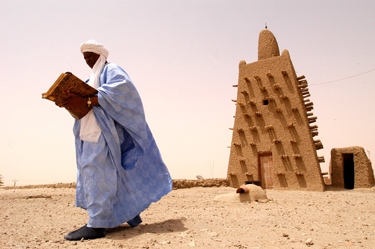
2013-Evacuation-manuscripts-Timbuktu-copyright-Prince-Claus-Fund-1
Muslim scholar

Another Muslim leader who met with Brother Thomas made regular appearances on national TV during Ramadan. “He came to Christ because we proved to him the Quran is not the inspired word of God and is not in the program of God for salvation,” he recounts. One Friday evening a mob of other scholars came to kill the recent convert, but were unsuccessful. “He was fearless,” Brother Thomas says. “They gave his wife to his best friend and took his daughter away because he rejected Islam. This year he was poisoned and died.” Brother Thomas believes that in the top ranks of Islamic scholars, many are atheists, because they no longer believe in the inspiration of the Quran.

In the last 15 years Brother Thomas and his team have led 18,000 imams, mullahs, and emirs to Christ. “We have led several Al Qaeda commanders to Christ, some of whom penetrated our centre as spies.” His team of 300 has dwindled to 65, due to the intensity of the fight. “Some have died, some left us, and some became afraid,” he says. He has developed a training program that is bearing fruit wherever it has been employed. Brother Thomas believes the church has been ineffective in reaching Muslims because they have concentrated on methods and strategies. “Christians want to bribe the Muslims to faith through relief and compassion, but those methods do not save. If you give relief to them it will not save them.” For salvation Muslims must discover Christ through His Word.

*name changed

Source: God Reports

There is an ongoing underground revival in the Muslim world. Over the past 20 years more Muslims have found Isa (Jesus) than in all the previous centuries together. See links:
Iran: where Christianity is growing fastest
Iran – fastest growing evangelical population
Iran: How two women brought hope in Tehran’s brutal Evin Prison
The Staggering Rise of the Church in Iran
Many Muslims are turning to Christ
Jesus and Muslims: Life in the desert
Jesus appears to Middle Eastern Muslim for a month
Iman hated Christians until Jesus raised him from the dead
Muslim woman returns from the dead to tell about Jesus
‘The Lord reached me right in the mosque’

If you want to know more about following Jesus, go here


Back to Main Page

Revival Blogs Links:

See also Revivals Index

See also Revival Blogs

See also Blogs Index 1: Revivals

GENERAL BLOGS INDEX

BLOGS INDEX 1: REVIVALS (BRIEFER THAN REVIVALS INDEX)

BLOGS INDEX 2: MISSION (INTERNATIONAL STORIES)

BLOGS INDEX 3: MIRACLES (SUPERNATURAL EVENTS)

BLOGS INDEX 4: DEVOTIONAL (INCLUDING TESTIMONIES)

BLOGS INDEX 5: CHURCH (CHRISTIANITY IN ACTION)

BLOGS INDEX 6: CHAPTERS (BLOGS FROM BOOKS)

BLOGS INDEX 7: IMAGE (PHOTOS AND ALBUMS)

BACK TO MAIN PAGE

Free PDF books on the Main Page

FREE SUBSCRIPTION: for new Blogs & free offers

Share good news  –  Share this page freely
Copy and share this link on your media, eg Facebook, Instagram, Emails:

18,000 Iman, Mullahs and Emirs led to Christ in West Africa:
https://renewaljournal.com/2016/02/01/18000-muslim-leaders-led-to-christ-in-west-africa/

Free Revival PDF books on the Main Page
FREE SUBSCRIPTION: for new Blogs & free offers

The church on the camel’s path

West Africa: The church on the camel’s path

And all this took place in the space of one year!

This spreading of the gospel is what Ahmed and his team call ‘the church on the camel’s path’.

Weat Africa

Maysa was an ordinary West African woman. She and her husband owned livestock and traveled about the countryside with groups of other nomads looking for grazing area for the animals. The couple were both Christians, alone in an area where everyone else was Muslim, and they had no church or Bible study to join.

Maysa realized that since none of the other people in her nomadic community could read, she had to be the one to bring the life-giving story of the gospel to her people. So she attended a training seminar offered by a missions organization, in which she learned how to tell stories from the Bible, beginning at creation and moving forward chronologically toward Christ.

As soon as she rejoined her family, Maysa began sharing these stories with other nomadic women. She told them how God repeatedly made himself known to men like Abraham and Moses, so that mankind could live according to His will. After every story, the women would discuss what the stories meant and, if they were true, how their lives would need to change to obey the God of truth. Within a few weeks, more then 40 women had accepted God’s gift of salvation and eternal life through his son Jesus.

Their husbands were quick to notice the change in their lives, and started asking Maysa‘s husband probing questions while they were out grazing their livestock. He was privileged to lead many of the men to Christ as well. After this, the men stopped their practice of raiding villages and instead began to take the good news of God’s Word to other nomadic groups of Muslims.

“Why did you leave them? You have space in your car.”

About one year later, two men named Ahmed and Mechela were driving through the desert, on their way to visit some Christ followers in a distant region. They belonged to the mission team that had trained Maysa how to make disciples by chronological Bible storytelling, and now they were travelling to an area 200 kilometers away.

As they bumped along the rutted dirt track, they came upon two elderly men walking with large burdens wrapped in blankets on their shoulders. The men had heard them coming and were waving them down, asking for a ride. Because the region was frequented by bandits, Ahmed was suspicious and didn’t slow down. He accelerated and roared past the elderly men.

But after a moment, the Holy Spirit pressed Ahmed. “Why did you leave them? You have space in your car.” Ahmed threw the car into reverse and picked up the hitchhikers who, relieved, clambered into the backseat. “We are taking a dowry gift to a young man in a distant village,” one of them explained. “We would have been walking all day if you had not come past.”

“Oh, we already know that story!”

Mechela asked: “Do you know God?” Throwing their heads back in laughter, the passengers replied: “Of course we know God! Who do you think made you stop and give us a lift?” Surprised, Mechela asked: “Would you like to hear a story?” The men readily agreed. “Do you know where the whole world came from? It was like this: in the beginning…” Mechela was abruptly interrupted. “Oh, we already know that story!” cried the hitchhikers in unison.

They quickly discovered that the men knew all the stories the missions team would teach new believers! Ahmed asked: “Where did you learn these stories?” The men answered: “Last rainy season a man moved to our village and taught us these stories and many others.”

During the remainder of the trip Ahmed and Mechela were able to piece things together. They traced the source of the Bible stories that the men had learned all the way back to Maysa and her husband, who had led others to become disciples of Christ, who in turn had gone to distant villages and shared the gospel with more nomads. These two elderly men, hitchhiking their way through the desert, were the fifth generation of Christ followers growing out of Maysa’s efforts, and they were on their way to share the gospel with a young couple who would soon be married and would carry it on to others. And all this took place in the space of one year!

This spreading of the gospel is what Ahmed and his team call ‘the church on the camel’s path’.

Source: Maysa, Ahmed and Mechela, interviewed by Jerry Trousdale for his book ‘Miraculous Movements’

Revival Blogs Links:

See also Revivals Index

See also Revival Blogs

See also Blogs Index 1: Revivals

GENERAL BLOGS INDEX

BLOGS INDEX 1: REVIVALS (BRIEFER THAN REVIVALS INDEX)

BLOGS INDEX 2: MISSION (INTERNATIONAL STORIES)

BLOGS INDEX 3: MIRACLES (SUPERNATURAL EVENTS)

BLOGS INDEX 4: DEVOTIONAL (INCLUDING TESTIMONIES)

BLOGS INDEX 5: CHURCH (CHRISTIANITY IN ACTION)

BLOGS INDEX 6: CHAPTERS (BLOGS FROM BOOKS)

BLOGS INDEX 7: IMAGES (PHOTOS AND ALBUMS)

BACK TO MAIN PAGE

Free PDF books on the Main Page

 FREE SUBSCRIPTION: for new Blogs & free offers

Helping in Myanmar/Burma

Helping in Myanmar/Burma

Posted in November 2015

Our family is still involved in helping in Myanmar/Burma

1412 JMemD speak guitar
Son Jonathan with his children Dante and Jemimah in Yangon

“My involvement in the country has been to help facilitate the care of orphans and abandoned children.”

Jonathan with orphans and needy kids

“So, with others, we have built homes, installed pumps and water purifiers, paid for food, clothing, medical care and education.”

Jonathan and Jemimah & Dante with Zo Min, a teacher in Yangon

This year my 3 adult children and most of my grandchildren will have served and helped in Myanmar/Burma and 5 of them west this December 2015..

Orphans & needy kids' first visit to a restaurant - $2 each!
Orphans & needy kids’ first visit to a restaurant – $2 each!

Jonathan’s post

See my Facebook page: https://www.facebook.com/geoff.waugh1

In the 1990 sham election run by the junta, Aung San Suu Kyi won almost 80% of the seats. The election was annulled and Aung San Suu Kyi put under house arrest for 20 years. Twenty five years later, the move towards democracy has seen a new election take place this past weekend. The military gave themselves 25% of the seats, opened the rest for public vote, and created a rule that would disqualify Aung San Suu Kyi from being elected. Despite these obstacles, it looks like her party is even more popular than in 1990 and able to accept office.

I’ve been in Myanmar every Christmas for the past 7 years and seen extensive social changes over that time. Improvements in the roads, vehicles, buildings and society. SIM cards went from costing over $2000 to under $2. I remember looking at my interpreter in disbelief when told a SIM card was more than $1000. What? I was sure they got the conversion from Kyats to dollars wrong.

My involvement in the country has been to help facilitate the care of orphans and abandoned children. Children so easily become helpless victims of poverty. Simply because of where I was born, I have resources that can help. So, with others, we have built homes, installed pumps and water purifiers, paid for food, clothing, medical care and education.

As I return this year, I am looking forward to visiting the kids I know in seven different orphanages. Playing games and having a laugh while concentrating on developing their education. Not only can a well-educated person escape poverty, they can help many other people reach the same heights. So I’d love to start some schools. It’s not something I can do on my own. If you would like to help, I’d like to hear from you.

In her speech, Aung San Suu Kyi noted the often overlooked and misunderstood concept of the servant leader. So often, we want to be in charge and run things our way. I was reminded of the most amazing person in history, the servant-King.

***

You can message me on my Facebook page as well as comment on this blog.

Back to Blogs

:

GENERAL BLOGS INDEX

Blogs Index 1: Revivals (briefer than Revivals Index)
Blogs Index 2: Mission (international stories)
Blogs Index 3: Miracles (supernatural events)

Blogs Index 4: Devotional (including Testimonies)
Blogs index 5: Church (Christianity in action)

Blogs Index 6: Chapters (Blogs from Books)
Blogs Index 7: Images (Photos & Videos)

Share any Blog to inform and bless others

Logo Square - PNG

Share good news  –  Share this and any page freely
Copy and share this link on your media, eg Facebook, Instagram, Emails:
Renewal Journal – a chronicle of renewal and revival:
www.renewaljournal.com

Permission: You have permission to reproduce any blog or book. Many books have been translated and reproduced.

Just include the link to Renewal Journal : www.renewaljournal.com

Christian Light is filling Columbia’s Spiritual Back Hole

CHRISTIAN LIGHT IS FILLING COLOMBIA’S

SPIRITUAL BLACK HOLE

After years of persecuting Christians, Helmer realized he had failed. “The more I persecute them, the more they grow, get stronger, multiply. Then I said, ‘How is this? If I’m trying to wipe them out and they grow more, are fruitful, and make a lot of progress. Then I start to doubt,” Helmer said. Those doubts led Helmer to a personal encounter with the Jesus he was persecuting. Today his weapon is a Bible, and he urges people to follow Christ instead of Karl Marx.”

For five decades, the South American country of Colombia has been at war with Marxist insurgents. Fighting can erupt at any time throughout scattered war zones, but that doesn’t stop an intrepid messenger of peace. For years, missionary Russell Stendal has taken Christian literature to all sides in the conflict: guerrillas, paramilitary, and government soldiers. He has forged friendships with all sides and his radio stations and solar-powered receivers pave the way.

Russell Stendal’s work has been portrayed in a film called “La Montana,” translated “The Mountain.”

See the film (with English subtitles) at http://blogs.cbn.com/globallane/archive/2015/02/20/american-missionary-released.aspx, and on YouTube at https://www.youtube.com/watch?v=1iVducvN9Ss#t=592.

Stendal tries to reach areas where it’s not possible to have church buildings or scheduled church services, and where it’s not possible to do normal missionary or evangelistic work. “And so we drop these radios on guerrilla camps, by parachute. We distribute them to soldiers; we distribute them to paramilitary forces,” Stendal told CBN News. Stendal has given out over 120,000 solar-powered radios. Former journalist Dario Silva has followed the conflict for years. He now pastors House on the Rock Church, one of Bogota’s larger churches, and sends aid to suffering families in rural Colombia.

But Silva said there’s a disconnect between Colombia’s megachurches and the country’s isolated and often persecuted Believers. “Megachurches are often not aware of the problems our brothers are going through.” Silva said that hardship and persecution have not kept the Gospel from reaching the remotest corners of Colombia. In fact, he remembers a guerrilla leader complaining: “Those Christians are the worst problem we have. We arrive at a remote part of the country where there is no electricity, no running water, no roads, or transportation, but there’s always some nut with a black book under his arm preaching about Jesus!”

In the mountains and jungles of southwest Colombia, guerrillas are still destroying churches, driving out Believers, and killing pastors. Open Doors reports that more pastors have been killed in Colombia than in any other democratic nation on earth. The southwest area of Colombia was home to Helmer, a FARC guerrilla commander known as Comandante Geronimo. “When I became a commander in the state of Cauca, I unleashed all that atheism against the people of God,” Helmer explained. “Expelling pastors, closing churches, killing evangelicals because they paid no attention to what we wanted them to do, which was to deny Jesus Christ, to deny God.”

But after years of persecuting Christians, Helmer realized he had failed. “The more I persecute them, the more they grow, get stronger, multiply. Then I said, ‘How is this? If I’m trying to wipe them out and they grow more, are fruitful, and make a lot of progress. Then I start to doubt,” Helmer said. Those doubts led Helmer to a personal encounter with the Jesus he was persecuting. Today his weapon is a Bible, and he urges people to follow Christ instead of Karl Marx.

Source: CBN News

Back to Blogs

GENERAL BLOGS INDEX 

BLOGS INDEX 1: REVIVALS (BRIEFER THAN REVIVALS INDEX)

BLOGS INDEX 2: MISSION (INTERNATIONAL STORIES)

BLOGS INDEX 3: MIRACLES (SUPERNATURAL EVENTS)

BLOGS INDEX 4: DEVOTIONAL (INCLUDING TESTIMONIES)

BLOGS INDEX 5: CHURCH (CHRISTIANITY IN ACTION)

BLOGS INDEX 6: CHAPTERS (BLOGS FROM BOOKS)

BLOGS INDEX 7: IMAGES (PHOTOS AND ALBUMS)

BACK TO MAIN PAGE


FREE SUBSCRIPTION: for new Blogs & free offers

Free PDF Books on the Main Page

Share any Blog to inform and bless others


Testimonies – included in The Lion of Judah (6) The Spirit of Jesus and (7) The Lion of Judah

A 6 Spirit of JesusA 7 LionTestimonies included in The Lion of Judah (6) The Spirit of Jesus and also in the one volume compiled edition (7) The Lion of Judah

*

Testimonies

eBook and Paperback

History and current experience are full of examples of people being filled with the Spirit of Jesus, the Holy Spirit. Jesus was filled with the Spirit at his baptism. The disciples were at Pentecost. The Samaritans were when Peter and John prayed for them. Paul was when Ananias prayed for him in Damascus. Cornelius and his household were while Peter was preaching. Believers in Ephesus were when Paul prayed for them. It still happens.

Here are some examples from history. Most of these are reproduced here from my books Flashpoints of Revival and Revival Fires.

Nicholas Zinzendorf and the Moravians in Saxony, Germany

No one present could tell exactly what happened on the Wednesday morning of the specially called communion service. The glory of the Lord came upon them so powerfully that they hardly knew if they were on earth or in heaven.   The Spirit of God moved powerfully on those three hundred refugees in Saxony in 1727. One of their historians wrote:

[Church history] “abounds in records of special outpourings of the Holy Ghost, and verily the thirteenth of August, 1727, was a day of the outpouring of the Holy Spirit. We saw the hand of God and his wonders, and we were all under the cloud of our fathers baptized with their Spirit. The Holy Ghost came upon us and in those days great signs and wonders took place in our midst. From that time scarcely a day passed but what we beheld his almighty workings amongst us. A great hunger after the Word of God took possession of us so that we had to have three services every day, at 5.0 and 7.30 a.m. and 9.0 p.m. Every one desired above everything else that the Holy Spirit might have full control. Self‑love and self‑will, as well as all disobedience, disappeared and an overwhelming flood of grace swept us all out into the great ocean of Divine Love.”[i]

John and Charles Wesley and George Whitefield in London, England

John Wesley found strong motivation for evangelism at a conversion experience at the age of 35 while hearing Martin Luther’s Preface to the Epistle to the Romans read at a meeting in Aldersgate Street, London. “About a quarter before nine while he was describing the change which God works in the heart through faith in Christ, I felt my heart strangely warmed, I felt I did trust in Christ, Christ alone for salvation, and an assurance was given to me that he had taken away my sins, even mine, and saved me from the law of sin and death.” From then on he resolved “to Promote as far as I am able vital Practical religion and by the grace of God to beget, preserve, and increase the life of God in the souls of men.”

He told how he and others including his brother Charles and George Whitefield with about 60 people were touched by God at a love feast in Fetter Lane, London: “About three in the morning, as we were continuing instant in prayer, the power of God came mightily upon us, insomuch that many cried out for exceeding joy, and many fell to the ground. As soon as we were recovered a little from that awe and amazement at the presence of his majesty, we broke out with one voice, ‘We praise Thee, O God, we acknowledge Thee to be the Lord.’”[ii]

Charles Finney in Adams, North America

Charles Finney (1792-1875) became well known in revivals in the nineteenth century. A keen sportsman and young lawyer, he had a mighty empowering by God’s Spirit on the night of his conversion on Wednesday 10 October 1821. That morning the Holy Spirit convicted him on his way to work. So he spent the morning in the woods near his small town of Adams in New York State, praying. There he surrendered fully to God. He walked to his law office that afternoon profoundly changed and in the afternoon assisted his employer Squire Wright to set up a new office. That night he was filled with the Spirit. He describes that momentous night in his autobiography:

“By evening we had the books and furniture adjusted, and I made a good fire in an open fireplace, hoping to spend the evening alone. Just at dark Squire W‑‑, seeing that everything was adjusted, told me good night and went to his home. I had accompanied him to the door, and as I closed the door and turned around my heart seemed to be liquid within me. All my feelings seemed to rise and flow out and the thought of my heart was, “I want to pour my whole soul out to God.” The rising of my soul was so great that I rushed into the room back of the front office to pray.

“There was no fire and no light in this back room; nevertheless it appeared to me as if it were perfectly light. As I went in and shut the door after me, it seemed to me as if I met the Lord Jesus Christ face to face. It seemed to me that I saw him as I would see any other man. He said nothing, but looked at me in such a manner as to break me right down at his feet. It seemed to me a reality that he stood before me, and I fell down at his feet and poured out my soul to him. I wept aloud like a child and made such confession as I could with my choked words. It seemed to me that I bathed his feet with my tears, and yet I had no distinct impression that I touched him.

“I must have continued in this state for a good while, but my mind was too much absorbed with the interview to remember anything that I said. As soon as my mind became calm enough I returned to the front office and found that the fire I had made of large wood was nearly burned out. But as I turned and was about to take a seat by the fire, I received a mighty baptism of the Holy Spirit. Without any expectation of it, without ever having the thought in my mind that there was any such thing for me, without any memory of ever hearing the thing mentioned by any person in the world, the Holy Spirit descended upon me in a manner that seemed to go through me, body and soul. I could feel the impression, like a wave of electricity, going through and through me. Indeed it seemed to come in waves of liquid love, for I could not express it in any other way. It seemed like the very breath of God. I can remember distinctly that it seemed to fan me, like immense wings.

“No words can express the wonderful love that was spread abroad in my heart. I wept aloud with joy and love. I literally bellowed out the unspeakable overflow of my heart. These waves came over me, and over me, and over me, one after another, until I remember crying out, “I shall die if these waves continue to pass over me.” I said, “Lord, I cannot bear any more,” yet I had no fear of death.

That night a member of the church choir which Finney led called in at his office, amazed to find the former sceptic in a “state of loud weeping” and unable to talk to him for some time. That young friend left and soon returned with an elder from the church who was usually serious and rarely laughed. “When he came in,” Finney observed, “I was very much in the state in which I was when the young man went out to call him. He asked me how I felt and I began to tell him. Instead of saying anything he fell into a most spasmodic laughter. It seemed as if it was impossible for him to keep from laughing from the very bottom of his heart.”[iii]

Dwight Lyman Moody in New York, North America

D. L. Moody (1837-1899), converted in 1855, later led powerful evangelistic campaigns in America and England. Two women in his church prayed constantly that he would be filled with the Spirit, and his yearning for God continued to increase. While visiting New York in 1871 to raise funds for churches and orphanages destroyed in the Chicago fire of October that year, in which his home, church sanctuary and the YMCA buildings were destroyed, he had a deep encounter with God. He wrote:

“I was crying all the time God would fill me with his Spirit.   Well, one day in the city of New York ‑ oh, what a day! ‑ I cannot describe it, I seldom refer to it; it is almost too sacred an experience to name. Paul had an experience of which he never spoke for fourteen years. I can only say that God revealed Himself to me, and I had such an experience of His love that I had to ask him to stay his hand. I went to preaching again. The sermons were not different; I did not present any new truths; and yet hundreds were converted. I would not be placed back where I was before that blessed experience for all the world ‑ it would be as the small dust of the balance.”[iv]

On a visit to Britain he heard Henry Varley say, “The world has yet to see what God will do with a man fully consecrated to him.” He resolved to be that man.

Evan Roberts in Loughor, Wales

Born in Loughor in Glamorgan, between Swansea and Llanelly, Evan Roberts (1878-1951) was an exemplary school pupil. At twelve he began working in the mine with his father. He founded a Sunday school for the children of miners, and decided to become a preacher. Constantly he read the Bible, even in the mine. He published poems in the Cardiff Times under the pseudonym of Bwlchydd, learned shorthand, and taught himself to be a blacksmith. He describes his encounters with the Spirit as follows:

“One Friday evening that spring (1904), as I was praying at my bedside before going to bed, I was taken up into a great expanse – without time or space. It was communion with God. Up to that time I had only had a God who was far off. That evening I was afraid, but that fear has never come back.   I trembled so violently that the bed shook, and my brother was awakened and took hold of me, thinking I was ill.

“After this experience I woke each night about one o’clock in the morning.   It was the more strange, as usually I slept like a log and no noise in my room was enough to wake me. From one o’clock I was taken up into communion with God for about four hours. What it was I cannot tell you, except that it was of God. About five o’clock I was again allowed to sleep until about nine o’clock. I was then taken up again and carried away in the same experience as in the early hours of the morning, until about midday or one o’clock.

“At home they questioned me, and asked why I got up so late … but these things are too holy to speak of. This experience went on for about three months.[v]

He entered the Calvanistic Methodist Academy at Newcasle Emlyn in mid‑September 1904. He was convinced revival would touch all Wales and eventually he led a small band all over the country praying and preaching.

Students from the Academy, including Evan Roberts and his room-mate Sidney Evans, attended the meetings of Presbyterian evangelist, Seth Joshua’s meetings in Blaenannerch. There on Thursday 29 September, Seth Joshua closed the 7am meeting before breakfast crying out in Welsh, “Lord … bend us.” Evan Roberts remembered, “It was the Spirit that put the emphasis for me on ‘Bend us.’ ‘That is what you need,’ said the Spirit to me. And as I went out I prayed, O Lord, bend me.”[vi] During the 9am. meeting, Evan Roberts eventually prayed aloud after others had prayed. He knelt with his arms over the seat in front, bathed in perspiration as he agonised in prayer. He regarded that encounter with the Spirit as crucial in launching him into his revival ministry which began one month later.

Djiniyini Gondarra in Elcho Island, Australia

The Lord poured out the Holy Spirit on Elcho Island in northern Australia on Thursday, 14 March, 1979. Djiniyini Gondarra was then the Uniting Church minister in the town of Galiwin’ku at the south of the island. He had been away on holidays to Sydney and Brisbane, returning on the late afternoon Missionary Aviation Fellowship flight.

He was travel weary and just wanted to unpack and get to bed early. Many of the people, however, had been praying for months, and especially every day while he had been away, so they wanted to have prayer and Bible study with him in his home. This is his account of that Pentecost among Australian Aborigines in the Arnhem Land churches across the north of Australia:

“After the evening dinner, we called our friends to come and join us in the Bible Class meeting. We just sang some hymns and choruses translated into Gupapuynu and into Djambarrpuynu. There were only seven or eight people who were involved or came to the Bible Class meeting, and many of our friends didn’t turn up. We didn’t get worried about it.

“I began to talk to them that this was God’s will for us to get together this evening because God had planned this meeting through them so that we will see something of his great love which will be poured out on each one of them. I said a word of thanks to those few faithful Christians who had been praying for renewal in our church, and I shared with them that I too had been praying for the revival or the renewal for this church and for the whole of Arnhem Land churches, because to our heavenly Father everything is possible. He can do mighty things in our churches throughout our great land.

“These were some of the words of challenge I gave to those of my beloved brothers and sisters. Gelung, my wife, also shared something of her experience of the power and miracles that she felt deep down in her heart when she was about to die in Darwin Hospital delivering our fourth child. It was God’s power that brought the healing and the wholeness in her body.

“I then asked the group to hold each other’s hands and I began to pray for the people and for the church, that God would pour out his Holy Spirit to bring healing and renewal to the hearts of men and women, and to the children.

“Suddenly we began to feel God’s Spirit moving in our hearts and the whole form of our prayer suddenly changed and everybody began to pray in the Spirit and in harmony. And there was a great noise going on in the room and we began to ask one another what was going on.

“Some of us said that God had now visited us and once again established his kingdom among his people who have been bound for so long by the power of evil. Now the Lord is setting his church free and bringing us into the freedom of happiness and into reconciliation and to restoration.

“In that same evening the word just spread like the flames of fire and reached the whole community in Galiwin’ku. Gelung and I couldn’t sleep at all that night because people were just coming for the ministry, bringing the sick to be prayed for, for healing. Others came to bring their problems. Even a husband and wife came to bring their marriage problem, so the Lord touched them and healed their marriage.

“Next morning the Galiwin’ku Community once again became the new community. The love of Jesus was being shared and many expressions of forgiveness were taking place in the families and in the tribes. Wherever I went I could hear people singing and humming Christian choruses and hymns! Before then I would have expected to hear only fighting and swearing and many other troublesome things that would hurt your feelings and make you feel sad. …

“There was a great revival that swept further west. I would describe these experiences like a wild bush fire burning from one side of Australia to the other side of our great land. The experience of revival in Arnhem Land is still active in many of our Aboriginal parishes and the churches.

“We would like to share these experiences in many white churches where doors are closed to the power of the Holy Spirit. It has always been my humble prayer that the whole of Australian Christians, both black and white, will one day be touched by this great and mighty power of the living God.”[vii]

These testimonies all show how God continues to pour out His Spirit.

Endnotes
[i] John Greenfield, 1927, Power from on High, Christian Literature Crusade (Reprint), p. 14.
[ii] Idle, C ed., 1986, The Journal of John Wesley, Lion, pages 46, 55.
[iii] Helen Wessel, 1977, The Autobiography of Charles Finney. Bethany, pages 20-22.
[iv] W R Moody, 1900, The Life of D. L. Moody, Revell, p. 149.
[v] Walter Hollenweger, 1972, The Pentecostals, Augsburg, pages 179-180.
[vi] Eifion Evans, 1969, The Welsh Revival of 1904, Evangelical Press, page 70.
[vii] Djiniyini Gondarra, 1991, Let My People Go, UCA, pages 14-19; also 1993, Renewal Journal, No. 1.

Share these testimonies to your Facebook, Twitter, Google, Linkedin and Pinterest
to inform and bless others.

Back to The Lion of Judah (6) The Spirit of Jesus
Back to (7) The Lion of Judah
Back to The Lion of Judah series

The Lion of Judah Series – Blogs

1  The Titles of Jesus – Blog
The Titles of Jesus – PDF

2  The Reign of Jesus – Blog
The Reign of Jesus – PDF

3  The Life of Jesus – Blog
The Life of Jesus – PDF

4  The Death of Jesus – Blog
The Death of Jesus – PDF

5  The Resurrection of Jesus – Blog
The Resurrection of Jesus – PDF

6  The Spirit of Jesus – Blog
The Spirit of Jesus – PDF

7  The Lion of Judah – in one volume – Blog
The Lion of Judah – PDF

GENERAL BLOGS INDEX

BLOGS INDEX 1: REVIVALS (BRIEFER THAN REVIVALS INDEX)

BLOGS INDEX 2: MISSION (INTERNATIONAL STORIES)

BLOGS INDEX 3: DEVOTIONAL (INCLUDING TESTIMONIES)

BLOGS INDEX 4: CHAPTERS (BLOGS FROM BOOKS)

BLOGS INDEX 5: CHURCH (CHRISTIANITY IN ACTION)

BLOGS INDEX 6: CHAPTERS (BLOGS FROM BOOKS)

BLOGS INDEX 7: IMAGES (PHOTOS FROM BOOKS)

FREE SUBSCRIPTION: for new Blogs & free offers

Fire of God among Aborigines by John Blacket

Fire In the OutBack, by John BlacketChurch on FireFire of God among Aborigines
by John Blacket

Chapter 2 of Church on Fire

Church on Fire is available in PDF

Church on Fire – PDF

The Rev. John Blacket, a Uniting Church minister is author of Fire in the Outback.

Share good news  –  Share this page freely
Copy and share this link on your media, eg Facebook, Instagram, Emails:
Fire of God among Aborigines:
https://renewaljournal.com/2014/12/20/fire-of-god-among-aborigines-byjohn-blacket/

Soon after the arrival of the first European settlers in Australia some Christians started to take the gospel to Aborigines. Much of this early work was thwarted by aboriginal repulsion at the life style and cruelty of these strange new people.

Not that all Aborigines rejected foreigners. There had been contact with Macassans from Indonesia every year for hundreds of years. They came to gather trepang, a sea delicacy found in North Australia. Some Aborigines visited Indonesia with them, and the cultures and even families mixed together.

No, the clash between Europeans and Aborigines was a deep cultural issue of differing world views related to what is important in each culture. Europeans did not value highly the same things Aborigines did, especially family relationships. They seemed more interested in material things.

These Europeans spoke about God and his love. They tried to teach the ‘inferior, primitive’ Aborigines by rational, cerebral processes. Aborigines, however, ‘know’ things by a heart experience rather than abstractly in their minds. So Europeans tended to see mission as a very long process of teaching abstract Western concepts.

There was some success. This came mainly from the love and commitment of these Christian foreigners to total strangers at incredible personal sacrifice. That spoke more than words.

Ron Williams, an aboriginal evangelist, observed that those Christians were the kind of heroes the children ought to know about, people not ashamed to shed tears and love their black friends, pioneers who poured out love and healed the wounds of many sorrowing, suffering and dying Aborigines.

Aborigines were searching for something in this new teaching to catch hold of, but it didn’t seem to have any spiritual handles for them. It seemed to be ideas without answers to the struggles of life. Their world was full of very real spiritual powers, especially evil spirits and the power of ‘magic men’. If this God was like they said, he should be stronger than the evil spirits, and they would see evidence of this. They didn’t.

To the European, this world view was primitive superstition and was wrong. People just had to learn with their minds. Then they would understand. Even missionaries who did believe in satan and evil spirits did not seem to have the ability and power to deal with them.

Yet through it all God was at work. Seeds were sown which paved the way for the aboriginal revival.

Aborigines began finding a real relationship between their culture and the gospel. They rejected aspects of their culture which conflicted with God’s Word but came to see that their ‘law’ was like the Jewish law which Jesus came to fulfil, not destroy. They sensed that God had given Aborigines some revelation of his divine nature and purpose in their culture that needed to be fulfilled in Jesus Christ.

Makarrwala (Harry) from Buckingham Bay in eastern Arnhem Land, North Australia was one. An early convert in the region, he committed his life to Christ at Milingimbi in 1940. His conversion resulted from God speaking to him in a dream, a way in which God speaks to many Aborigines still. That led to the beginnings of indigenous changes, submitting the culture to the gospel, not through missionary teaching but through personal conviction by the Holy Spirit.

God prepared the way for revival, in people like Harry, in visions and dreams, in personal sacrifices and teaching, in signs and wonders, in healings and struggles, in personal relationships, and in meetings where God’s power was clearly evident and many lives were changed.

Arnhem Land revival

It was not until 1979 at Galiwin’ku (Elcho Island) that a really powerful community-changing move of the Holy Spirit occurred. It seems that most of the revival among aboriginal people has stemmed from this in some way.

Arnhem Land, the north east section of the Northern Territory, is an aboriginal reserve, so over 90% of the residents are Aborigines. The rest are called ‘balanda’ (non-aboriginal) who work in the region to assist the aboriginal communities. Galiwin’ku is one of the largest communities with over 1,000 people.

The Methodist Church (which became part of the Uniting Church in 1977) pioneered missionary work in this region in 1923. Rev. Harold and Ella Shepherdson worked at Galiwin’ku from 1942, spending 35 years there and 50 years altogether in the region. This gave Galiwin’ku great stability through their incredible practical wisdom.

The church and tribal elders carefully trained key young local Aborigines for leadership. Rrurrumbu Dhurrkay, the assistant school principal and an evangelist was one. Another was Rev. Djiniyini Gondarra who was placed in charge of the local church in 1977. God was preparing him for a wider and important national apostolic task. For both of them, this involved preparation in spiritual dimensions of family life which neither balanda nor aboriginal training had given them.

Yet the Holy Spirit began to move visibly in the community at the time Djiniyini and a number of other leaders, who were all praying expectantly for this move of God, went on holidays.

The first evidence of this special move of the Holy Spirit came with the wet season of 1978-79. People started to ask about God. At a social gathering on the beach Christians sensed God’s presence in a unity they had never before experienced. Only one or two balanda were present. People wanted to spend more time together, and with God. Many fellowship meetings began to happen spontaneously, every night and at other times.

The fruit and gifts of the Holy Spirit started to be experienced in new ways. Non-Christians felt God’s presence, came to join in, were convicted of sin and repented. Even some who were sceptical and opposed to what was happening were drawn to come and sit on the side-lines and mock, but were brought to repentance by God.

While Djiniyini was on holiday he prayed for God’s leading about what should be planned for the church for 1979. He listed many things.

On the day of his return in March some people said they wanted a fellowship meeting at his house that night. Tired after his journey, his spirits fell. But it turned out to be an exceptional night. During the night people began crowding into the lounge room. Many of them were people he had never seen at church. They began telling what had been going on while their pastor had been away. As Djiniyini and his wife Gelung listened, tears filled their eyes. Everything on that list had already happened, or was beginning to happen.

A visit by the Rev. Dan Armstrong, a Uniting Church minister and evangelist, had previously been planned for May. He arrived with a small team and found a people prepared by God. The church had more than doubled that year already. The team discovered they had come on the crest of a wave of God’s Spirit moving among the people.

Dan Armstrong tells the story of their visit to that revival.

‘The first day when we arrived there was such a sense of expectation. It was tremendous. We had a feast the first night, not a meeting. About 500 people arrived! They were gathered around the area, sitting at their little fires. Someone just started strumming a guitar. Others joined in and a few people started to sing.

‘Then out of the darkness more people started to come. They knelt down all round the area. Some started to weep. I hadn’t preached or anything at this point!

‘We started to gather around and pray with them. The incredible thing was that the Lord just ‘smote’ them. But then they would get up and join with us in praying for others.

‘There must have been fifty of them who came to Christ that night. Then the next day the word got out and the place was just jammed with people. We couldn’t fit in the building where we started and had to move out into a big open area.

The beautiful thing was that the first morning the old men came first and started weeping. Others gathered around them day after day and night after night. We saw miracles. Several people were totally delivered from demonic power. Some were healed of all kinds of physical ailments.   Particularly significant was the description that they gave again and again of a blanket of blackness being lifted and the light of Christ shining in.

One of the meetings was held on an old ceremonial ground. Through the worship and praise in that place that night the evil spiritual forces were at first aroused and then soundly defeated by the mighty power of God. Some dramatic manifestations were reported. This was another point of release for many people.

Each night after the team retired, others would remain singing and praying into the early hours of the morning. One night a country and western group held a concert in the big hall near the space where they held their meetings. Only 40 attended the concert while over 500 attended the meeting. For Aborigines, that is a miracle!

Aboriginal teams

This revival took teams from Galiwin’ku throughout Arnhem Land, into Queensland, Western Australia, and even to Canberra. They visited aboriginal communities in remote places but included some balanda churches in cities. The results showed powerful evidence of God’s ministry to receptive people. Mostly it was not as dramatic as at home, except for Warburton.

Warburton, with a population of 400, lies in the Central Desert area 250 kilometres west of the junction of the Northern Territory, South Australian and Western Australian borders.

The United Aborigines Mission has worked there for many years but it was hard going. Fighting, drunkness and despair filled the town. In 1980, the Federal Minister for Aboriginal Affairs described it as the worst aboriginal community in Australia.

In September 1981, Rrurrumbu led a team from Galiwin’ku to Alice Springs, and the Pitjantjatara area south of Ayer’s Rock, and finally to Warburton. They flew almost 3,000 kilometres, mainly by light aircraft, to conduct the meetings.

One man commented about Warburton: ‘We knew things couldn’t get worse, so God was our only hope.’ There was real expectancy in spite of disruptions.

A group travelling to a men’s tribal ceremony arrived in town at the same time as the mission team. They intended to take all the men with them on to the ceremony.

One of their truck drivers said, ‘I want to stay and listen to what these strangers have to say.’ So they all stayed!

Drunkenness and petrol sniffing caused disruptions. The old warehouse community store made of corrugated iron used for the meetings echoed with every dog fight or disturbance, despite being packed out. Young people hurled rocks onto the roof or rattled sticks along the corrugated iron walls.

Yet, somehow God moved sovereignly that weekend. Hundreds came to new life. A change took place in the spiritual realms over that place.

A couple of months later, Djiniyini led a smaller team from Galiwin’ku to Warburton in response to another request for help. Once again the Holy Spirit moved in power. Hundreds had prayer for the release of the power of the Holy Spirit in their lives, receiving supernatural signs of his answer and a real sense that God was anointing people for ministry.

The first test of this change came through a horrible car accident where six young people were shockingly burned. Instead of plunging into ceremonial grieving, wailing, injuring themselves and seeking revenge, the Christian leaders went to the hospital to pray for the young people, some of whom were dying. Christians went around comforting and praying with the families and ministering to them.

Within a few weeks a team went out from Warburton to share what they had received. In 1982 the team had up to seventy on the road for months at a time, preaching the gospel all over Western Australia. Their teams picked up new members from each community they visited. No outside church group supported them. Basically it was a tribal movement.

The revivals of Arnhem Land and the Central Desert resulted in thousands of aboriginal people having their lives changed from misery to new life in Christ. Families were re-united and many family relationships healed. The misery of alcohol was exchanged for joy and hope. Over 1,000 people were baptised. In one small town 150 were baptised. Even non-aboriginals, seeing the changes, made their own commitments to Jesus Christ.

Sometimes God worked through unusual events to deal with social evils and sins. A group of gamblers were mocking Christians who were praising God in the front yard of a house in one aboriginal community in South Australia. Suddenly one of the gambler’s vehicles started up, drove into a ditch, and burst into flames and the cards in the gambler’s hands caught on fire. That is a true story! The people who told it gave the moral: ‘Don’t mock God.’

I have concentrated here on Galiwin’ku and Warburton. The Holy Spirit has moved strongly in other places as well, especially the Kimberleys, Fitzroy Crossing, and Roeburn in Western Australia, and in rural and urban areas of northern New South Wales. The details I have given portray some of the overall picture.

Results of revival

Has it lasted? The gatherings of 100 to 200 every night at Galiwin’ku gradually diminished. By August 1979, weekly Bible studies were established to nurture new Christians, and have continued. Five years after the revival began a core group of 30 to 50 people still met three nights a week for fellowship, with attendances sometimes as high as 100. In the nineties a strong core group is still meeting.

When I revisited Warburton and the whole region late in 1989 I saw that many had fallen away from the Lord and a lot of the fire had gone. I asked about the changes that remained. Even non-Christian European staff acknowledged that conditions were enormously better than before the revival.

Similarly I have seen some of the highs and lows of spiritual life at Galiwin’ku in several recent visits. Many have fallen away, and some still have an active faith but are not involved with the organised church.

However, conversions still happen, lives are changed, relationships healed, and there are miracles, physical healings, signs, wonders, dreams and visions among them. Many who did not know Jesus before the revival and had been real problem people now follow him with a strong commitment. Some still reach out to groups beyond the normal family responsibilities, including ministry to outcast groups.

There is a deep desire to work through the relationship between the gospel and their own culture, rather than sweeping it under the carpet or trying to deny their roots by rejecting all their culture. This process will take time, prayer and hard work with the Holy Spirit’s inspiration, guidance and strength. It requires prayerful support, not the misguided intervention of well meaning non-aboriginals.

Most of all they have a growing expectation of a further wave or move of the Holy Spirit. There is a new earnest calling out to God. I believe that what has happened is just a foretaste of an ingathering that is far greater than most of us have dreamed possible. Certainly the vision regarding Aborigines that God has given to many people, even before the revival, has only just begun.

The Lord gave Dan Armstrong a vision on the last day of his 1979 mission at Galiwin’ku. He saw the young men going out in groups and landing in other spots. Everywhere they went, a fire came up. He shared this with them and the Lord gave them the word from 1 Corinthians 1:26-29,

Not many of you were wise by human standards, not many were
powerful, not many were of noble birth. But God chose what is
foolish in the world to shame the wise; God chose what is weak in
the world to shame the strong; God chose what is low and despised
in the world, things that are not, to reduce to nothing things that
are, so that no one might boast in the presence of God.

Back to Church on Fire

See Australian Reports – Aboriginal Revivals

Revival Blogs Links:

See also Revivals Index

See also Revival Blogs

See also Blogs Index 1: Revivals

GENERAL BLOGS INDEX

BLOGS INDEX 1: REVIVALS (BRIEFER THAN REVIVALS INDEX)

BLOGS INDEX 2: MISSION (INTERNATIONAL STORIES)

BLOGS INDEX 3: MIRACLES (SUPERNATURAL EVENTS)

BLOGS INDEX 4: DEVOTIONAL (INCLUDING TESTIMONIES)

BLOGS INDEX 5: CHURCH (CHRISTIANITY IN ACTION)

BLOGS INDEX 6: CHAPTERS (BLOGS FROM BOOKS)

BLOGS INDEX 7: IMAGES (PHOTOS AND ALBUMS)

BACK TO MAIN PAGE

 FREE SUBSCRIPTION: for new Blogs & free offers

Share good news  –  Share this page freely
Copy and share this link on your media, eg Facebook, Instagram, Emails:
Fire of God among Aborigines:
https://renewaljournal.com/2014/12/20/fire-of-god-among-aborigines-byjohn-blacket/

Church on Fire


Twenty-first Century Revivals: Transforming Revivals

Revival FiresA Flashpoints 1

Twenty-first Century Revivals:

Transforming Revivals

    See Revivals Index  –  https://renewaljournal.com/revivals-index/


Revival Fires – updated
Revival Fires – PDF
Chapter 7: 21st Century Revivals

See more on Revival Fires

1. Eighteenth-Century Revivals: Great Awakening & Evangelical Revivals
2. Early Nineteenth-Century Revivals: Frontier and Missionary Revivals

3. Mid-nineteenth Century Revivals: Prayer Revivals

4. Early Twentieth Century Revivals: Worldwide Revivals

5. Mid-twentieth Century Revivals: Healing Evangelism Revivals
6. Late Twentieth Century Revivals: Renewal and Revival
7. Final Decade, Twentieth Century Revivals: Blessing Revivals

8. Twenty-First Century Revivals: Transforming Revivals

Share good news –  Share this page freely
Copy and share this link on your media, eg Facebook, Instagram, Emails:
Twenty-first Century Revivals: Transforming Revivals:

https://renewaljournal.com/2014/04/28/twenty-first-century-revivals-transforming-revivals/

FREE RENEWAL JOURNAL SUBSCRIPTION: for updates, new Blogs & free offers
FREE PDF books on the Main Page


Revival explodes globally now. Where God’s people take his Word and his promises seriously in repentance, unity and commitment, revivals of New Testament proportions blaze like wildfire across the nations of the earth. This chapter gives some examples of current transforming revivals where whole communities and even the ecology have been totally changed.

See also:

House Church: the fastest growing expression of church

Grassroots movements with no church buildings explode

Dinner Churches

House Churches, by Ian Freestone

House Churches in China (Barbara Nield)

China: how a mother started a house church movement

Laos: a church for the So


Links to current revivals


Snapshots of Glory: Mizoram, Almolonga, Nigeria, Hemet, Cali

Global Phenomona: Kenya, Brazil, Argentina

Transforming Revivals in the South Pacific:
Papua New Guinea, Solomon Islands, Vanuatu, Fiji 

Some Revival accounts in the 21st century

Christianity is Growing Faster than Ever – 2020
Why Culture won’t Change without Radical Revival – 2017
Global Faith Revival – 2016
 
UK – Alpha in Prison – 2014
 
Europe – Seven Signs of Hope – 2014 
Europe – Two Unlikely People in Rome – 200 million – 2014

North America – The Jesus Film – now in 1500 languages, 500 million responses – from 1979
See The Jesus Film
See Radicals can’t stop the Jesus Film
North America – Whatcom: day and night prayer – 2008
North America – Aurora: Gangsters in the Doorway – 2011
North America – Revival Fires in West Virginia – 2016
North America – Revival hits army base – 2018

North America – Revivals Across the South of USA – 2018
North America – Current Revival in America’s Largest University – 2018
North America – American Revival Reports – 2023
North America – Fresh Outpouring at Asbury University – 2023
North America – A ‘surprising work of God’ in Asbury chapel – 2023

Central America – Missions at the Margins – 2008
South America – Amazon: Revival in the Amazon among “Skull Splitters” – 2012

South America – Christian Light is filling Columbia’s Spiritual Black Hole – 2015

South America – Brazil: Transformation through Prayer – 2016

Europe – 5 Signs of Christian Revival – 2022

Israel – Reconciliation & Jews coming to faith – 2020
Israel – Supernatural Signs & Wonders break out among 1,000 Jews – 2015

Israel – Jews finding Jesus in Israel – 2000s
Middle East – Revival in the Middle East – 2000s

Middle East – Many Muslims are Turning to Christ – 2016

Arabia – Sheiks import Bibles – 2000s

Iran – fastest growing evangelical population – 2000s

Iran – where Christianity is growing fastest – 2000s
Egypt – Thousands gather – 2000s

Africa – Reinhard Bonnke’s beginnings – 1970s
Africa – Nairobi: Reinhard Bonnke’s Final Crusade in Africa – 2017
Africa – West Africa: The church on the camel’s path – 2000s
Africa – Mozambique: The Primacy of Love (Heidi Baker) – 2000s
Africa – Mozambique: Revival with Iris Global – 2000s

Africa – Ghana: He woke up totally healed (Daniel Kolenda) – 2014

Asia’s Maturing Church (David Wang) – from 1970s
Asia – Radicals can’t stop the Jesus Film – 2000s
Asia – 3,000 churches from one man’s obedience – 2020
Nepal – Revival Meetings (Raju Sundas) – 2000s
Nepal – Jesus invaded a Buddhist Monastery in the Himalayas – 2015

India – One Touch from Jesus – 2000s
Bangladesh – Christianity exploding in Bangladesh – 2000s

China – The Spirit told us what to do (Carl Lawrence) – 2001

China – Revival in China (Dennis Balcombe) – late 1900s
China – House Churches – late 1900s
China – New Wave of Revival – 2016

China – Chinese turning to Christianity – 2000s
China – Revival Breaks Out in China’s Government Approved Churches – 2000s
China – How Christians respond to the coronavirus outbreak – 2020

South Pacific – Vanuatu Revival Meetings – 2000s
South Pacific – 21st Century Revivals in the South Pacific – 2000s
South Pacific – Transforming Revivals: blog and book – 2000s 
Australia & South Pacific – Healing Evangelism – 2000s
Australia – Young Christians sharing Good News on the streets in Brisbane – 2015


Christianity is Growing Faster than Ever – 2020


Israel – Reconciliation & Jews coming to faith – 2020

 
Revival hits army base, 2018

f-akers
Revivals Across the South of USA, 2018

ASU
Current Revival in America’s Largest University, 2018


Day and night prayer impacted a community – Whatcom 2008

Virginia2
Revival Fires in West Virginia, 2016


Iran: where Christianity is growing fastest

ConferencePraise
China – New Wave of Revival


Revival with Iris Global – Roland & Heidi Baker


See also Snapshots of Glory by George Otis Jr.

George Otis Jr presents vivid stories of the transformation of cities and regions in the two DVDs Transformations 1 and 2, and other DVDs of The Sentinel Group. This transforming revival now spreads worldwide in the twenty-first century. Otis summarises some outstanding examples, rooted in the late twentieth century, and blossoming now.

For some time now, we have been hearing reports of large-scale conversions in places like China, Argentina and Nepal. In many instances, these conversions have been attended by widespread healings, dreams and deliverances. Confronted with these demonstrations of divine power and concern, thousands of men and women have elected to embrace the truth of the gospel. In a growing number of towns and cities, God’s house is suddenly the place to be. In some communities throughout the world, this rapid church growth has also led to dramatic socio-political transformation. Depressed economies, high crime rates and corrupt political structures are being replaced by institutional integrity, safe streets and financial prosperity. Impressed by the handiwork of the Holy Spirit, secular news agencies have begun to trumpet these stories in front-page articles and on prime-time newscasts. Of those on file, most are located in Africa and the Americas. The size of these changed communities ranges from about 15,000 inhabitants to nearly 2 million.

See also

riverlife-goingdeeper
Podcast link: 21st-century revivals – Riverlife Church: Geoff & grandson Dante talk with
staff about revivals they’ve seen  


The Life of Jesus – Blog
The Life of Jesus – PDF eBook
Amazon link – paperback, hardcover, Kindle


Revival Fires – updated
Revival Fires – PDF
Summary of over 50 revivals


God’s Surprises – Blog
God’s Surprises – PDF

Biographical stories of current revivals in 20 countries 

God’s Surprises summarises revival events in 20 countries. It’s a brief summary of information in my books Journey into Mission (most detail) and Journey into Ministry and Mission (condensed autobiography). 

Blogs and videos about God’s Surprises:


Jesus’ Last Promise – Blog and Video – Pentecost
You shall receive power when the Holy Spirit comes upon you


God’s Promise – Blog and Video – I will pour out my Spirit
Seeing God’s Spirit poured out in over 20 countries

If my people who are called by my name humble themselves, pray, seek my face, and turn from their wicked ways, then I will hear from heaven, and will forgive their sin and heal their land. (2 Chronicles 7:14)

Back to Summaries of Revivals Contents

See Revivals Index  –  https://renewaljournal.com/revivals-index/

GENERAL BLOGS INDEX

BLOGS INDEX 1: REVIVALS (BRIEFER THAN REVIVALS INDEX)

BLOGS INDEX 2: MISSION (INTERNATIONAL STORIES)

BLOGS INDEX 3: MIRACLES (SUPERNATURAL EVENTS)

BLOGS INDEX 4: DEVOTIONAL (INCLUDING TESTIMONIES)

BLOGS INDEX 5: CHURCH (CHRISTIANITY IN ACTION)

BLOGS INDEX 6: CHAPTERS (BLOGS FROM BOOKS)

BLOGS INDEX 7: IMAGES (PHOTOS AND ALBUMS)

BACK TO MAIN PAGE

Share any Blog to inform and bless others

Logo Square - PNG
Click here to be notified of new Blogs

Share good news –  Share this page freely
Copy and share this link on your media, eg Facebook, Instagram, Emails:
Twenty-first Century Revivals: Transforming Revivals:
https://renewaljournal.com/2014/04/28/twenty-first-century-revivals-transforming-revivals/