You can apply this to giving messages and preaching.
Anybody can learn to give a great speech. The best speakers include a clear, relevant message and a few great stories to illustrate it. Forget fancy PowerPoint presentations and loads of data. Instead, keep your speech simple, with a clear beginning, middle and end. Focus on one theme, and eliminate everything else. “People struggle so mightily writing speeches when all they have to do is find a message and three great stories to prove it,” says Jane Praeger, a Columbia University professor and the president of the speech presentation and coaching firm Ovid Inc.
“Speeches are an inefficient form of communication,” adds Nick Morgan, the president of Public Words, Inc., and author of Trust Me: Four Steps to Authenticity and Charisma. “People don’t remember much of what they hear, so focus and keep it simple.” Here are tips from the experts.
Practice beforehand
“You would do better practicing in the shower, and running through the speech in your head, than practicing in front of a mirror, which is distracting,” says Jane Praeger. “You do have to practice out loud, hopefully with a small audience.” Practice replacing deadening filler words like “um,” “so,” and “like” with silence. If you can rehearse in the space where you’ll be speaking, that’s a real plus. Go to the back of the room, imagine that you’re deaf or distracted, and you’ll know how to reach those people.
Work the room
Try to speak to audience members before your speech, so that you can focus on a few friendly faces, particularly if you get nervous. “If you’re making eye contact with a friendly person in quadrant one, everyone to their left will think that you’re talking to them,” says Praeger. “Then do the same thing in quadrant two. You want to see your talk as a series of conversations with different people throughout the room.”
Prepare with relaxation techniques
If you’re nervous before approaching the stage, take a few deep breaths. Picture yourself delivering a successful speech. “Most people will be nervous for the first few minutes,” says Praeger. “You want to channel that adrenaline into positive energy.”
Don’t read your speech
Tell your speech from heart, or use a note card with bullet points as a cheat sheet. Bring the card with you and place it on the lectern. If you freeze up mid-speech, you can take a deep breath, look at your card, and know exactly what story you’re going to tell next.
Stand up straight
Whether you walk across the stage or stand behind a lectern, try to maintain good posture. “Imagine that your head is being held up by a string,” says Praeger.
Lead with an anecdote
Ditch the thank yous and jump right in. [Unless “Thanks Name” is appropriate] People often make the mistake of starting speeches by thanking the introducer, or expressing their happiness at being there. “Instead, jump right in with a framing story that suggests what the topic is without giving it all away, a statistic, a question or some kind of interaction with the audience,” says Nick Morgan. If you know what your speech is about–and it should be about one thing–you should have an easy time deciding on an opening. Get right into the story and let the audience know what the speech will be about.
Keep it simple
Forget fancy PowerPoint presentations and loads of data. Focus on one theme and eliminate everything else. “Speeches are an inefficient form of communication,” says Morgan. “People don’t remember much of what they hear, so focus and keep it simple.” The best speeches include one clear, relevant message and a few great stories to illustrate that message.
Keep it short
“I think a speech should not be more than ten minutes long,” says Praeger. “Five to seven minutes is ideal.” If you’re aiming for seven minutes, your prepared speech should run shorter than that so that you can factor in extra time for pauses and audience responses.
Use body language that makes you appear comfortable
If you show signs of nervousness, like crossing your arms, or clutching your hands in front of your stomach, your audience will sense your nerves and be less open to your message. “You have to pretend that you’re having a good time and are open to the audience so that they can have a good time and be open back to you,” says Morgan. “Successful public speaking is all about passion and emotion. If you’re excited, then we will be, too.”
Slow down
Articulate your words, regardless of your natural speaking style. “Authenticity is key,” says Praeger. “You can’t be someone you’re not. On the other hand, you can be your best self. Softness doesn’t detract from a speech if you’re committed to what you’re saying. Passion, commitment and conviction are critical for delivery, and you can do that whether you’re soft-spoken or not. Any number of delivery styles will work.”
Source: Forbes
How To Give A Great Speech, Nick Morgan
Prolific Cuban church planter: 300 churches planted and 1,000 leaders trained
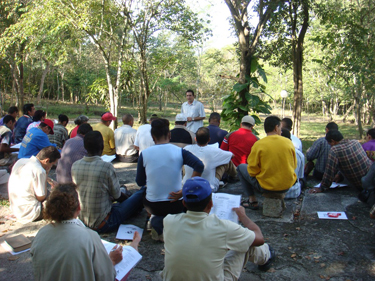
Training in a camp ground
Otoniel Martinez grew up in a Christian family.His father was a pastor in a time when government pressure made it difficult to follow Jesus. Otoniel was a gifted student and could have attended one of the top schools in Cuba.
But in order to attend a top university he had to deny his christian faith, which we would not do. He decided he would bypass upper-level education to follow Christ no matter what, according to a report by United World Mission (UWM).
His resolve was tested many times as he faced opposition from the authorities. He successfully planted one church, which proceeded to reproduce 26 other churches.
From there, the Holy Spirit planted a God-sized vision in Otoniel’s heart: to see churches planted in every corner of Cuba and to send workers into the rest of the world. For assistance, Otoniel
reached out to UWM, because they led his family to Christ many years ago.
A church planting trainer from UWM was introduced to Otoniel. Together, they developed a
training for Cuba known as the “Sembradores” (Sowers) Network.
They assembled 50 people from 20 denominations in Bayamo, the heart of communism in Cuba. After just one training session they were kicked out of the church they were using because the pastor feared that he would receive retribution from the local authorities.
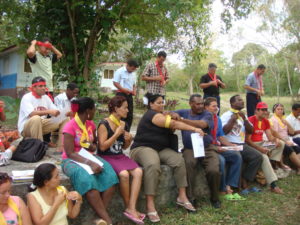
“We began to meet outside in a remote area of a campground,” noted Joseph Milioni in the Evangelical Missions Quarterly (EMQ). “We didn’t use any chairs so that we could scatter if local officials came near.” Rocks scattered around the camp became their chairs.
Training without buildings
“Even with all the setbacks, it was never a question of stopping the training. Otoniel showed dependence on God when things went well and when obstacles developed. This went on to be
one of our best trainings. Many of our current network leaders came out of this training.”
As churches were planted a new need arose. In a country where the average person makes
$15 a month, how could churches support church planters and achieve Otoniel’s long-term vision?
“By partnering with several different North American partners we began to help develop micro-enterprises on the island. We have seen everything from bicycle taxis to ice cream stands.
All the funds go towards church planting and the churches that support it,” according to UWM.
Milioni marvels at the fruit. “Together, we developed a church-planting network that has seen
close to one thousand church planters trained in less than five years. One of the greatest lessons he (Otoniel) taught me is dependency—not the dangers of developing dependency on outside resources, but rather of being truly dependent on God.”
Otoniel’s reliance on God sets him apart. “Despite having more talent, passion, and vision than
many could hope to have, he met every step with a heart pleading to God for guidance,” Milioni notes. “Every step of the way, despite success, Otoniel has never relied on his own abilities.”
“He is recognized by many national leaders and has tremendous respect both in and out of Cuba,
but inevitably during each visit, I still see him gathering his family together, looking to God to meet needs and give guidance.”
Inevitably, a God-sized vision is met with adversity. “When everything seemed to be going well, Otoniel’s father passed away and his wife, Idalmi, was diagnosed with cancer.
However, because Otoniel has established a habit of leaning on God, he is seeking God to comfort him and be with him as he has always been,” Milioni notes.
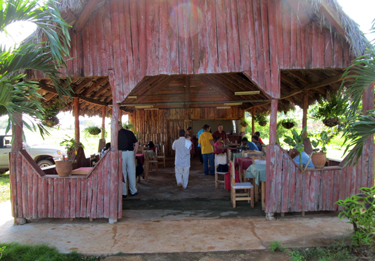
Typical church
Otoniel’s vision has grown to develop Cuban missionaries to go to the unreached.
From the beginning, the responsibility of the church to be involved in missions was taught. A missions professor from Costa Rica was brought in to teach the Cuban pastors how local churches could be involved in missions. After a few days the hearts of the pastors were burdened to send church planters around the world, according to UWM.
Despite the fact that these churches had very little income, the pastors raised $60 for missions
on their first night (4 months wages). A committee was formed to create a Cuban missions organization and training center for missions.
The Sembradores network has resulted in more then 300 new churches being planted.
Many second-generation churches have been counted. More then 20 micro-enterprises have been established.
“We have seen God do amazing things and believe there is still more to come.”
To learn more about United World Mission and their work in Cuba, go here .
For nearly half a century, Evangelical Missions Quarterly (EMQ) has served the missionary community worldwide by providing relevant, engaging, thoughtful articles on a vast array of ministry foci. To subscribe, go here .
Vincent van Gogh’s unappreciated journey with Christ
By Mark Ellis
The Raising of Lasarus, 1890
A record 1.2 million visitors came to the giant retrospective of Van Gogh’s work in Amsterdam in 1990, which coincided with the 100th anniversary of the Dutch post-Impressionist’s death. What visitors did not see at that major exhibition were van Gogh’s Christian-themed paintings, which were left in the basement of the museum.
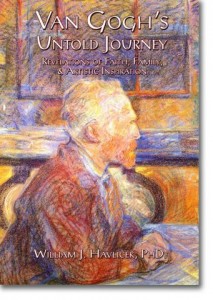
“None of the religious imagery was in the show. It was deliberately kept in the basement,” says William Havlicek, Ph. D , author of “Van Gogh’s Untold Journey” (Creative Storytellers). “In Western art there has been a move toward secularization through existential thinking,” he notes, which followed the disillusionment of many artists after two world wars.
Van Gogh’s Untold Journey
Havlicek spent 15 years researching and studying more than 900 of van Gogh’s letters. His revealing book dispels many of the myths that surround the painter’s tumultuous life. “Vincent’s letters portray a very different story than the popular tale of the mad artist who cuts off his ear,” Havlicek notes. “What emerges instead is a story of selfless loyalty, the epitome of the Gospel’s sacred counsel – ‘love one another.’”
“Many of his religious letters were held back and only released in the last five or six years,” Havlicek adds.
Vincent’s father and grandfather were pastors and it seems many in the van Gogh family gravitated toward religion or art. His father Theodorus – a Dutch Reformed minister — was not known as a compelling preacher, but a “welfare pastor” who distributed food and clothing to the poor, Havlicek notes.
As Vincent’s zeal for Christ grew in his early twenties, he wanted to study theology, but failed his entrance exam for seminary. Instead, he went off to serve as a missionary to coal miners in the Borinage district of Belgium.
He found miners who were sick and starving, living a bleak existence, without adequate food, water or warm clothing. A mining explosion had left many in a horrible condition. Fighting for survival, they apparently had little interest in his evangelistic appeals.
In response to their plight, Vincent gave away everything he owned, including most of his clothing. To tend to their medical needs, he ripped up his own bed sheets for bandages, and slept on straw on the ground. “By such actions he won the admiration and respect of the workers, and was able to convert some of them,” Havlicek notes.
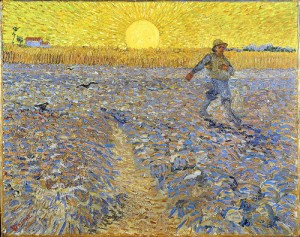
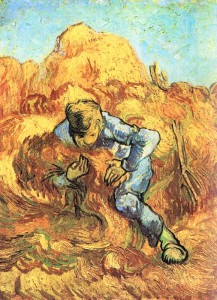
The Sower, 1888
“Vincent was a very generous man. He understood that unconditional love of God extended to unconditional love for others. He would never recognize love that was not an action.” Van Gogh was also inspired by the writings of Charles Dickens in his compassionate response to human suffering.
Sadly, a church committee overseeing Vincent thought he suffered from excessive zeal and fired him because he did not dress or preach eloquently. “It did not seem to matter to them that he literally poured out his life in sacrifice and service on behalf of the diseased and destitute,” Havlicek laments.
Vincent went home to his parents, but the physical and emotional ordeal of caring for the miners and the rejection by the church hierarchy had taken its toll. He appeared to suffer a nervous breakdown, which caused his father to make his first quiet inquiries about committing Vincent to an asylum.
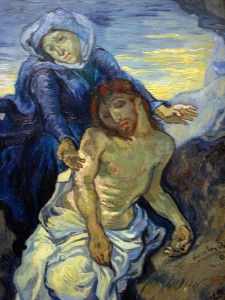
Pieta, 1889
At the same time, the drawings Vincent had made of miners and others captured his brother Theo’s interest. He persuaded Vincent to begin formal art studies at the Académie Royale des Beaux-Arts in Brussels. Van Gogh wanted to continue to serve God with his art, stating: “…to try to understand the real significance of what the great artists, the serious masters, tell us in their masterpieces, that leads to God. One man wrote or told it in a book, another in a picture.”
In 1881, he fell in love and proposed marriage to woman who was seven years older. She turned him down, but his advances persisted in a clumsy manner. Exasperated, the woman and her parents forcibly rejected Vincent, partly due to the struggling artist’s inability to support himself.
During the time Vincent lived with his family, Vincent and his father got into more and more heated arguments. After one particular violent exchange on Christmas day when Vincent refused to go to church, Vincent left to live on his own in The Hague.
The following year Vincent attempted to rescue a prostitute, Sien Hoornik. He wrote of his unusual relationship with Hoornik in his letters: “I met a pregnant woman, deserted by the man whose child she carried. A pregnant woman who had to walk the streets in winter, had to earn her bread, you understand how, I took this woman for a model and have worked with her all winter. I could not pay her the full wages of a model, but that did not prevent my paying her rent, and, thank God, so far I have been able to protect her and her child from hunger and cold by sharing my own bread with her.”
As one might imagine, his family was shocked he had taken in a prostitute and pressured him to alter his living arrangement. His parents continued to explore the idea of committing Vincent to an asylum due to his errant behavior.
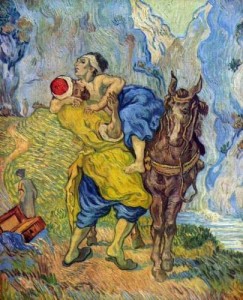
The Good Samaritan, 1890
Vincent’s father died of a stroke in 1885 and Vincent’s sisters blamed him for “murdering” his father, due to the emotional fallout from their intense discussions and unresolved conflict.
After his father’s death, Vincent went into a tailspin. “Vincent embarked on a three-year drinking binge in Paris,” Havlicek notes. “This was the most destructive period of his life. Even so, he continued to produce some remarkable work inspired by the Impressionists who exhibited in the great city.”
He experimented with absinthe, which was a highly popular drink in some circles made from unstable wormwood alcohol. The unpredictable side effects for many users included nerve damage, blindness, and insanity. Absinthe may have triggered the epileptic seizures that began to plague Vincent during this period.
The Sheaf Binder, 1889
“After drinking a large quantity of absinthe, Vincent slashed off a portion of his ear,” Havlicek recounts. “It’s possible he had a grand mal seizure when he slashed the upper part of his ear,” he says.
Most art critics and historians believe Vincent lost his faith sometime between 1882 and 1885. Yet Havlicek found abundant evidence in Vincent’s letters and his art that an abiding faith remained, even as his health and behavior deteriorated. Surprisingly, most of the Christian-themed paintings appeared in the last three years of his life.
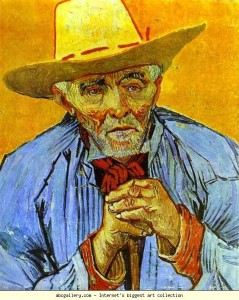
For the sake of self-preservation, Vincent moved to Arles in southern France, where he had an unusual meeting one day in a café he frequented. A local peasant walked in who bore a striking resemblance to his deceased father. “This chance meeting led to some of the most emotionally wrought portraits in the history of art – a father’s posthumous portrait painted vicariously using the face of another,” Havlicek notes.
Portrait of a Peasant, 1888
Vincent painted the man’s hands clasped as if in prayer, holding a shepherd’s staff. “He surrounded his father in a gold light, which is always a symbol of the divine,” Havlicek notes. “It’s a sacred work; Vincent loved sacred references.”
Havlicek made the significant discovery that a saintly bishop’s ruminations on the cosmos in Victor Hugo’s Les Miserables inspired one of Vincent’s most famous works, The Starry Night:
Victor Hugo wrote, “He was there alone with himself, collected, tranquil, adoring, comparing the serenity of his own heart with the serenity of the skies, moved in the darkness by the visible splendours of the constellations, and the invisible splendour of God, opening his soul to the thoughts that fall from the Unknown. In such moments offering up his heart at the hour when the flowers of night inhale their perfume, lighted like a lamp in the centre of The Starry Night…”
Vincent used the same title for his painting and Havlicek notes the striking similarities. “The theme of Les Miserables is redemption,” Havlicek observes. In van Gogh’s painting, “the stars are painted like flowers. There is an interaction between the earth and heaven. It is as if heaven is reaching down.”
“Starlight implies in Vincent’s view that the darkness of sin, guilt, and death are overcome by divinely mediated grace.”
“Van Gogh’s interest in the Gospel is very profound,” Havlicek says. His paintings, The Good Samaritan, The Raising of Lazarus, The Sower, The Sheaf Binder (or harvester) all display Christ-centered themes.
The Starry Night, 1889
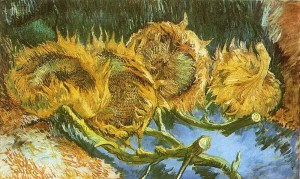
Havlicek even sees the work of Christ in van Gogh’s famous painting of sunflowers. “In 1886 van Gogh found sunflowers thrown in a street gutter in Paris. He went home and painted these beautiful cast-off flowers. The way the flowers were transformed through love shows redemption.”
Van Gogh died under unusual circumstances in what most label a suicide, but Havlicek has some doubts. “No gun was ever found,” he says, and there were no powder burns near the fatal wound to his abdomen.
Two boys admitted they were target shooting near van Gogh and had an encounter with him that appears suspicious. “One wrote a confessional letter years later saying they were harassing van Gogh. He didn’t admit he shot him, but he said there were things he did to him he wish he’d never done.”
Four Cut Sunflowers, 1887
Vincent lingered for two days after the fatal shot. When he was interviewed by police, Vincent said, “I’m hurt but don’t blame anybody else.”
Havlicek believes that if he was shot accidentally by the boys, it was consistent with Vincent’s character to withhold that information. “He had a very sacrificial aspect to his personality. There were several times in his life when he took the blame for someone else,” he says.
“He loved Christ enormously at the end of his life,” Havlicek maintains. “He said Christ alone among all the magi and wise men offered men eternal life. In spite of a broken life, something glorious emerged.”
Dr. William Havlicek has over 30 years of experience in college teaching, museum administration, publishing and fine art/studio production and exhibition. He holds a Ph. D from Claremont Graduate University. He currently teaches at the Laguna College of Art and Design in Laguna Beach, California. Proceeds from the sale of his book are donated to PROGENY, an international organization dedicated to the rescue, treatment, and rehabilitation of exploited and endangered children and the pursuit of justice on their behalf.
PHILIPPINES VILLAGE EMBRACES CHRIST AFTER VIEWING PASSION OF THE CHRIST
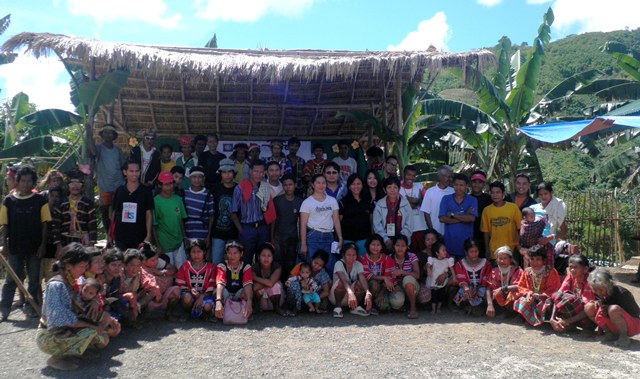
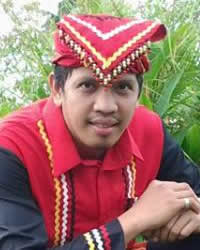
A Manobo tribal group
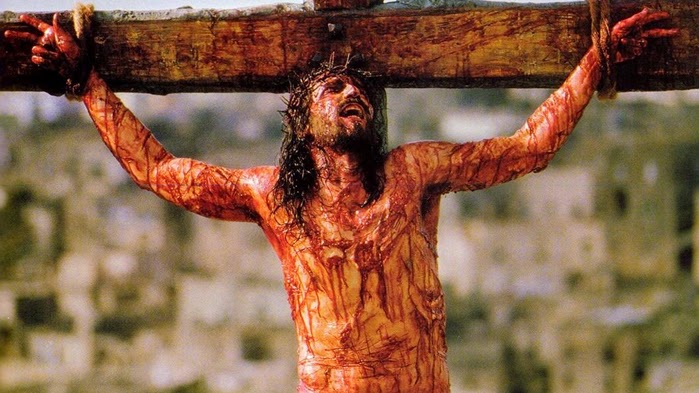
According to reports, a local Philippines ministry spent eight months building a relationship with the Manobo tribal peoples in northern Mindanao. During that time, mission leaders held Bible studies, teaching chronologically through the narratives of the Hebrew Scriptures to the New Testament. Men, women and children began attending these sessions and expressed a tremendous thirst for the Gospel. “The week before presenting the Gospel lesson was a week of suspense,” said the director, whose name is withheld for security reasons. “Everyone was in anticipation as to what would happen to Jesus after He was arrested by the Jewish leaders. To make the teaching of the Gospel that night more vivid, the teacher inserted a brief video clip of the suffering and crucifixion of Jesus from the movie, ‘The Passion of Christ.'”
The Passion of the Christ
After viewing “The Passion,” which depicts the final 12 hours in the life of Jesus, on the day of His crucifixion in Jerusalem, many of the villagers expressed anger at the mistreatment of Jesus by Jewish authorities and Roman soldiers. “One of the old men emotionally said, ‘How I wish I could be by Jesus’ side and help Him!'” But after the truth had been explained concerning the death and resurrection of Christ as God’s only provision for man’s salvation, a feeling of awe and amazement was felt. Moved by the sacrifice of Jesus, many of the villagers professed faith in His death and resurrection, and embraced Christianity. “Finally, after teaching over the past eight months from Genesis onward, we were able to present the Gospel, and nearly the whole village responded and trusted Jesus as their Lord and Saviour,” he said.
Manobo tribal people with World Vision
“It was a great joy for us to see them understand the saving grace of Jesus for salvation; some cried as they shared their testimony of faith.” The next day, even more villagers shared how the Gospel had changed their lives. One elderly man who said he had put his trust in Jesus as the promised Messiah concluded, “He suffered so much for me. I’m glad He rose again from the dead.” One particularly heart-warming story came from an 84-year-old woman who said that she was grateful to hear what Jesus had done on the cross for her. She said that while she had little time remaining in this world, she knew that Heaven was her sure home because of what Christ did for her. “Many more Manobo, both children and adult, expressed faith in Jesus,” the ministry director said “Truly, God is at work in the lives of these people”
Source: Gospel Herald
Manobo tribal man
The Manobo are several people groups who inhabit the island of Mindanao in the Philippines. They speak one of the languages belonging to the Manobo language family. Their origins can be traced back to the early Malay peoples who came from the surrounding islands of Southeast Asia. Today, their common cultural language and Malay heritage help to keep them connected.
The most common lifestyle of the Manobo is that of rural agriculture. Unfortunately, their farming methods are very primitive. They grow maize and rice as their principal crops. Some of the farmers have incorporated plowing techniques, while others have continued to use the “slash-and-burn” method. Some use a farming system called kaingin. This is a procedure in which fields are allowed to remain fallow for certain periods of time so that areas of cultivation may be shifted from place to place. This is very inefficient since many plots of land are not being used at one time.
Social life for the Manobo is patriarchal (male-dominated). The head of the family is the husband. Polygamy (having more than one wife at a time) is common and is allowed according to a man’s wealth. However, among the Bukidnon, most marriages are monogamous. The only exception is that of the powerful datus (headmen).
The political structures of the Manobo groups are all quite similar. A ruler, called a sultan, is the head of the group. Beneath him are the royal and non-royal classes. Only those people belonging to the royal classes can aspire to the throne. Those belonging to the non-royal classes are under the power and authority of the royal classes. Each class is interdependent on the others.
The political aspects of life are often integrated with the social aspects. For example, many social events, such as weddings, require political leaders. Whenever there is a negotiation for marriage, both the bride and the groom must use the local datu (headman) to make all of the arrangements. So when their leaders embrace Jesus the tribe does also.
They are being told that there is a loving God who longs to make them a part of His family, that the “great creator spirit” is really a Father who cares for them. Prayer has the power to break through the strongholds of spirit worship. Intercessors are needed to daily stand in the gap and pray for the salvation of these precious people.
Her children rise up and call her blessed; Her husband also, and he praises her: “Many daughters have done well, But you excel them all.” Charm is deceitful and beauty is passing, But a woman who fears the Lord, she shall be praised. Give her of the fruit of her hands, And let her own works praise her in the gates. ~ Proverbs 31:28-31
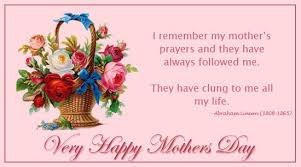
Mother’s Day – 2nd Sunday in May
Australia, New Zealand, Canada, Germany and Italy are among those that follow the United States, celebrating mums on the second Sunday in May. The US tradition began with Miss Anna Jarvis, a Philadelphia schoolteacher. In 1907 she started a movement to set up a national Mother’s Day in honour of her mother, Mrs Ann Jarvis. Mrs Jarvis had spent her life mobilising mothers to care for their children, and she wanted mothers’ work to be recognised.
“I hope and pray that someone, sometime, will found a memorial mothers’ day commemorating her for the matchless service she renders to humanity in every field of life. She is entitled to it,” Mrs Jarvis said. Miss Jarvis sought to fulfil her mother’s wish. She and her supporters began to write to ministers, businessmen, and politicians in their campaign to establish a national Mother’s Day. The first Mother’s Day observance was a church service on the second anniversary of her mother’s death, the second Sunday of May. Anna handed out her mother’s favourite flowers, white incarnations. By 1911, Mother’s Day had spread nationwide and was being celebrated in almost every US state. In 1914, President Woodrow Wilson proclaimed the second Sunday in May as a national holiday in honour of mothers.
Over the years, Mother’s Day became increasingly popular, and the current traditions of card and gift-giving increased. The blatant commercialisation angered Anna – she even began to campaign against the greed and profit motive that was demeaning her day of remembrance. But Mother’s Day continues. Many Christian families ignore the commercialisation, making an effort to show their appreciation for their mums with a special visit, meal, or gift of flowers. And remember the first Commandment with a promise: “Honour your father and your mother, that your days may be long in the land that the LORD your God is giving you.” – Exodus 20:12 Happy Mother’s Day to all mothers and thank you for your tireless love and service to your families.
Jesus left the shores of the Sea of Galilee and Capernaum
to return to Nazareth to teach the people there.
And when Jesus had finished these parables,
he went away from there, and coming to his hometown
he taught them in their synagogue,
so that they were astonished, and said,
“Where did this man get this wisdom
and these mighty works? (Matthew 13:53-54 ESV)
When he left Nazareth He “went about among the villages teaching” (Mark 6:6).
When I see the scene depicted at Nazareth Village of the stone house, the olive trees,
and the dusty path, I recall the visits Jesus and His disciples made throughout Galilee.
Lois Tverberg, in her excellent book Walking in the Dust of Rabbi Jesus, has written a helpful
work about Jesus and His teaching drawing on the Jewish concept of the rabbi and his disciples.
The way Jesus taught his first disciples was not unique
but part of a wider tradition in Judaism that began
a few centuries before his time.
Jesus didn’t hand his disciples a textbook
or give them a course syllabus.
He asked each one of them to follow him —
literally, to “walk after” him.
He invited them to trek the byways at his side,
living life beside him to learn from him as they journeyed.
His disciples would engage in life’s activities along with him, observing his responses and
imitating how he lived by God’s Word.
Out of this unusual teaching method
arose a well-known saying:
you should learn from a rabbi by
“covering yourself in his dust.”
You should follow so closely behind him as he traveled
from town to town teaching that billows of sandy granules
would cling to your clothes.
As you walked after your rabbi, your heart would change.
This will be our task in this book,
to stroll through Jesus’ ancient world at his side,
listening to his words with the ears of a disciple.
(Walking in the Dust of the Rabbi Jesus, Zondervan, p. 28)
There must have been a buzz of excitement when Jesus and His disciples walked
the dusty paths of Nazareth, and indeed, of all Galilee.
When Jesus came to Nazareth He entered the synagogue on the Sabbath day
and participated in the study.
Lee Levine of Hebrew University summarizes the archaeological evidence for known
first century synagogues.
Solid archaeological evidence for the first-century synagogue
is attested at eight sites in Judea:
Masada, Herodium, Jerusalem (the Theodotos inscription from the City of David),
Qiryat Sefer, and Modi’in (both in western Judea),
with a possible additional site at Horvat ‘Etri, south of Bet Shemesh.
In the Galilee, it is found at Gamla, Migdal,
and quite probably Khirbet Qana,
with considerably less certain remains from
Capernaum, Chorazin, and at a second site in Migdal.
(Lee I. Levine, “The Synagogues of Galilee” in Fiensy and Strange, Galilee in the late second temple and mishnaic periods,
Vol. I. Minneapolis: Fortress Press, 2014. 129-150.)
The New Testament writers mention other synagogues such as the one at Nazareth.
It is unfortunate that the residents of Nazareth did not want to get dusty.
Are you dusty from following Jesus?
Share good news – Share this page freely Copy and share this link on your media, eg Facebook, Instagram, Emails: Kingdom Life:The Gospels: https://renewaljournal.com/2016/05/06/kingdom-life-in-the-gospels/
Relational Bible studies on every Gospel reading for the year of Matthew in the Common Lectionary (Year A).
Part I, The life and ministry of Jesus: Preparation – the coming of Jesus the Messiah, Commencement – the figure of Jesus the Messiah, Christ’s design for life in God’s kingdom, The spread of God’s kingdom, The mystery of God’s kingdom, God’s kingdom on earth and the church, Authority and invitation, God’s kingdom fulfilled.
Part II, The death and resurrection of Jesus: Preparation for the passion of Jesus, Resurrection appearances of Jesus, Observations about Jesus, The coming of the Holy Spirit, The Godhead.
Kingdom Life in Mark
Relational Bible studies on every Gospel reading for the year of Mark in the Common Lectionary (Year B).
Part I, The life and ministry of Jesus: Preparation – the coming of Jesus the Messiah, Commencement – the figure of Jesus the Messiah, The mystery of the Son of God, The way of the Son of Man, The fulfilment of the mystery.
Part II, The death and resurrection of Jesus: Preparation for the passion of Jesus, Resurrection appearances of Jesus, The coming of the Holy Spirit, The Godhead.
Kingdom Life in Luke
Relational Bible studies on every Gospel reading for the year of Luke in the Common Lectionary (Year C).
Part I, The life and ministry of Jesus: Preparation – the coming of Jesus the Messiah, Commencement – the figure of Jesus the Messiah, Luke’s program for Jesus’ ministry, The Galilean ministry,The travel narrative – part one, The gospel within the gospel, The travel narrative – part two, The ministry in Jerusalem, the fulfilment of the ministry.
Part II, The death and resurrection of Jesus: Preparation for the Passion of Jesus, Resurrection appearances of Jesus, The coming of the Holy Spirit, The Godhead.
Kingdom Life in John
John’s purpose is evangelistic – “that you may believe”. This book surveys John’s own approach to telling his story.
Section 1: Details exclusive to John, briefly surveys John’s unique account of Jesus’ life and ministry and focuses on his very personal record of the crucifixion and resurrection.
Section 2: Study Outlines covers key passages in John’s Gospel compiled from relational Bible from the three books Kingdom Life in Matthew, Mark and Luke, which use common lectionary readings from John scattered through those three books.
John’s intimate, personal Gospel story transcends time and space to show us his living Lord, the Son of God, revealed in human flesh, living among us, full of grace and truth, “for God so loved the world that he gave his only begotten Son, that whoever believes in him should not perish but have everlasting life” (3:16).
Share good news – Share this page freely Copy and share this link on your media, eg Facebook, Instagram, Emails: Kingdom Life: The Gospels: https://renewaljournal.com/2016/05/06/kingdom-life-in-the-gospels/
“Last Christmas, I was speaking at a Three-Self Church in Yuhuan and I was amazed there were 12,000 people.”In Shenzhen, there is usually an average of 500 people being baptized each Sunday!CHINA — You’re about to hear first-hand testimony of an unprecedented Christian revival happening in parts of China. What is unique about this story is how God is moving among communist-controlled government churches.
CBN News traveled to southern China and obtained exclusive, never-before-seen images, from inside these churches.
When God Shows Up in a Communist Church
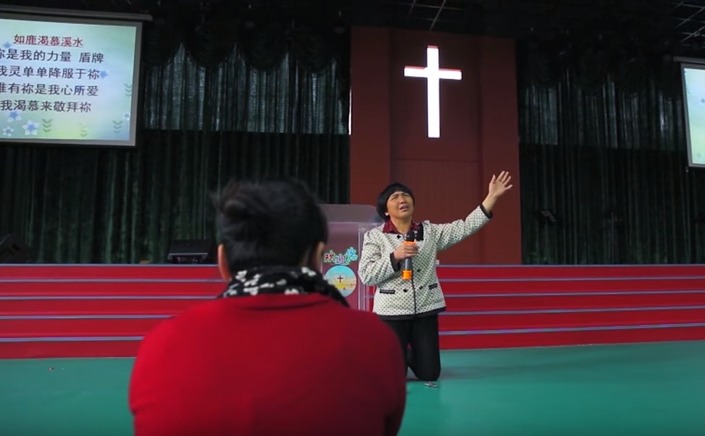
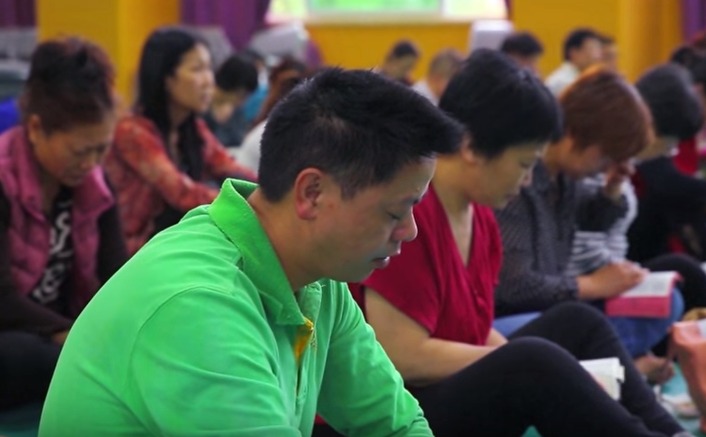
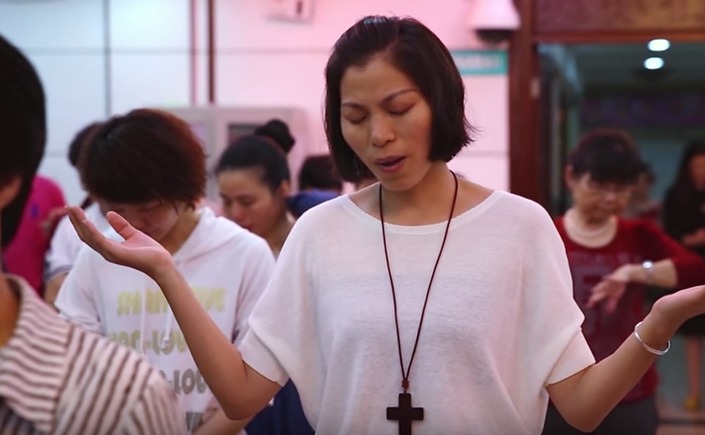
It’s Thursday evening in Fujian Province, southeast China. Scores of men and women are dancing, waving flags, blowing shofars, singing and worshipping God.
Chinese woman blowing Shofar
You might think these images come from a charismatic service in the United States. But they’re not. This is communist, and officially still atheist China.
And what Duan Huilai says is remarkable about this scene is that it’s happening in an officially government-controlled congregation known as Three-Self Church.
Duan and his wife have witnessed this move first-hand. Both are evangelists and have for several years criss-crossed the Chinese countryside documenting the Holy Spirit’s move among Three-Self Churches.
“Dramatic changes are happening,” Duan told CBN News. “God is moving in a powerful way inside these Three-Self Churches.”
Pastor Duan Huilai
“The most amazing thing is that the Lord is raising up God-loving people in these churches — so many brothers and sisters who love God deeply and want to serve Him,” Duan said.
Signs and Wonders Now Allowed
Pastor Duan says what is happening today in Beijing and in other parts of China as it relates to the powerful move of God amongst the Three-Self Churches is quite remarkable considering where the church has been in the last 30 years.
“Every sermon that the pastor preached back then had to be vetted by the government authorities. Young people were never allowed to attend these churches so you’d only see old people, mostly women,” Duan said. “Preaching about the power of the Holy Spirit was forbidden. You couldn’t talk about end times or preach repentance.”
Topics on healings, miracles, signs and wonders were out of the question. Not anymore.
“Nowadays people have accepted these topics,” Duan said.
Two main types of churches exist in China: registered and unregistered. Registered congregations, also known as Three-Self Churches, are government-approved.
Unregistered, sometimes called underground or house churches, operate outside government control, and for decades faced intense persecution. And with that persecution came tremendous growth.
Three-Self Churches on the other hand never experienced that kind of explosive growth. Until now.
“Now there are big revivals happening in the Three-Self Churches,” Dr. Zhao Xiao told CBN News from his offices on the outskirts of China’s capital city.
Communist Encounters Christ
Zhao is one of China’s foremost experts on Christianity. A former Communist Party member and atheist, Zhao converted after reading the Bible.
“If you go to Haidian Church, you’ll find yourself in a more than 100-meter line trying to get inside and worship. In Shenzhen, there is usually an average of 500 people being baptized each Sunday!” he shared.
Decades ago, the Chinese government had a law that said that young men and women below the age of 18 could not attend Three-Self Churches. Zhao says those rules have been loosened in recent years.
“There’s an increasing proportion of them in churches now — more young male believers, professionals, mainstream celebrities, especially in the big cities, that are attending the church unlike the past when it was mainly the elderly who attended.”
Love Camp
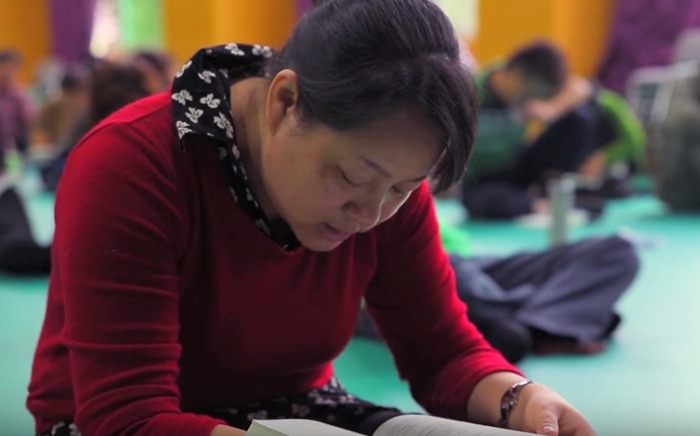
Back at the Thursday night meeting in Fujian Province, folks have gathered for a four-day event affectionately called “Love Camp”
“Love Camp aims to help the believer grow in their faith walk and get closer to God,” Sun Rengui told CBN News one evening.
Sun is a pastor and leads the camp. He says the idea came 12 years ago when he says the Holy Spirit one day showed up while he was preaching at the Three-Self Church he pastors here.
“We were in the middle of the service; suddenly everyone at the church felt the Holy Spirit anointing fall. Some couldn’t stand straight, others fell down. Some were dizzy and nauseous. When the worship began, people started crying. After the service, some were being healed. I saw demons being chased away from people’s bodies.”
Pastor Sun says his church had never experienced anything like it.
“We were seeing something unprecedented. We had no theological training in the move of the Holy Spirit. This was completely new for us,” he said.
Word quickly spread.
“We were one of the first churches to experience this in the area. Soon, leaders from other churches came to us and were eager to receive the Holy Spirit. Later they also started witnessing the Holy Spirit’s move as well,” Pastor Sun said.
But it wasn’t without controversy.
“People doubted if this was real. There was even conflict among my church staff,” Sun said. “But as time passed, more people accepted the power of the Holy Spirit.”
Transformed Lives
Twelve years later, Pastor Sun says the impact of the Holy Spirit’s move is seen in the transformed lives of church members.
“Our cell groups are expanding, more people are attending church, and more people are going outside the church walls into society to share the Gospel.”
The church runs two orphanages and two elderly care centers, and twice a year puts on the Love Camp.
“We have four goals in this camp: to evangelize people, strengthen the family, disciple believers and encourage other Three-Self Churches to embrace the power of the Holy Spirit.”
For Pastor Duan and his wife, this is evidence that God is doing something special in the world’s most populous nation.
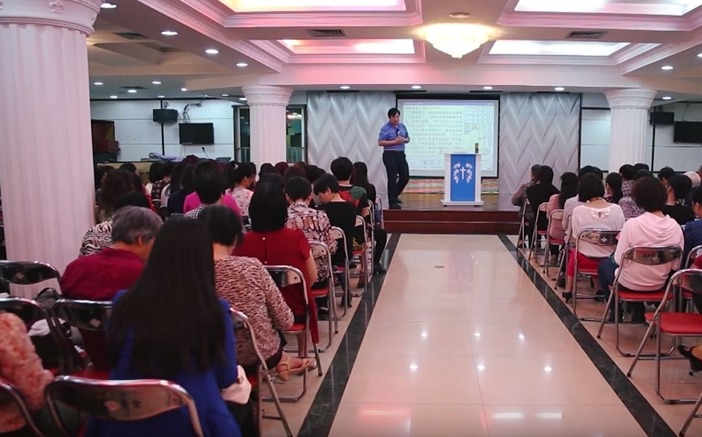
“I was speaking in Shandong, Henan and Zhejiang recently. Around 8,000 people joined the meeting. Last Christmas, I was speaking at a Three-Self Church in Yuhuan and I was amazed there were 12,000 people,” Duan exclaimed with joy.
They, Dr. Zhao and countless others say they feel honored to play a part in helping more Chinese turn to Jesus Christ.
“The number of Christians in China is growing rapidly. It means Christ is starting to play an active role in China’s society and that’s good in many ways,” Zhao said.
Despite the threat of street unrest, thousands of people went to hear Dr. Michael Youssef preach at Kasr el Dobara Church in Cairo recently, with at least 500 people giving their lives to Christ during the three-day event.
Dr. Youssef, founder of global outreach ministry Leading The Way, was born in Egypt, and returned to the largest evangelical church in Egypt, with the hope of encouraging a spiritual renewal there. During the first evening, a heavy military presence was outside the church bracing themselves for protests in Tahrir Square against the government. However, throughout the weekend, approximately 5,000 people still came to hear Dr. Youssef preach a Gospel message of victory over sin and addiction, with millions more watching live via satellite television.
“Over the last five years, the people of Egypt have seen extreme civil unrest in their country,” Dr. Youssef said. “Since 2011, the nation has endured the bloody uprisings of the Arab Spring and two presidents overthrown. This church-and many more across Egypt-began crying out to God 24 hours a day to bring peace and justice to their nation. In many ways, God answered their prayers. “By God’s grace, I pray this event will fan the flame of spiritual revival that is already occurring in this region.”
“Leading The Way” with Dr. Michael Youssef continues to reach the Muslim world for Christ through 24/7 Biblical programming, personal discipleship, and practical help for persecuted Christians in the region. Many are responding to the Gospel message even in the midst of political upheaval and global crises.